3 months ago
17
3 months ago
17
Opinion
December 8, 2025 — 7.00pm
December 8, 2025 — 7.00pm
Things are changing at the State Library. They have been changing every decade or so since Redmond Barry, our founder, opened the doors to the public 170 years ago.
That change has given us vastly expanded and beautiful spaces enjoyed by thousands of Victorians and visitors every single day of the week.
Our critics take a different view of change. Astonishingly, some seem to pine for the library as it existed 40 or so years ago – as writer Helen Garner described it last week, a “temple of calm and a refuge from racket”.
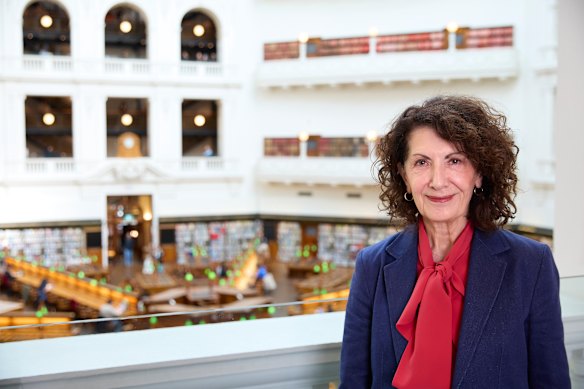
Christine Christian, president of Library Board Victoria, in the State Library.Credit: Susan Gordon-Brown
I’m also fond of a bit of calm. But I happen to take a clear-eyed, not a misty, romantic, view, of the way students, researchers and scholars now want to access the library in different ways.
Walk in here any day, and you’ll see young students, the life of the city, and our future, using screens, checking reference points with their mates, and yes, even occasionally getting a book off the shelves.
I’d call it a temple of engagement.
As Library Board president, I also look to the State Library charter and clearly stated government policy, on a daily basis, which requires us to offer an inclusive service for a diverse range of users.
To those who want to recreate some imagined golden era, I would point out that 40, even 20, years ago, few Indigenous Victorians used this library. The same could be said for regional Victorians or families with young children.
That situation has been completely reversed in recent years – and for the better.
In 2021, we established the Indigenous Research Centre and the recent Treaty exhibition that opened in October last year is now a central feature of the library based in the South Rotunda. Our critics don’t seem to mention that, for decades, this important part of our shared history was ignored.
Another important change has been the establishment of the Women Writers’ Fund. This has been aimed at redressing the shocking shortfall in the collection of the works of prominent women writers and scholars.
Critical initiatives such as this would not have happened had the library not embraced change.
At the same time, the traditional reference and research services that we have always offered are not going anywhere. I invite any of those individuals who’ve signed a petition in the last few days to come and see for themselves.
We have had a consultation process under way for some time about how we best direct the skills and experience of our talented and professional library staff in ways that responds to the modern needs of our users.
The changes we are looking at will mean enhanced, not reduced or diminished, services. It will mean investing in boosting our librarians’ digital skills, not unlike what is happening in every major public library anywhere in the world. Our core purpose as a research and reference library remains. For people who use those services – less than 10 per cent – they will continue to have access to that professional expertise. We will have at least 71 librarians across the entire library to support the public. And we will continue to make the same number of public-access computers available, as we always have: to support research, learning and digital inclusion.
Let me address some other wild claims.
The term “vanity project” has been thrown around. The sheer silliness of this is revealing.
On a modest budget, we are digitising parts of the collection to boost object-based learning. This is precisely the sort of thing that is designed to engage younger users of the library, and to grow their interest and enthusiasm in local and national history.
Visit any museum or library in Europe and this is exactly what they are doing. They are providing a modern take on story-telling that lifts enjoyment of the actual collection, be it paintings, documents or maps.
Loading
Another charge levelled at us is that the library leases out space for special events: just like the NGV down the road, the Museum and ACMI. Yet for some reason, our critics think the library should remain only for the exclusive use of a select group.
It just so happens that the library is one of the most popular venues in town. If we failed to respond to this, then our primary funders, the state government, would be asking questions about why we are denying ourselves the revenue.
An institution that is not financially well run cannot expand its offerings.
As we work through the details of the reorganisation proposal that is currently on the table, there will be change at the State Library. It will be done in a respectful and negotiated way, and in line with our values.
To quote from Lampedusa’s great novel, The Leopard: “if we want things to stay as they are, things will have to change”.
Christine Christian is president of the Library Board of Victoria. This is an edited extract from her speech at State Library Victoria’s End-of-Year Celebration on Thursday, December 4.
The Opinion newsletter is a weekly wrap of views that will challenge, champion and inform your own. Sign up here.
Most Viewed in National
Loading