3 months ago
15
3 months ago
15
Opinion
December 5, 2025 — 7.00pm
December 5, 2025 — 7.00pm
So, the acting chief executive and the State Library board are at war with the librarians. Again. This has been going on, in one shape or another, since about 1913. But this time, it feels as if a tipping point has been reached, or has even been passed. The issue now is whether the State Library is still a library. Or has it become something else?
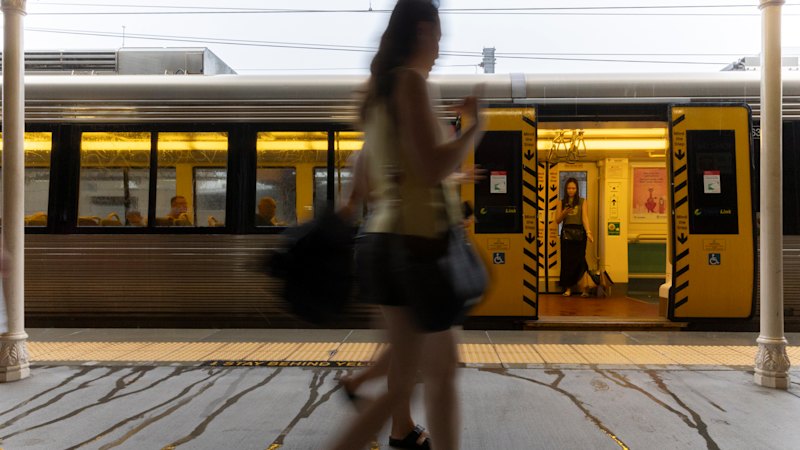
It has certainly become a destination, with its own train station. But when you get off at State Library station, have you arrived at our great public library or just at a heritage building?
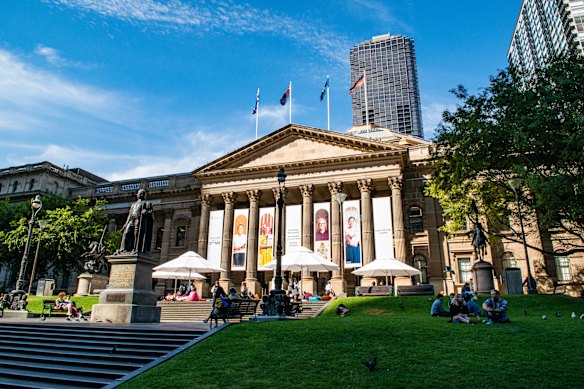
Changes at the State Library have prompted outcry from writers, researchers and librarians.
The banner-bedecked facade promotes exhibition spaces. The impression is confirmed by the phalanx of guides who greet you as you enter and the promotion of “exclusive” $39 tours. Little to suggest it might also be about books, reading and research.
What has brought out the hundreds of angry historians, researchers and writers is the library board’s plan to redeploy a significant number of reference librarians. This follows an earlier reduction of their numbers. The purpose of the change, according to the plan, is to release more funds for the digital displays that attract visitors.
But what about its other function as a library?
Even experts need help in accessing the immense collections. It is the reference librarians who provide this. While the number of scholarly users has always been small at any one time, the product of their research has often changed the way we understand ourselves. How do you measure that? It is simply impossible to predict what future researchers might discover from the collections.
Rare items in libraries are like rare plants – we don’t know how useful they might be. Shifting staff critical to research reminds me of an earlier idea that long ago sank: that unused rare books should be sold off to help library revenue.
Loading
A board spokesperson has said: “We are currently reviewing how best to support the needs of our visitors, users, and the community.” Note the order of words: visitors first, users second. For management, the main purpose of the library is to service visitors.
Nor is the State Library being pitched just as a tourist destination. It is in the venue-hire business in a big way. The Queens Hall caters for receptions, parties, product launches, even weddings. Even the sepulchre, the La Trobe Reading Room, is on offer.
There are many good reasons to draw people to the library other than for research. The great dome and the Queen’s Hall are sights to behold, and exhibitions drawing on the collections are a proper use of the library resources. But getting married there?
I am not a purist in this. I have co-written and produced plays under the dome and in Queen’s Hall. They were about the history of the library, drawn largely from the collections. They show that the present struggle has deep roots.
It is not surprising that the jewel of the current “library experience” is the La Trobe Reading Room. The dome, built just before World War I, was intended to be admired as a structure rather than to function as a library. It was an exercise in pure monumentalism – the largest ferroconcrete cupola in the world at the time – designed to bring the Melbourne Public Library into the exclusive company of the British Library and Washington, DC’s Library of Congress.
The idea was pushed by the modernising chief librarian, Edmund La Touche Armstrong, but it was strongly resisted within the library’s senior ranks. His deputy, Amos Brazier, wanted “a working library” – something rectangular that worked efficiently to service researchers. The dome never worked. With attendants scurrying up and down narrow spiral staircases to retrieve material, it was wildly inefficient.
But it looked impressive. And workability was not its core purpose. As far as Armstrong and the government were concerned, it had one job: to put Melbourne on the map. It left its librarians – aided by those nimble attendants – to struggle on heroically for the next century.
In the age of tourism, the repurposing of the library as a destination fits snugly with the government’s obsession with visitation numbers, as if tourism is always worth the cultural cost, a strategy being strongly challenged all over the world.
Is Victorian Minister for Creative Industries Colin Brooks unaware of the cost to the Victorian community in this instance? Does he want to be the person who signs off on the sidelining of a core Victorian institution to boost visitor numbers? He can’t shuck it off on the board because the board was appointed by the government.
Armstrong got his dome, but the fight with the staff nearly destroyed him when it generated a scarifying parliamentary debate. Now the current stoush is rapidly going political. The issue raises questions about what we value as a people.
Loading
The minister and the library board may be unaware of the Armstrong scandal, but the lesson remains. And librarians and the research community are really angry about this. We are a savvy bunch, and we won’t give up. Because something big is at stake – our preserved written and visual heritage.
We want a library that is not just a building, an exhibition space and venue-hire operation, but is also a high-functioning research library. A state institution that is not reduced to an Instagram backdrop. And a first-class research library needs reference librarians.
Bill Garner is a playwright and historian.
The Opinion newsletter is a weekly wrap of views that will challenge, champion and inform your own. Sign up here.
Most Viewed in National
Loading