3 months ago
17
3 months ago
17
Just when it felt like the internet had just grasped the concept of the Sephora tween, a new celebrity brand has launched sheet face masks made for very young kids.
Rini is a Korean skincare range for children aged four and up. Co-founded by Canadian actress Shay Mitchell, of Pretty Little Liars fame and the founder of Beis luggage, the new business venture launch was announced via Instagram on November 6.
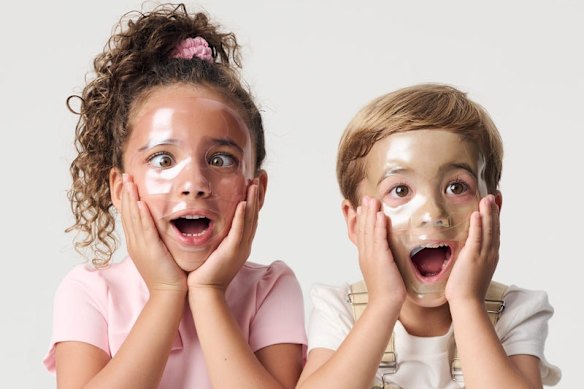
The Rini jelly mask come in a hydrating and after-sun formulas.Credit: Courtesy of Rini
In an interview with Elle US, Mitchell and co-founder Esther Song said the idea was sparked when they were struggling to remove Song’s daughter’s purple face paint: “We’re paper-towelling her face with water to try and get it off. I don’t know what was in this paint, but it stayed on – that stuff, it was really, really strong,” Mitchell told the publication.
The response on the Instagram post has a few parents excited about a product to divert their child from their own adult skincare. However, the majority expressed concern, with one commenter writing: “My mom used to put cucumbers over my eyes when I wanted to do a face mask with her. Let’s keep it at that.”
In an Instagram story, Mitchell posted a statement: “Rini isn’t about beauty it’s about self-care. About teaching our kids that taking care of themselves can be fun, gentle and safe… Kids are naturally curious, and instead of ignoring that, we can embrace it with safe, gentle products parents can trust, and sweet moments that bring us closer.”
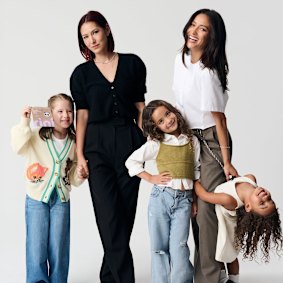
Ester Song and Shay Mitchell are the co-founder of Rini a skincare brand for kids.Credit: Courtesy of Rini
The initial launch includes three products, starting at $US5.99 ($9.16) – a hydrogel mask in a hydrating or after-sun formula and an everyday sheet mask in puppy, unicorn, and panda designs.
The products are not available in Australia, but it raises the question: how young is too young to market beauty products? It seems obvious to say that toddlers and children don’t need specialty skincare, but what’s the harm?
Dermatologist Leona Yip says that the bare minimum and maximum skincare for young children is a gentle cleanser, moisturiser and SPF with products you can buy at the supermarket.
“It does not need to be expensive, and they certainly do not need face masks,” she says.
Face masks are designed to restore skin hydration, but Yip says that this can also be achieved with a suitable moisturiser. Eczema is one of the more common skin concerns seen in younger children, which may prompt parents to seek a solution beyond the basics.
Toddlers’ and children’s skin is less robust than adults’. Young skin has a weaker skin barrier and absorbs more, which is more likely to result in allergic reactions or irritation, especially with products containing fragrance.
Yip says that some products will use “fragrance-free” labelling as a selling point, but may still contain natural fragrances, which are not necessarily safer and can still cause reactions.
The Rini masks list botanical ingredients which Yip warns against.
“We know that botanicals sometimes can cause allergic reactions, so I would exercise caution for those. It is quite misleading when they say it’s safer for sensitive skin,” she says.
Yip says that skincare shouldn’t be about self-care for kids, and hygiene is the responsibility of parents.
“Skincare at a young age should not be about a beauty construct. It shouldn’t be about teaching self-care; they wouldn’t understand that at this age.”
The Butterfly Foundation’s head of communications and engagement Melissa Wilton says self-care has become commercialised.
“Caring for ourselves can be about simple everyday acts of being kinder to our body – rest, movement we enjoy, nourishing and tasty food, and connection with others,” says Milton.
Loading
Milton says that while studies are limited, they have shown that age six may be an important time for the onset of body dissatisfaction, and products like these expose children to beauty standards.
“It ultimately sends the message that our appearance is somehow ‘wrong’ and needs to be fixed, and that it’s easier to live in this world if we meet society’s ideals with wrinkle-free, fresh, perfect skin, and that it takes expensive products to achieve that.
“Young people are not only learning to fear ageing before it has even begun, but they are being sold the message that they must purchase expensive products to be accepted,” says Milton.
When is it dermatologically appropriate to advance your child’s skincare game? Yip says puberty can mean skin changes like acne might require addressing, but this needs to be guided by a GP or dermatologist.
“In terms of starting anti-ageing skincare, that does not need to be considered until early to mid-twenties,” says Yip.
Rini has been contacted for comment.
Butterfly National Helpline, 1800 33 4673.
Make the most of your health, relationships, fitness and nutrition with our Live Well newsletter. Get it in your inbox every Monday.
Most Viewed in Lifestyle
Loading