3 months ago
35
3 months ago
35
To experience the absolute peak of what the Australian Open has to offer, somewhat counter-intuitively, you have to head down and not up. Because it is underground, in the hidden city beneath Rod Laver Arena – normally strictly the preserve of players and officials – where fans can truly experience what the grand slam tennis event is fond of calling the “premiumisation of leisure entertainment”.
There, AO staff will escort the lucky few – just 16 each match, to be precise – through the player sanctum and out onto the playing court itself. Next to the photographers’ bleachers sit the tournament’s hottest tickets: two rows of 16 high-backed, airline-style seats, with individual canopies, for a select few to see and hear the action, closer than ever before.
“They are for tennis enthusiasts wanting a phenomenal, once-in-a-lifetime type experience at the tennis,” says Fern Barrett, Tennis Australia’s head of food, premium experiences and precincts. This might well be an AO marketing blurb, but it is also – in the lived experience of this writer – accurate. When I sat in these very exclusive seats during a 2021 match and Rafael Nadal walked within a few feet of me to dump his sweat towel into an adjacent hopper, it produced a truly heart-in-mouth moment. I didn’t dare move a muscle lest I distract the great one. We were that close.
Unsurprisingly, the “premium experience” seats have a price to match (this year starting at $2500), and they have been patronised by everyone from Russell Crowe and Liam Hemsworth to the AFL’s Daicos brothers. For a semi-final session, the price can soar to beyond $35,000. (The women’s and men’s finals have already sold out.)
The very pinnacle of the Open’s “AO Reserve Premium Experience” program, which launched last year, such premium seats are now all linked to the AO’s premium restaurant partners, too – meaning you can’t have one without the other.
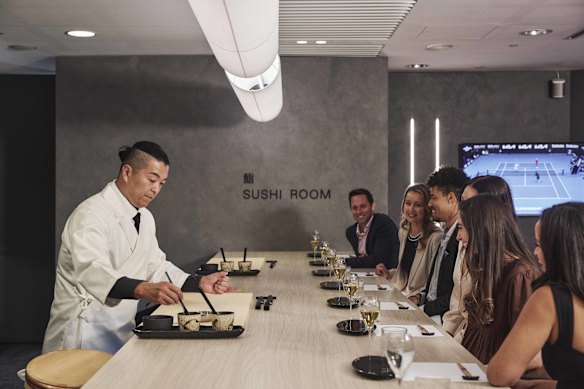
Chef Shimpei Raikuni at work below Rod Laver Arena.Credit: Michael Pham
In 2025, for instance, the AO carved out a space under Rod Laver Arena and built a sushi omakase room (to be helmed this year by Shimpei Raikuni, from Brisbane’s Sushi Room) solely for the pleasure of its on-court seat patrons. After their repast of sashimi and nigiri, spectators enter the court via the hallowed “Walk of Champions”, with its ground-to-ceiling panels lauding previous winners, and then at the day’s end are dropped back to their hotel thanks to a fleet of cars courtesy of major sponsor Kia.
While this rare-air experience is for the 1 per cent, the AO’s hospitality offerings have been expanding across Melbourne Park as the world’s most attended grand slam tournament gains traction each year. After nearly 30 years of pushing the envelope, the Australian Open has now arguably edged ahead of its major event rivals in Melbourne, from the Australian Formula 1 grand prix in March to the Melbourne Cup Carnival in November.
“The Australian Open is a pillar of our $2.5 billion major event sector and it’s transitioned,” says Sally Curtain, chief executive of the Victorian Chamber of Commerce and Industry. The event has moved from being purely a sporting competition into a two-week festival of sport, food, music and culture, she says. “I think businesses are increasingly wanting to be involved.” Often, Curtain adds, ideas are generated and partnerships formed, and sometimes “a spark flies”. “You happen to be at the tennis enjoying this phenomenal spectator sport and the food and the music and the culture, but business can thrive too.”
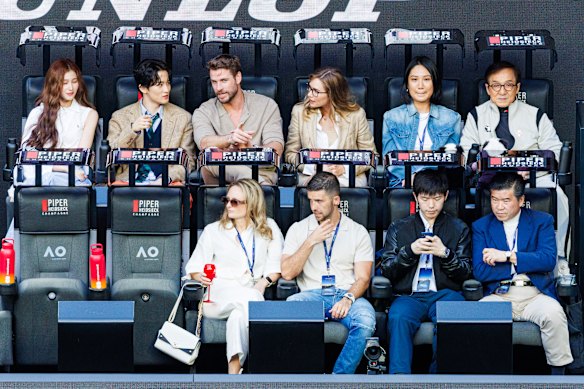
Liam Hemsworth and Jackie Chan (back row) enjoying on-court seats at the 2024 men’s final.Credit: Courtesy of Tennis Australia
Each event vies with the other over its benefit to the state economy. Now the AO is making inroads into fashion and glamour, which has traditionally been the preserve of the spring racing calendar.
Since moving to Melbourne Park in 1988, the Open, in its ceaseless quest for ever bigger crowds, has built and built as much as its sometimes fractious relationship with its landlord, the Melbourne and Olympic Park Trust, and their state government overlords, would allow. But nothing has had as much of an impact on patrons over the past five years as the Open’s massive expansion of food and beverage options, thanks in part to a vast building upgrade completed in 2021.
One rung below the on-court seats (within the seven tiers of hospitality packages offered) is the Club 1905 restaurant, which will feature a Michelin-starred chef from England’s Lake District this year. In the next tier down, diners in The Bistro from Brisbane’s SK Steak and Oyster will be serenaded alongside a baby grand.
“As you know, we are bursting at the seams,” says Cedric Cornelis, the Australian Open’s chief commercial officer, who points out that last January, 90,000 people attended each day for the first week. “So we are looking for space. And one of the things that we’re doing for ’26 is going vertical.”
A new observation walkway over the western courts, where spectators can stroll along, drink in hand, is an experience cribbed straight from Manhattan’s famed High Line. The new high line connects directly with the courtside bar – a double-storey party bar with room for 400, which launched in 2024 – and wraps around corners, allowing spectators to wander and get a clear view of courts 5 and 7 while also observing courts 6, 8 and 9 from more of a distance. It is shaded and protected from the rain.
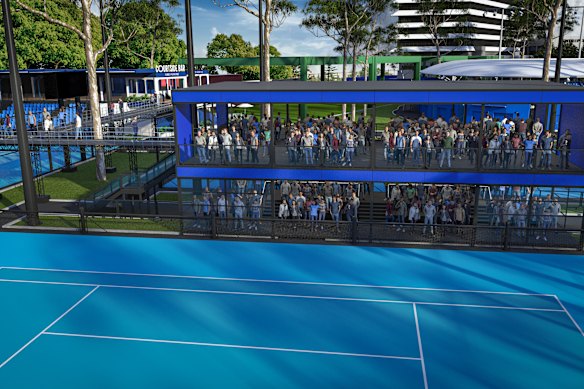
An artist’s render of The Highline, an observation walkway over the western courts.Credit: Courtesy of Tennis Australia
Meanwhile, the Practice Villages zone for court 16 and 17, sandwiched between Kia Arena and John Cain Arena – where players turn up for autographs – will this year accommodate an elevated platform and terrace. There is a pillar for kids and families, too, and for music, fashion, and Gen Z (with its TopCourt gaming facility). When Cornelis says he wants the Open to be a celebration of “the best of Australia, as well as some global stars”, he’s talking about the hospitality offering, not the tennis.
Sydney chef Peter Gilmore is also trying something new – a Champions Rooftop restaurant operating during the finals on a terrace normally reserved for the players to relax atop Rod Laver Arena. Gilmore says he sees parallels between the kitchen and the court.
“I was really excited by the idea of bringing that same spirit of performance, precision and Aussie produce to the plate,” the Quay executive chef says of his menu, which will include marron and marigold tart, suckling pig sausage roll and king prawn skewers, which he will cook in front of guests. Despite his craft, Gilmore promises his dining experience will be one that “fits into the rhythm of the tournament”. That is, you won’t miss a minute of the matches because your meal is late.
Loading
Cornelis is adamant that the AO’s hospitality expansion is not sucking patrons away from nearby restaurants in the CBD, South Yarra and Richmond – an understandable concern – and yet stands by the quality on show: “I take to heart a compliment from one of the executives of Roland Garros, who said in Paris, ‘We pride ourselves of being the best gastronomy in tennis, and the Australian Open is at least as good as that.’ ”
The AO Reserve tiers also include the fun, casual and convivial Riverside Social, situated in Riverside Row alongside Margaret Court Arena, just along from private marquees for sponsors. Last year, some long-standing tennis fans who had sat in the same seats at Rod Laver Arena for decades, but didn’t want the hospitality package, complained to the media about the vast extra expense the Open was trying to force upon them. Barrett denies it has been controversial – “No, not all,” she maintains, “it’s proved hugely successful so far” – but the ostentatious opulence can prove an easy target.
An emphasis on cabaret and performance is part of another reset for the AO this year, this one ordered by Piper-Heidsieck’s new chief executive Stéphane Decaux. “We have some values in common with the Australian Open,” Decaux says over a Teams call from France, referencing the oft-repeated phrase that the AO is known as the “Happy Slam”. (In 2025, the house poured 85,000 flutes at the tournament, a sharp rise from 52,000 flutes the previous year.)
The champagne house has previously sponsored the Oscars and the Cannes film festival, and this year at the Australian Open, its celebrations of “living art” will come in the form of singers, a marching band and cabaret staged at a bar designed to look like a Parisian street cafe. “One-fourth of the people who go to the Australian Open don’t go to watch the tennis matches,” Decaux says, “but just to be entertained by one of the most entertaining events in the world.” Its sponsored post-match dressing room, Club 1905, will, he adds, attract a melting-pot of celebrities and high-net-worth individuals from Australia and all over the world – something that will surely please AO executives, who know that celebrities increase the tournament’s media footprint. In 2024, the Open lured model and businesswoman Elle Macpherson to give its “AO Inspirational Series” lunchtime talk. This year, it will be CNN anchor Christiane Amanpour. All of which will, according to a spokeswoman, “add to the global stature of the tournament”.
Loading
Music is another related space in which the AO behemoth rolls on. Last year, PRs for Piper-Heidsieck targeted Kylie Minogue – whose Kylie Signature Rosé wine is distributed by Piper distributor Oatley Fine Wines – in the hope her celebrity presence would burnish the tournament, but the Melbourne-born singer did not make an appearance. This year, Crowded House performs at the AO’s inaugural opening ceremony. The AO Live music program, meanwhile, will feature The Veronicas, The Kid Laroi and hot pop property Reneé Rapp, and the hope is that singer Ed Sheeran may pay a visit.
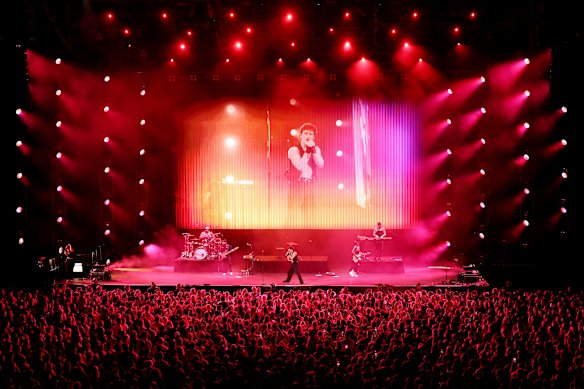
US singer Benson Boone performing at AO Live last year.Credit: Courtesy of Tennis Australia
Retail brands are also expanding their shopfronts. Fashion brand Ralph Lauren, which has its own private dining marquee as well as a substantial shop, became the official outfitter in 2021, while sports brand New Balance, which sponsors several players, including Coco Gauff, arrived in 2024 with a shop adjacent to Rod Laver Arena and its own private lounge overlooking Grand Slam Oval. New this year is a vast shop created by Mecca Cosmetica, near the Practice Village.
As to the future, the Open is constantly exploring, says Cornelis – “We’d love to have a hotel on site” – even if all the extra construction means that the Open is spending more money this year. “We’re confident,” he adds, “that it will pay off in terms of momentum.”
And, presumably, pay off in terms of putting the tennis ahead of its major event rivals?
“Look, I think we play our own game.”
Get the best of Good Weekend delivered to your inbox every Saturday morning. Sign up for our newsletter.