3 months ago
7
3 months ago
7
Opinion
September 2, 2025 — 3.30pm
September 2, 2025 — 3.30pm
What if you don’t actually have a money problem?
When we talk about achieving bigger, better, faster financial results, the default thinking is – you need bigger, better financial strategies. You need to do more, harder – invest more, sell better, work harder. You keep hunting for the next thing that’s going to unlock a new level of growth.
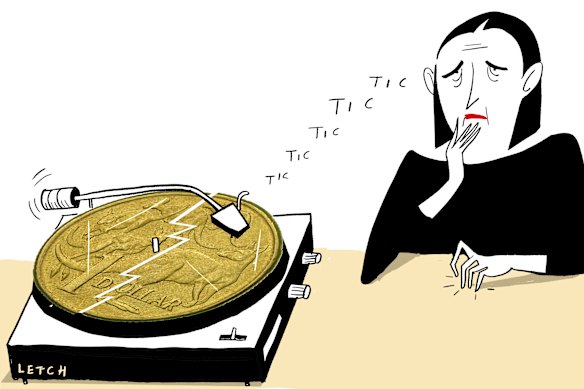
If you find yourself with financial woes, it might be time to change your tune.Credit: Simon Letch
But behind closed doors, with my private clients, that’s rarely what we talk about – because not all money problems are about money.
The business owner who is frustrated he’s not hitting bigger revenue goals faster doesn’t need a new sales strategy – he needs to detach from the external validation and reconnect to the purpose that inspired him to begin with, bringing the passion and energy back into the fold.
The senior professional who is anxiously obsessed with building a secure retirement for her future doesn’t need another investing podcast – she needs to strengthen her sense of internal security so she can start to ease how hard she’s clinging to her bank balance to feel safe.
The asset-rich, cash-poor investor who still feels a long way off his early-retirement dream doesn’t need yet another “financial freedom seminar” – he needs to detach from the outcome and time-frame and reignite his excitement of the journey, which is where new possibilities exist.
Not all money problems are about money. Today, I’m sharing some of the common non-money problems I see blocking financial progress in my work with clients – and how to address them.
You defer feelings to a future financial milestone
This is the classic – “I’ll be or do X when I achieve or get Y”. “I’ll be successful/secure/happy when I achieve $X in income/savings/net-worth.” The problem is that this never really works.
This is because you’re training your mind to not value or enjoy what you have right now. When you finally get what you want – you might be happy for a moment, but your baseline emotional state will eventually kick in, that being discontent with what you have now and needing something else – something you don’t currently have – to feel the feeling.
This is what creates the never-ending chase. Maybe you’ve already had the bizarre feeling that you’re on a hamster wheel. There are aspects of your life today that a past version of you would have dreamt of – but somehow, you still don’t feel how you thought you would. So you think perhaps you’ll finally feel it when you reach the next financial milestone. And so it continues.
However, often, what we feel is actually a practised response. Over time, it has basically become an emotional pattern or habit. If you’ve practised deferring happiness to a future financial milestone, that becomes your emotional habit.
So if you want to feel X (insert desired emotion – successful, accomplished, secure etc), you need to choose to actively cultivate that feeling consistently, repeatedly, in the present moment.
Now, your knee-jerk reaction might be: “But I can’t feel X until I have the external circumstances required to feel it.” My question to you is: Said who? Why not? They’re your feelings. Money can’t create your feelings. Only you can.
Loading
You spend more time in the past or future than the present
So much of how we discuss money is rooted in the past or the future – calculating returns we’ll get in 10 years, worrying about market crashes wiping out our retirement funds, planning for future goals; or regretting past decisions (debt, spending, not investing sooner etc).
The problem is – the only place from which you can take any sort of meaningful action is the present moment. So you’re losing the only thing you have power over (what you choose to do in the present moment) to thoughts about things you have no direct control over (past, future). This creates analysis paralysis, procrastination and inaction.
You can worry about a sharemarket crash or you can start implementing risk management strategies such as asset allocation and dollar cost averaging to help mitigate the risk. You can keep replaying the regret, shame and fear of past mistakes and losses, or you can take the learnings and start taking new actions that move you forward.
There is a subtle but crucial difference between having an exciting vision for the future that guides your present-day actions and trying to control the outcomes of your actions such that you’re operating from fear not desire.
Maybe your next level of financial growth doesn’t need a financial solution. Maybe you don’t need another fancy new investment strategy, sales tactic, pay-rise or budgeting app.
Maybe it’s not about chasing something outside of you, or adding more to your to-do list – but figuring out how to get out of your own way so you can create more results with more ease.
Paridhi Jain is founder of SkilledSmart, which helps adults learn to manage, save and invest money through financial education courses and classes.
- Advice given in this article is general in nature and not intended to influence readers’ decisions about investing or financial products. They should always seek their own professional advice that takes into account their own personal circumstances before making any financial decisions.
Most Viewed in Money
Loading