3 months ago
46
3 months ago
46
This story is part of the January 17 edition of Tennis magazine, brought to you by Good Weekend.
See all 11 stories.Alex de Minaur, 26, is one of the greatest tennis players on Earth right now – rising within the top 10. Can you even imagine being that good at what you do?
Now, just for a second, imagine that is you, and imagine that you are not only dissatisfied with this outcome, but that it is also responsible for sending you this past year into moments of “rock bottom” darkness. That’s the reality for Australia’s best tennis player – the man known as “The Demon” – ahead of the 2026 Australian Open at Melbourne Park. Fortunately, it’s not remotely in his nature to give up.
Here’s a quote of yours from the last tournament of 2025, the ATP Finals in Turin, after a close loss to world No. 8 Lorenzo Musetti. “I was in a very, very dark spot,” you said. “I could tell you that I hated the sport.” Why were things so dark?
In sport, results mean a lot, right? And this was a feeling after having a couple of matches not going my way, and me putting myself in great positions to succeed, but not being able to get over the line and take that next step. That was a very tough moment of dealing with not only the loss, but the way it happened. As well as I’ve played this whole year, there’s matches and situations that I need to improve on for me to get there, and I stumbled in a pretty big tournament.
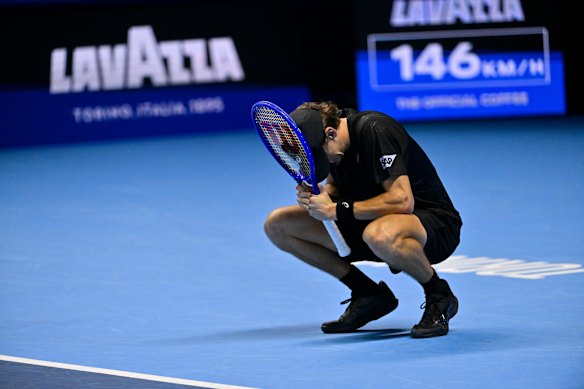
During the ATP semi-finals in Turin in November. At 26, and now ranked world no. 7, “it’s crunch time,” he says.Credit: Getty Images
I suppose it’s a case of not so much about being far away from where you want to be, as being just so tantalisingly close?
Yeah, exactly that. I think it probably is more difficult to handle knowing how close you are, seeing it within grasping distance, but you just somehow are not able to get there. It just frustrates you even more that you can’t take that next step.
Let’s zoom all the way back. You were 12 years old when you decided to play as a full-time professional. Twelve. Would you make that decision again, or would you maybe give yourself a couple of years of adolescence to enjoy?
That’s a great question. We are seeing tennis players develop differently nowadays. You’ve got college [the US college system, which offers scholarships and high-level facilities to promising young players] as a very good, viable option, and you’re seeing more and more players go through that system and have that kind of safety net, but at the same time being able to develop for two to four years and come out on tour. For me, that decision at 12 years old was obviously a life-changing one. One that I did not take for granted, by any means, and in fact helped me become the person that I am right now. From that point onwards my job was to be the best possible tennis player I could be, and do everything in my power to achieve that.
And you’ve done that. The growth in your career has been steady and upwards for a long time. You’re currently deep in the top 10. What does it feel like to be so good at something that there is only a handful of people on the planet who are better?
There’s still the endless drive for improvement and getting the absolute most out of myself. I do believe strongly that part of the reason why I’m still able to keep on improving and getting more out of myself is because I am one of my harshest critics, right? And I do expect the most of myself, and I do want to push until I can’t go any more. There is that fine line though, of also taking a step back and thinking about how that 12-year-old kid making that decision would be pretty happy right now.
He would be thrilled.
But at the same time there’s this other part of me that is wanting more, because I don’t want to be satisfied. I want to make sure that once I’m done in my career, I can sit on the couch and just know that I gave it my all, right? That’s the biggest thing. Knowing that I left no stone unturned. Ultimately, it’s that fine line that is difficult to navigate, between pushing yourself and at the same time enjoying the journey or even giving yourself a pat on the back every now and again.
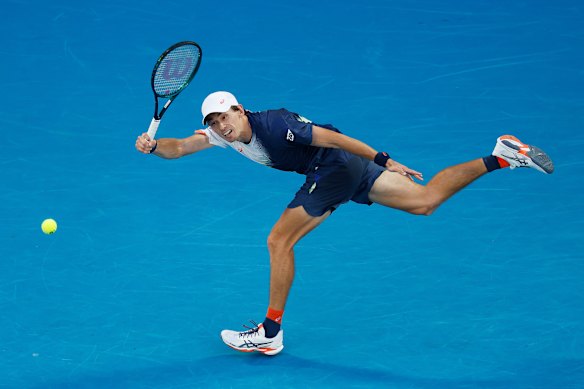
At full stretch during last year’s Australian Open.Credit: Getty Images
Today you’re having a day off. Do you get to enjoy the odd cheat day after one season is done, before the next begins, or does that drive to succeed invade every spare moment?
What I’ve learnt throughout the last couple of years – and by no means am I perfect at it, I’m still a work in progress – but the goal is to enjoy and cherish moments more frequently, right? Because there’s a lot of sacrifice, there’s a lot of hard work, and very rarely in our sport do you finish a week on top, not losing, so it’s finding ways to enjoy the little wins, and that’s definitely allowed me to kind of have a different perspective. And I think it’s going to be crucial for what’s to come for me and to not add any more pressure on myself. But right now on my days off, yes, I do eat whatever I fancy. I am enjoying myself just not being stressed. That’s the biggest thing, enjoying a second to myself.
Experts tell me your game is built on things like deft volleys, smooth transitions, devastating reaction time and pace, combined with focus and tenacity. Todd Woodbridge described you as someone who no player wants to go up against because you make life so hard for your opponents. “You have to beat Alex de Minaur,” he said. “He will not go away.” Where does that come from?
I guess it’s just hunger. The hunger to want to improve, or win the match, win the battle. And ultimately my one rule whenever I step out on court is that I can have a good day, I can have a bad day, but the non-negotiable is me competing from the first point to the last and creating that kind of persona or aura. That’s something that’s obviously very powerful, and it echoes throughout the tour, and I’m very proud of being known for this. But that also means that I need to show up every day, right? There are no days off in that sense. That’s why I pride myself on consistency – showing up every single day, every single week – and doing my best to be that guy who doesn’t have too many bad days.
You’ve definitely built an aura. On to more domestic matters, last time we chatted you were about to move into a new apartment near Wimbledon with your girlfriend, fellow tennis player Katie Boulter, who is now your fiancée. I think you had just been out furniture shopping in Soho, and again I’m reminded that players don’t really take a whole lot of time off, so what do you and Katie do to relax when you do get the chance?
What we have done over the last few years is whenever we’re at the same tournament, we make a conscious effort to try and switch off, anything from going out for a walk, finding a coffee shop, going out shopping, just exploring – anything that will make us feel like normal human beings. That has really helped us in that sense where we can kind of have a little getaway and at the same time just mentally not be as burnt out as we would be if the only thing on our mind 24/7 was tennis.
Loading
And that’s a hard thing for a lot of players, many of whom have started pushing back against the relentlessness of the tour. A handful just this year decided to step away and take a break and to tell the world that the schedule is almost unsustainable. Do you think we need to reassess the rigours of the tour and what it demands of the players?
I do know that personally. I went through it in the middle part of this year. During the French Open, I realised that what I was doing wasn’t sustainable, and I needed to take a little bit of time to step back and have a mental reset and shift the priorities a little. We play basically every single week. We start on the 1st of January, we finish mid-November, then we’re straight into the preseason, so there’s not a lot of time. You can obviously take weeks off in the middle of the season and choose your tournaments wisely, but the way the ranking system is set up, you’re always chasing someone, or someone is chasing you. I do think we need to start looking at a potential way to give the players a clear off-season.
You’ve got the number 109 tattooed on your chest because you are the 109th player to play Davis Cup for Australia, yet of course you’re also bound by your family heritage to Spain. What do you remember about playing in front of a local crowd in a big setting for the first time?
I mean, it’s just epic, right? It’s what you dream of as a kid. I know that’s what I was dreaming of when I was practising, 12 years old, in the Sydney Tennis Centre on Ken Rosewall Arena. I was dreaming of being able to play on that court one day and play the tournament in front of a packed crowd. As Aussies we’re so fortunate to get to start the year at home in Australia, and it is truly the biggest blessing – an energy that is unmatched. It doesn’t matter how many times you walk onto that court, I still get goosebumps every time and that’s by far what I look forward to the most every single year, knowing that the Australian crowd has my back through and through. All I want to do is play well for them.
You mentioned Ken Rosewall Arena. You’re often seen as a worthy successor to Australians like him and John Newcombe and Rod Laver for the way that you conduct yourself. Is that tricky – always being the best-behaved guy, the one giving up time for fans, for meeting commitments to Tennis Australia or even talking regularly to local media? Being a role model is a kind of big job.
I don’t see it that way. The way I see it is, I was a kid once, and I looked up to all these players and I was fortunate enough to get so much help as a young kid. And for me, that is by far the most important thing: doing my best to inspire the next generation. That’s something that’s very close to my heart, and the biggest reason why we started the Alex de Minaur Foundation, so we could start helping and funding kids to pursue their tennis dreams, and not only have that financial benefit but to also be able to pick my mind apart and spend time with a pro and understand what it takes. Those moments are just invaluable. The schedule couldn’t be busier, but this is a priority for me.
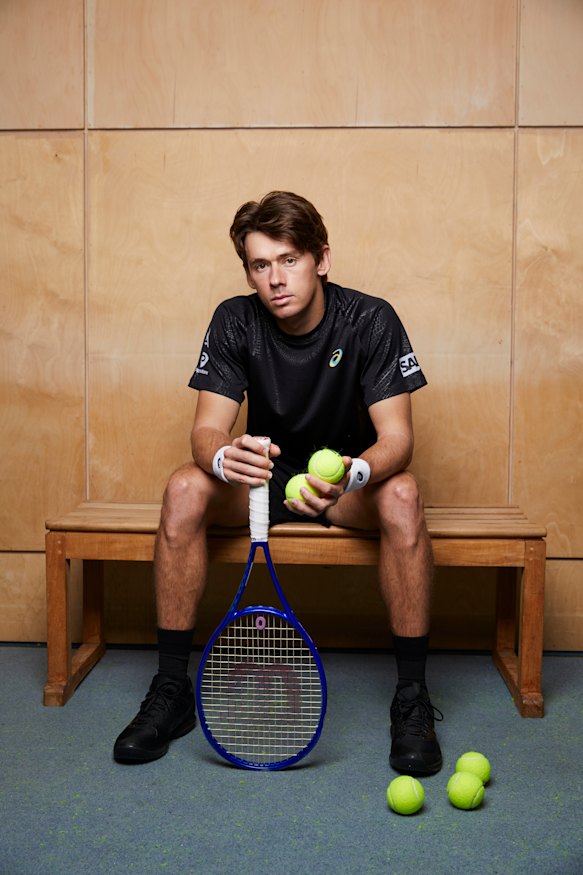
“I realised what I was doing wasn’t sustainable. I needed time to step back and have a mental reset.”Credit: John Davis
A few years ago, when you were ranked 25 in the world, you found it hard to go up against the top 10 players and you described it this way: “You’ve got this wall in front of you, and you try to break through it 18 times. On your 19th go, it’s hard for you to believe you’re going to break through, but that’s the only way it’s going to happen, through belief.” The challenge for you now is believing you can beat top-five players.
The same wall is in front of me, and it’s the same feeling. And I have to go full speed at this wall believing I’m going to break through, and no matter how many times I get knocked down, I need to get back up, give myself a little bit of room, and make sure I fully commit the next time, still believing. There’s a lot of noise – people saying, “Why don’t you put a helmet on? Why are you going to run towards a wall? Why even bother?” – but the only way through is just committing fully, and I’m going to do that until I can’t do it any more.
Loading
Is that why the French Open was so difficult for you? You’ve described it as your “rock bottom”, probably not so much because you lost but because you lost the will to compete. Is that accurate?
That is completely accurate. And it is the first time in my career that I’ve felt that way. And that was the moment that I realised how big of a hole I was actually in. Because that was my one non-negotiable – the one thing that I knew I could always count on – and that just disappeared. It was a scary feeling because if these thoughts or these things start to happen, it’s probably when you’re at the tail-end of your career. But we as a team found a way to get through it, and I’m very proud of that.
You’ve worked with psychologists in the past. You’ve mentioned reading books by James Clear (Atomic Habits) and Johann Hari (Stolen Focus), but here’s another quote from you at the ATP Finals: “If I really want to be serious about taking the next step in my career, these matches, I can’t lose them. I just can’t. More than anything, it’s getting to a point where mentally it’s killing me.” That’s dramatic language. What do you do now to quieten the mind?
All that stuff happens in the background, but I do believe that the biggest thing that will help is a shift in mindset. I know the culprit. I know what is pulling me down – what is affecting me in those types of moments – and it is placing too much emphasis on the results. I need to stop giving so much importance to the result. I need to get to a mindset of just focusing on what my game plan is and not letting that game plan change or shift depending on the result. That’s the big one, and that is what the best players in the world do so well.
You’ve made more than $US20 million (about $30 million) in prize money, not counting sponsorships, and you do all the right things. You take care of family members, back your own foundation, but you’re also able to enjoy the fruits of your labour, like an interest in classic cars, one of your favourites being a 1973 Mini. What’s the latest indulgence or toy?
I actually got myself another Mini – a 1992 Mini. I just love how unique they are and how they bring a smile to everyone’s face. Like, I’ll drive everywhere in my Mini. I’ll go practise at the courts, with kids or other players, and they’re expecting me to come in this …

With his Mini collection.Credit: @alexdeminaur/Instagram
Bentley? Phantom?
Exactly! And I just rock up in my little green Mini, and that’s priceless to me. Even going places with my mates – with four grown adults – it’s funny. You’re not going quickly anywhere, but you’ve got a smile on your face. I love the fact that I don’t know if they’re going to start or not, and I don’t know if I’m going to make the full journey. I’ve had many instances where I’m stuck in the middle of the road because it just decided to stop working. I mean, they live with the mechanic more than at my own place.
Let’s talk about the technical side of tennis. You had an incredibly strong 2025 with more calendar-year wins than any Aussie male since Lleyton Hewitt. Tennis watchers say that was for a range of reasons. You’re taking the ball earlier. You’re attacking the net more. You’re not only faster but stronger. Your first serves are bigger. You’ve got the intensity on the baseline. You can draw players in with drop shots and bamboozle them with lobs. Where can you improve?
It’s building on what I’ve been doing, a big shift in mindset, and the fact that if I want to beat the top players in the world, I couldn’t do what I was doing – and that was being a little bit too passive and relying on my speed for just defence. I actually had to take it to these guys and show that I can be an aggressive player, and play with the variety that I have. Of course there were elements that I needed to improve on, and that’s been the serve and the physicality. I’ve always been very quick but I’ve been on the smaller side of some of these players. We’ve had a big emphasis on bulking up, having a bigger weight on my ground strokes.
You really did have a big 2025. Making the ATP Finals – where only the top eight players in the world are invited – was a big deal, and that’s twice in a row for you. Your final win of the season was against Taylor Fritz, the world No. 6 at the time – another significant moment.
Against top 10 opponents, I had a lot of close battles that just didn’t go my way, so that win did feel more than anything else like a little bit of relief, that it finally went my way and I could kind of move on. You’re always going to have regrets, but it made it a little bit smoother.
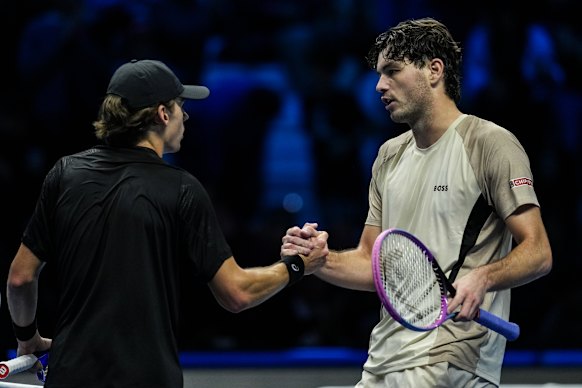
A win against US player Taylor Fritz (right), then ranked world No. 6, at last year’s ATP Finals was a “relief “.Credit: Getty Images
The flip side of those achievements is: what happens if this is it for you? Do you ever worry about becoming the next David Ferrer – an outstanding player who was once top three in the world, who made more than a handful of grand slam semi-finals, but never broke through for that big win? Would you be content if that was your career?
I am very sure that David Ferrer can sit on his couch, look back at his career and be content. Of course he would have wished to win a grand slam, as we all do, but he got the absolute most out of himself. And the only people that have a problem with his career are critics. I don’t mind what other people think of my career, as long as I’m content with what I have achieved. People are always going to have opinions, and I do listen to them – I do hear them, and the outside noise – but at this stage of my career I just use it as motivation. I add fuel to the fire, and then once I’m done, I’ll be able to sit down on my couch and know that there was no unfulfilled potential or talent wasted.
Loading
You have clearly reached an important point in your career. You’re 26, so you don’t have the inexperience of youth to blame for any bad results – not that you would – and you also can’t make any claims about needing to grow into your body. Your time is now. Is that scary or exciting?
I see it as an opportunity. It’s crunch time. I’ve had maybe 10 years on tour, so I’ve got 10 years’ worth of experience, and my goals are clear. It’s being at the end of the biggest tournaments in the world. If I want to take that next step, I need to be better at the biggest tournaments and be one of the contenders. And I’m sure as hell going to give it everything I have to achieve that.
Hear Konrad Marshall’s full interview with Alex de Minaur at Good Weekend Talks, wherever you get your podcasts.
Get the best of Good Weekend delivered to your inbox every Saturday morning. Sign up for our newsletter.