3 months ago
35
3 months ago
35
Like most other new employees at Car B, a car-sharing start-up in Colombia, Esteban Dalel was intrigued to meet the boss.
Zulma Guzman Castro, a feisty Bogota entrepreneur, had started the firm from scratch despite knowing little about cars, and was full of ambition. She had even pitched it on the TV program Shark Tank. Alas, like so many other entrepreneurs who talk a good game, the “reality” behind Castro’s venture wasn’t quite what it seemed.
“There was no office, it was just her living room,” recalls Dalel, 31, who was hired as Car B’s chief technical officer. “She was very difficult with money … and she liked yelling at people.”
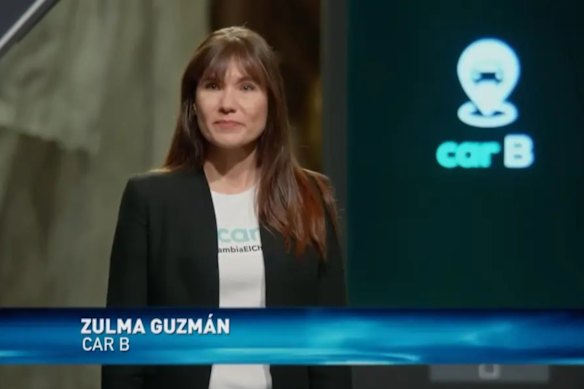
Zulma Guzman Castro pitches her business Car B on the Colombian version of ‘Shark Tank’.
Despite winning funding from a Shark Tank investor, Castro’s car venture ceased operations in 2019, owing debts. That was not the last Dalel would hear of his boss – who is back on Colombian TV screens for very different reasons.
Last week, she was identified as the chief suspect in a case that has gripped both Colombia and the wider world – the alleged poisoning of two Bogota schoolgirls, Ines de Bedout, 14, and Emilia Forero, 13, who died after eating chocolate-covered raspberries sent by courier to Ines’s family home.
Police allege that the raspberries were injected with thallium, a colourless, odourless heavy metal that is intensely toxic even in tiny doses. They claim that Castro, 54, sent the deadly gift as an act of revenge against Ines’s father, Juan de Bedout, with whom she says she had an affair five years ago.
Believing Castro to have fled abroad, police issued an Interpol red notice in October. She was then fished out of the River Thames, thousands of miles away in London, on Tuesday morning, having apparently thrown herself from Battersea Bridge.
The allegations have astonished former employees of Castro’s firm, who used to swap gripes about their demanding boss via an employees’ WhatsApp group. That has since burst back into life.

The Battersea Bridge across the River Thames in London, off which Zulma Guzman Castro apparently threw herself last week.Credit: Alamy Stock Photo
Castro is being treated in hospital for non-life threatening injuries, pending an extradition hearing at Westminster Magistrates Court, which is understood to have issued a warrant for her arrest. In a further twist, Colombian investigators are also probing whether Juan’s late wife, Alicia Graham Sardi, who died in 2021, may also have been a victim of thallium poisoning.
Castro has already protested her innocence, giving an interview to Focus Noticias, a Colombian media outlet specialising in legal affairs, the day before her apparent suicide attempt. She admitted having a relationship with Juan – which at times had turned stormy – but claimed that she was now being framed.
“I am a mother, and that must be unbearable pain,” she said of the girls’ deaths. “I understand that for that reason they want to find the culprit and use all possible means to do so, but I am not that culprit. The strategy is clearly to completely destroy me before any legal proceedings ... without any guarantee of a fair trial at this time.”
Ironically, Castro’s pre-emptive attempts to clear her name apparently gave away her location to police. During the interview, she was seen drinking from a bottle of Buxton mineral water – a brand generally only available in the UK.
An unexpected gift
Behind the lurid headlines that the case has attracted on either side of the Atlantic lies a horrific episode at the de Bedout family’s luxury apartment in Bogota on April 3. Ines, Emelia and another girl had come home from school together and were baking cookies when a courier arrived unexpectedly with a jar of chocolate raspberries – a gift, the courier said, for the family.
Unable to resist the temptation, the girls sampled the raspberries, all collapsing soon afterwards. Ines and Emelia died in an intensive care ward four days later, while their friend, who has not been identified, suffered life-changing after-effects. A 21-year-old brother of one of the deceased was also hospitalised.
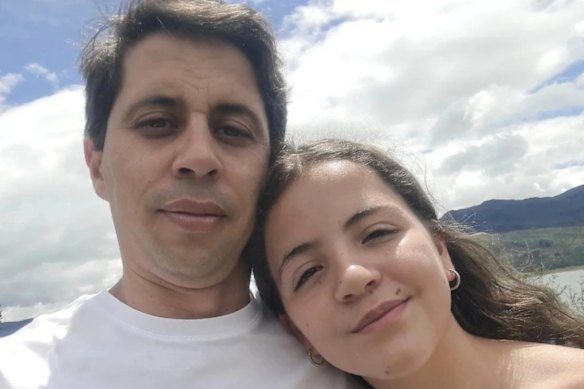
Pedro Foraro with his daughter Emilia. Emilia died from eating poisoned chocolate berries.Credit: Pixel8000
Castro, who allegedly knew Ines’s daily routine and was aware of her fondness for chocolate-covered raspberries, is understood to have left Colombia about 10 days later. She is since understood to have spent time in Argentina, Brazil and Spain. The case against her was not made public until this month, although in August, Emelia’s family hinted that they suspected a female hand in their daughter’s death.
In a social media post to mark what would have been her 14th birthday, Pedro Forero, her father, wrote: “Fourteen years ago, a life of hopes, joys and dreams began… As a father, it is incomprehensible to think that someone was capable of taking this away.
“She did not just take away my dreams, my desires and my prospects in life as a father... She took away my daughter’s opportunity to be a girlfriend, a professional, a wife, a mother and a daughter.”
The Interpol red notice – alerting countries around the world that Castro was wanted for questioning – was not issued until late October, although it appears that she became aware of the accusations before they became public. In an undated message sent to friends, she said she was the innocent victim of “gossip”.
“I find myself in the middle of a very serious situation…where I’m being accused of having been the person who sent a poison that killed two girls. I imagine the gossip is growing like wildfire,” she wrote.
“They accuse me of having fled to Argentina, and then to Brazil, Spain and the UK. Those who know me know I haven’t fled anywhere. They know I’ve been working in Argentina and began a masters in journalism here.
“I imagine they’re accusing me because I had a secret relationship with the father of one of the girls.”
An illicit affair
Castro’s claims of a relationship with Juan de Bedout are backed by her former employees at Car B. Dalel claims that she would order her employees out of her house at short notice when Bedout came to visit.
“We started to realise when she was asking for her space to have sex – she would call us and tell us to get out of her place within 10 minutes,” he said.
In her interview on Monday with Focus Noticias, Castro claimed the couple’s relationship ended in early 2020, a year before Bedout’s wife died. She admitted, though, that she had not been happy about the break-up, and that at one point, she had put a GPS tracker on his car to find out where he was.
“When I was in a relationship with Juan, out of jealousy and because I was entangled in all the lies, he challenged me ... saying that I wasn’t capable of knowing where he was hiding,” she said.

The investigation into the deaths of the two girls has gripped Bogota in Colombia.Credit: Bloomberg
“I told him that I was capable, and that’s when I looked for a way to put the GPS in the car.”
While Castro made no mention of feelings towards Bedout’s late wife, Sardi, investigators are now apparently re-examining an earlier diagnosis that she died from cancer. It is understood that traces of thallium were found in Sardi’s body, but were originally presumed to have been ingested accidentally.
Innocent until proven otherwise
The plot thickened yet further when Fabio Humar, the de Bedout family’s lawyer, told Colombia’s El Tiempo newspaper that authorities were looking into yet more possible poisoning attempts using thallium.
This was prompted by the apparent discovery that both Pedro himself and one of his sons – who did not touch the contaminated raspberries – had thallium traces in their blood.
According to reports on Friday in La Nacion, an Argentinian newspaper, Castro first arrived in Argentina in 2023 and began a postgraduate journalism course on April 14. The paper said she had left Argentina on October 1.
Officials have stressed that despite the slew of allegations against her, Castro must be treated as innocent until proven otherwise.
Officials in Colombia are understood to be concerned about whether she will be mentally fit to stand trial, given her apparent suicide attempt, and whether that might have an impact on extradition proceedings.
Whatever happens next, her old colleagues will be watching closely for the latest updates on a case now known across Latin America as the “raspberry killings”.
Loading
If Castro is found guilty, they say, it will prove that she was inept as a criminal as she was as a businesswoman.
“We were talking about how dumb she was if she used a delivery service for the raspberries, because that would have left a perfect trail,” Dalel said. “Those are the kind of errors she would make with the company.”
The Telegraph, London
Get a note directly from our foreign correspondents on what’s making headlines around the world. Sign up for our weekly What in the World newsletter.