3 months ago
16
3 months ago
16
Cultana: The dusty ochre plains of rural South Australia are a world away from Ukraine, which is entering its fourth frigid winter of fighting since Vladimir Putin launched his full-scale invasion of the country. But here in the outback, four hours’ drive from Adelaide, with flies buzzing and the sun pounding, the Australian military is putting the lessons from war in Eastern Europe into practice.

The Cultana training area during a live-fire demonstration by the Australian Defence Force.Credit: AAP
The biggest revolution from the war in Ukraine has undeniably been the central role that drones play in modern warfare. Ukraine churns out an estimated 4 million drones a year, up from about 800,000 two years ago. About three-quarters of Russian casualties in the war are now attributed to drones, which Ukraine has used to sink several prized Russian warships and destroy fighter jets. In turn, Russia has ramped up its own drone production and is using them to terrorise Ukrainian civilians and soldiers alike.
Australian companies are among the world leaders in uncrewed aerial vehicle technology, but military analysts have long criticised the Australian Defence Force for being sluggish to enter the drone age. Bespoke, crewed platforms – such as submarines, fighter jets, frigates and tanks – have dominated Australian military planning and defence spending.
The rapid advances in offensive drone technology in Ukraine have sparked equally impressive developments in counter-drone capabilities – that is, the technology used to defend against drone attacks. As well as lacking armed drones, the ADF has had disturbingly little protection against drone attacks on its troops, bases and expensive military equipment.
That’s now beginning to change. In February, the Albanese government launched a $1.3 billion program to fast-track the delivery of advanced drone-killing technologies to the ADF. On Thursday, this masthead watched the army simulate using these technologies against a drone attack at the Cultana Training Area, between Port Augusta and Whyalla.
Among the technologies on trial was VAMPIRE (Vehicle-Agnostic Modular Palletised ISR Rocket Equipment), which has been used to great effect by the Ukrainian army to repel Russian drone attacks. Developed by American firm L3Harris, this uses laser-guided rockets to shoot down approaching drones. From atop a Hawkei armoured 4WD, the VAMPIRE successfully shoots down an approaching drone that is invisible to the naked eye.

The VAMPIRE rocket launcher.
A different system, using a mini-gun affixed to a Hawkei, also successfully repels its target. Other technologies on display are hand-held, used by soldiers to target drones much as they would with a conventional rifle or machine gun.

The mini-gun affixed to the top of a Hawkei four-wheel drive.
Systems such as the VAMPIRE are labelled kinetic, meaning they physically shoot down approaching drones. Others are non-kinetic, freezing and disabling targets by using jamming technologies. At Cultana, we watch a jammed drone freeze and suddenly fall from the sky without physical contact, as if its batteries had died.
“If I’m going to war tomorrow, I’m taking a few of these,” a soldier, holding up a drone jammer, tells Defence Industry Minister Pat Conroy as he tours the site. The soldier adds, with relief, that he had no idea the army had such tech at its disposal.
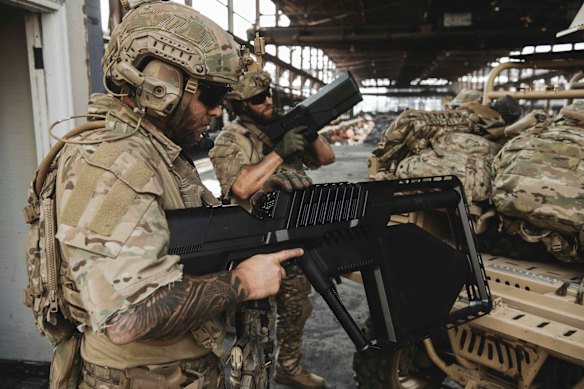
Ukrainian soldiers have used “drone guns” to great effect to shoot down Russian drones.
The Sugar V, an ultra-lightweight passive drone detector that has been used by Ukrainian forces, is among the technologies bought for the ADF. Each device weighs just 250 grams.
The sensors being acquired by the army can detect drones up to 5 kilometres away; the rockets can bring them down from 2.5km away, mini-guns from 1.5km. Some of the technologies are bought from overseas, but others are Australian, among them the anti-drone Slinger that has been deployed in Ukraine. Adelaide company Acacia Systems has been contracted to provide the command-and-control set-up for the counter-drone program.
Loading
Conroy describes the initiative – known in army parlance as Project Land 156 – as one of Australia’s fastest acquisitions. After these successful trials, drone-hunting equipment will be rolled out to the army within months. As the government overhauls the defence bureaucracy to speed up the delivery of major projects, Conroy calls it a blueprint for how military acquisitions should work.
Conroy stresses that the government is investing in an array of technologies, rather than betting on a single platform. With drone and counter-drone technologies evolving so rapidly, it would not be prudent to lock the ADF into tech that could soon be rendered redundant. Reflecting the transformative nature of drone warfare, legislative change has been needed to ensure the ADF can legally respond to potential attacks.

ADF soldiers show the new technologies to Defence Industry Minister Pat Conroy.Credit: AAP
“Anyone who’s watched any of the footage of the Ukraine war understands that war is changing,” Conroy says. “The pervasive nature of drones is changing the way wars are fought, and it’s incumbent upon governments of the day to change quickly with them to protect our troops and make sure our troops have the best equipment they can.”
The Australian continent is bigger than Ukraine and “surrounded by a moat”, but Conroy argues the threat of drone attacks must be taken seriously.
Major General Richard Vagg, the army’s head of capability, agrees. “Drones have changed the character of war,” he says. “Consequently, we must have an ability to detect and destroy drones at every level of our organisation.”

Soldiers also used virtual reality to practise shooting down drones at the training base in Cultana, South Australia.
Australia’s network of army, navy and air force bases is the obvious priority for urgent fortification against drone attacks. So is such expensive equipment as the army’s new Abrams tanks, which currently lack counter-drone protection.
Counter-drone technologies also will have civilian applications, including protecting major events – football grand finals and the 2032 Brisbane Olympics, for example. The government is mandating that Defence’s counter-drone contracts include civilian capabilities to shield Olympic sites from attack.
“The rising threat of drones provides an asymmetric threat to all forces ... It’s a very difficult technology to keep up with, and you need to be very serious about doing that,” says Lieutenant Colonel Josh Mickle, who is overseeing the army’s push into counter-drone technology. “The race to defeat the drones is on.”
Cut through the noise of federal politics with news, views and expert analysis. Subscribers can sign up to our weekly Inside Politics newsletter.