3 months ago
39
3 months ago
39
Brisbane: Emerson Jones remembers playing – and losing to – a then-16-year-old Maya Joint in practice sets at Tennis Australia’s national academy in Brisbane about three years ago.
It was a shock to the system for Jones, who knew little at the time of Joint, a Michigan-born emerging talent who had just switched allegiances from the United States to Australia thanks to her Melbourne-born father.
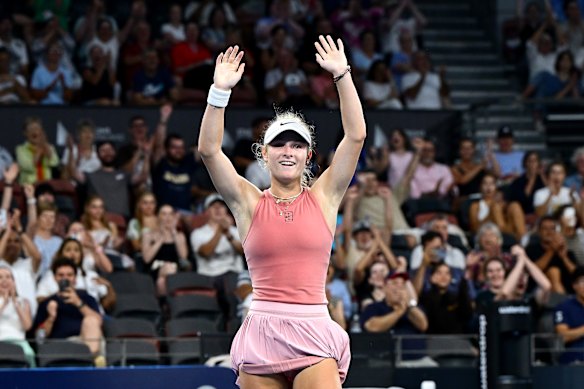
Emerson Jones claimed her second career top-50 scalp at this week’s Brisbane International.Credit: Getty Images
Jones was only 14, but a higher-ranked junior than Joint back then and already the “it” player in Australian tennis circles, tagged as a significant part of the solution in the post-Ash Barty era. Getting used to those new challenges, and challengers, is all part of the journey Jones is embarking upon.
“We didn’t know who Maya was,” Jones told this masthead. “I played a couple of practice sets with her, and she beat me. I was like, ‘Why am I losing?’ – but now it makes sense. She’s really good.”
Loading
Joint is 19 now, Australia’s top-ranked women’s player, and set to be seeded for the first time at this month’s Australian Open. Jones, who does not turn 18 until July, is making exciting strides of her own.
Together, they could put Australian women’s tennis on the map for the next decade or more, alongside fellow young guns Talia Gibson and Taylah Preston, and the slightly older Olivia Gadecki.
Jones reached two junior slam finals and spent an extended period as the No.1 junior on the planet, but has left that world behind – while still completing her year 12 studies – to commit fully to the women’s tour, where she has zoomed inside the top 150.
She earned an Australian Open wildcard with an impressive three-tournament run in November where she won a title and reached a final and semi-final.
That form rolled on with Jones’ straight-sets dispatching of world No.43 Tatjana Maria in Brisbane on Monday night, which was her second career top-50 scalp, on top of advancing to final-round qualifying at Wimbledon and the US Open last year.
She then blasted her way to a 3-0 lead over 17th-ranked Liudmila Samsonova on Wednesday – almost 12 months after facing Elena Rybakina in her Australian Open debut – before going down 6-4, 6-1.
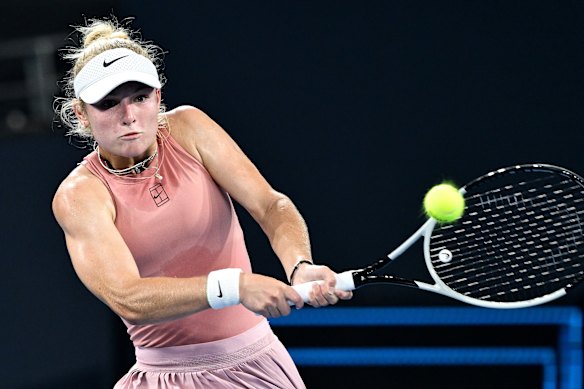
Jones has a world-class backhand.Credit: Getty Images
Jones wants to be where Samsonova is, but received a reminder of where she needs to improve.
The Australian teenager, who already boasts a world-class backhand, matched Samsonova from the baseline for parts of the clash, but the taller and physically stronger Russian routinely out-served her by 20km/h or more.
Loading
“I feel like my serve definitely has gotten a bit better as I’m playing women’s, just because it has to,” Jones said.
“It’s fine in juniors, but when you move out of juniors, you’ve got to take the next step into women’s. I think playing a top-20 [opponent] is another step from playing a top 50 … when you take another step up, things just have to get a little bit better.”
That is where Jones’ coach, Carlos Cuadrado, comes in.
Jones is an outstanding athlete – her mother, Loretta Harrop, won a world title and Olympic silver in triathlon, so her genetics are strong – but is closer in height to Barty than Aryna Sabalenka or Rybakina, so the plan is to become as accurate a server as possible and gradually add power as she matures.
Cuadrado knows what it is like to be a prodigy, given he won the Roland-Garros boys’ title in 2001, including defeating former world No.8 Janko Tipsarevic along the way, before injuries cruelled his career.
He has since worked with top-20 stars Svetlana Kuznetsova, Daniela Hantuchova and Anastasia Pavlyuchenkova, but rates Jones as the best competitor he has coached.
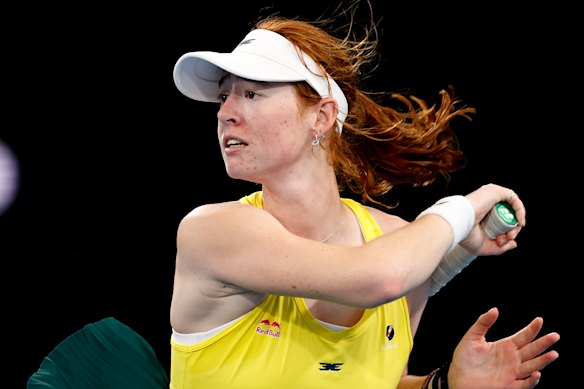
Maya Joint in action at the United Cup.Credit: Getty Images
“I never had a player who competes as well as her, and can lift her level in the most important moments of the match,” Cuadrado said.
“I think that’s impossible to teach, but she has mastered that and is fearless. Our focus is on development, and I don’t want to put pressure on her, but our goal is to try to reach top 100 this year, which I believe is realistic. I would not be surprised if she does better than that, so we’ll see.”
Jones wants that to happen quickly, but is trying to be patient.
Fellow teenagers such as Mirra Andreeva, Victoria Mboko, Joint and Iva Jovic are already inside the top 40, while Tereza Valentova and Sara Bejlek have double-digit rankings, too. But they are all older than Jones, even if by mere months.
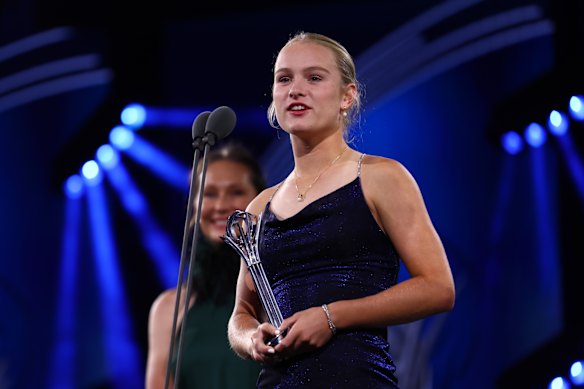
Jones won Tennis Australia’s female junior athlete of the year award in 2025.Credit: Getty Images
Jones hit with 18-year-old Andreeva this week, and the world No.9 believes the aggressive Gold Coaster is “very talented” and destined to be a great player.
“I’ve always wanted to do stuff young,” Jones said.
“I played junior tournaments with Mirra, and you look at Maya, too, so obviously, it’s possible [to succeed at an early age], especially in women’s [tennis] – and I think everyone knows that. But you’ve got to have the belief to do it.”
News, results and expert analysis from the weekend of sport sent every Monday. Sign up for our Sport newsletter.
Most Viewed in Sport
Loading