3 months ago
22
3 months ago
22
Cast an eye across the headlines, and 2026 feels like a world of obfuscation and distraction. The modern world as we see it on TV suddenly looks more like the fractious and shadowy universe of espionage writer John le Carré, populated by spies like George Smiley and Jonathan Pine.
Is this life imitating art? Or art imitating politics? At a time, when we are invoking Orwell’s famous line “the Party told you to reject the evidence of your eyes and ears – it was their final, most essential command”, there are many questions but few easy answers.
Loading
“Art has to engage with the real world, and yet the best art can exist on its own,” says actor Tom Hiddleston, who plays superspy Jonathan Pine in The Night Manager. “But if there’s a tangible connection to the real world, I think it invites the audience to bring their own experience to it.”
“One of the things I know le Carré cared deeply about was, if he’s talking about the East and West and their capacity for invention, [that] he’s coming to it from the point of view of the West, right? And I know that his work to some extent evolved out of a response to what was happening in the world.
“What fascinated him as a British writer was, ‘what does it mean to be British’?” Hiddleston says. “Douglas Hodge, who plays [high-ranking intelligence officer] Rex Mayhew, says in the first episode, a nation’s security service is the truest expression of itself. Know thyself. And the challenge is: what does this country stand for? Where is it going, and who’s driving the boat?”
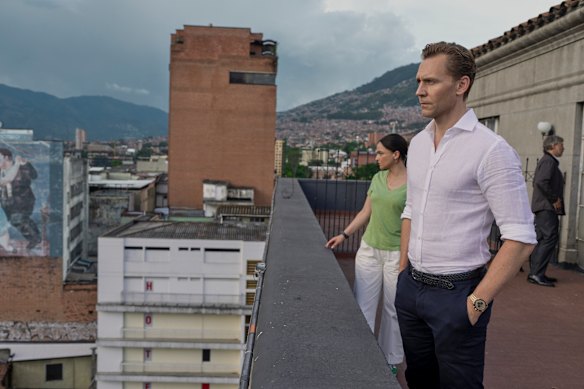
Tom Hiddleston stars as Jonathan Pine in The Night Manager.Credit: Des Willie/Prime
“I can speak as a citizen of the United Kingdom that the conversation is alive and real at the moment about who are we and what do we stand for, and where do we want to go?” Hiddleston adds. “And I think le Carré was always interested in that question.”
The Night Manager, which is now in its second season, is based on le Carré’s 1993 novel of the same name. The first season, which aired in 2016, drew wide acclaim, winning two Emmys and three Golden Globes. A decision on a second season felt slow, but Amazon made up for it by commissioning second and third instalments in 2024.
For Hiddleston, whose Hollywood day job (my wording, not his) is playing the mischievous Norse god Loki in the billion-dollar Marvel movie franchise, The Night Manager is an infinitely more nuanced work. It is a collaboration with some of Britain’s best actors – Hugh Laurie, who plays arms dealer Dickie Roper, and Olivia Colman, who plays agency boss Angela Burr – and acclaimed director Susanne Bier, whose duties are taken in the second season by Georgi Banks-Davies.
But everything changed for Hiddleston when he got to know the man himself, and le Carré’s sons, Simon and Stephen Cornwell, who manage their father’s literary estate and executive produce the adaptations of his work.
He confided in me. [It might be] because he was getting older, and he was less protective of his personal history.
Tom Hiddleston on John le CarreHiddleston and le Carré had met several times during the production of the first season of The Night Manager, but a more personal friendship developed in the years that followed, as they lived near each other in London.
“I’d run into him in the park, training my young puppy, and he’d be on his morning constitutional, and we would talk about current affairs and world events,” Hiddleston says. “I really understood that he confided in me, and I believe maybe it’s because he was getting older, and he was less protective of his personal history.
“His process of writing was a process of self-discovery, that really these extraordinary stories were about trying to understand his own experience,” Hiddleston adds. “He had an extraordinarily turbulent and difficult childhood. His father was a conman and his mother left the home when he was five.”
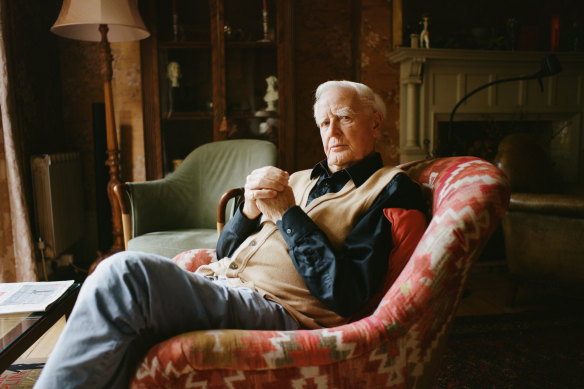
John le Carre in London, one year before his death.Credit: Charlotte Hadden/The New York Times
To le Carré, people were unreliable, and there was no centre to a human being, he told Hiddleston. There was no such thing as truth or conviction. The thing that mattered was the imprint of personality, and that risk was attractive.
“He became incredibly agile at reading people because he was so accustomed to it,” Hiddleston says. “The masks that people wear and the lies they tell. And his sense that the particular kind of human being that is drawn into this world, that is good at it, is a human being that is in some way broken. Immensely competent, immensely capable, highly intelligent and aware and awake, but also fragmented.
Loading
“Le Carré’s works are grounded in that complexity,” Hiddleston says. “An understanding of the relationship between trust and the inevitable betrayal. Between danger and vitality. That risk itself is a human drive. And yet, he was a patriot. He cared very deeply about the United Kingdom. And also because he cared so much, he got angry with it.”
Perhaps the most peculiar thing about le Carré is our own perception of him. For high school students in Australia, his works have been part of the curriculum, along with the works of other writers such as Henry Lawson and even Jane Austen. But company tends to cast le Carré as a historic figure.
In truth, he lived through almost all the 20th century, and only died, at the age of 89, in December 2020. Far from being an old-world spy, le Carré was a man who went through the pandemic with us. Which makes him a somewhat modern man, given the place of his name in the classics.
But it also creates an artistic dimension around his work that is both unexpected and deeply affecting. I suggest to Hiddleston that le Carré is some kind of artistic ghost, whose presence will inevitably be felt, either in the pages of his works, or indeed on the sets of their film and television adaptations.
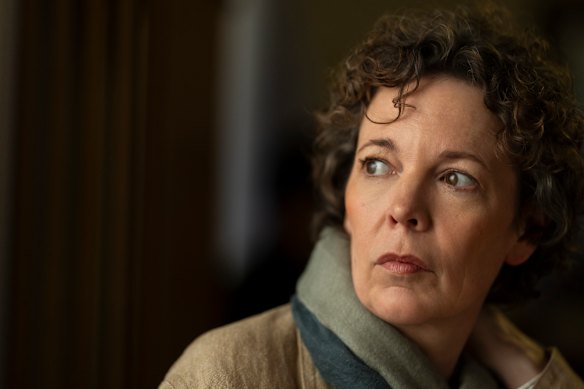
Olivia Colman as Angela Burr in season two of The Night Manager.Credit: Des Willie/Prime
“My sense of him in the work is of a keen searching, yearning, intelligence, a curiosity to desire and understand the world, and to understand the world as it really is, not as it is presented to us. And that takes enormous courage because you have to be able to withstand what you discover,” Hiddleston says.
“He had this profound courage, I think, in trying to understand the world and himself,” Hiddleston adds. “And enormous playfulness and mischief because he understood that people are complex and contradictory, and so nobody moves in straight lines. I tried to honour that profound curiosity that feels very deep in his spirit, but also his mischief.
“Having met him, got to know him and to have received his profound kindness and humanity – he was deeply kind to me – I felt I carried him close on the set,” Hiddleston says. “I suppose I could feel the artistic ghost, if you like, his presence in the work. That somehow his spirit was with us, at least the legacy of it.
“Before the first season, I asked him, David – his [real] name is David Cornwell – is there anything you would like me to know at this last moment before we start?” Hiddleston recalls.
“And he said, well, of course, Tom. You’ll have guessed by now … Jonathan Pine is me, and now he must be you. And in those words was an encouragement to possess and inhabit and to make this my own, to commit as much of myself to the role as he had, which I always felt like was a brotherhood I share with him.”
The Night Manager is streaming now on Amazon Prime.
Find out the next TV, streaming series and movies to add to your must-sees. Get The Watchlist delivered every Thursday.