3 months ago
43
3 months ago
43
This story is part of the January 17 edition of Tennis magazine, brought to you by Good Weekend.
See all 11 stories.One of grand-slam great Andre Agassi’s fondest memories of his former coach Darren Cahill does not, at first, appear to be about tennis at all.
Agassi, who became the then-oldest world No. 1 at age 33 under Cahill’s guidance in 2003 (replacing Lleyton Hewitt at the time), had a trick for softening the burden of travelling the world on the unforgiving tennis circuit by always ensuring he stayed somewhere with a fireplace. Cahill not only knew of Agassi’s fondness for the smell of wood smoke and the crackle of burning timber, but intuitively understood how that simple homely comfort was important to the American’s happiness and therefore his ability to perform at his optimum.
The master coach went one crucial step further, however, taking it upon himself to attend to the trivial matter of keeping any dying embers alight. “If Darren saw the fire going down, he was the first one to find more wood for later, because he knew it brought me a level of peace,” Agassi says from his Nevada home.
It was classic Cahill, whose emotional intelligence is assuredly a major reason for his extraordinary success – proven beyond doubt by coaching four different players to grand slam titles and the coveted No. 1 ranking.
The amount of sensitivity that the coach put into any day, says Agassi, was incredible. “This was not a situation where I needed wood and was looking for someone to go get it. I might be out and about, and he would just do it. It’s the way he was as a friend, and I miss my time with him and his family.”
Cahill, who turned 60 in October, rates among the top handful of Australian tennis coaches ever. He might even be the best – and he continues to be one of the most in-demand people on the planet in his profession. Former world No. 1 Andy Roddick is adamant Cahill should be recognised with a place in the sport’s Hall of Fame.
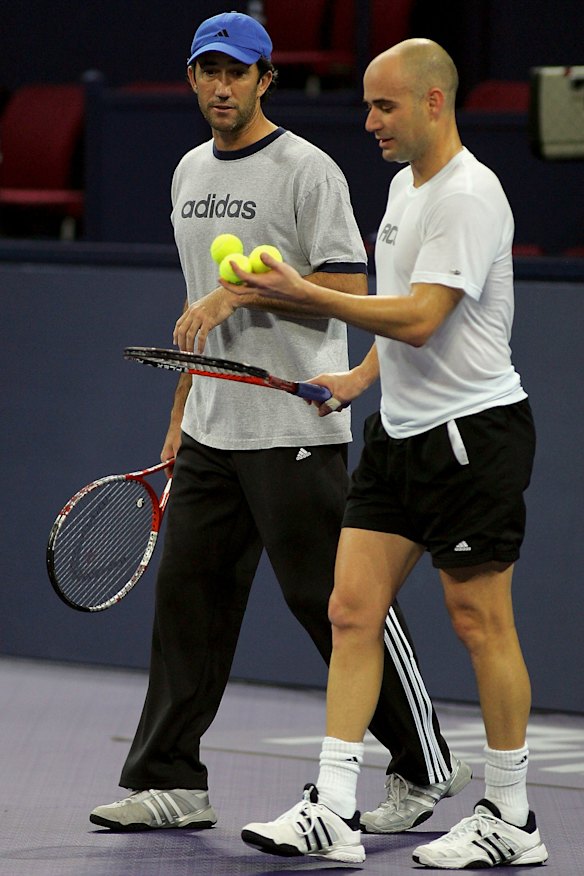
With Andre Agassi in 2005. “Darren lives with such a beautiful balance between his head and his heart,” Agassi says.Credit: Getty Images
He was a more-than-handy player himself, too – reaching career-high rankings of No. 22 (singles) and No. 10 (doubles) – but is best known for four superstar pupils he mentored across a stellar three-decade coaching career. As well as Agassi, he also worked with Australia’s Hewitt, Romanian Simona Halep and currently, Italy’s Jannik Sinner. Sinner famously and accidentally let slip after beating local wildcard Tristan Schoolkate at last year’s Australian Open that Cahill, whom he likens to a “second father”, told him the 2025 season would be his final one as a coach.
“He brought me so many things. One year is still long. I don’t want to talk so much about his retirement,” Sinner said 12 months ago. “I feel very, very lucky and happy to be his last player on tour. He has been an amazing coach and person – not only for me, but for all the other players he has worked with. For me, it’s just a huge honour.”
After fielding further questions in Italian – and realising what he had done – a red-faced Sinner dashed back to the Melbourne Park locker room to find Cahill and apologise for spilling the beans. Whether he could convince Cahill to remain as his co-coach, along with Italian Simone Vagnozzi, became one of the key storylines for the rest of the season. Sinner at one stage even cheekily admitted changing Cahill’s mind would be his “biggest challenge”.
Sinner met that challenge, of course, just as he almost always does on court. In November, Cahill confirmed he would continue a partnership that started in mid-2022 and has delivered 19 of Sinner’s 24 singles titles, including his four majors, two ATP Finals triumphs and five Masters 1000 victories. Sinner also spent 66 weeks as world No. 1.
The Australian made a bet with Sinner on the eve of this year’s Wimbledon final that the Italian could decide whether Cahill continued if he captured his maiden All England club title. Sinner duly went on to defeat great rival Carlos Alcaraz in four sets to uphold his end of the bargain. Four months later, Cahill said with a nod that he was “a man of my word” and agreed to remain in place.
But within Cahill’s confirmation and continuation of his role within Team Sinner was another insight into his success. Where many coaches might cling on to a rare talent like Sinner for dear life, his priority remains the player. “When we spoke about this, this time last year, I felt the time was right. I’m not a young buck any more,” Cahill said ahead of the ATP Finals in November.
“Also, my particular role within the team is something that he should consider; to get a new voice in, a new set of eyes, new inspiration, and it would be good to rotate that at times. If he’s not ready to do that, it’s no problem – but that will be up to him.”
Far from the tennis tour, Cahill grew up in and around Australian rules football heartland, namely the Port Adelaide change rooms, where his father John is a legend. Known affectionately as “Jack”, his father played 266 games and kicked 286 goals for Port between 1958 and 1973, including seven years as captain. He was club champion four times and captained South Australia in representative duty. Port Adelaide’s best-and-fairest award is named the John Cahill Medal. Cahill snr was also Port Adelaide’s inaugural coach in the AFL in 1997, and coached 695 matches overall, leading Port Adelaide to 10 premierships.
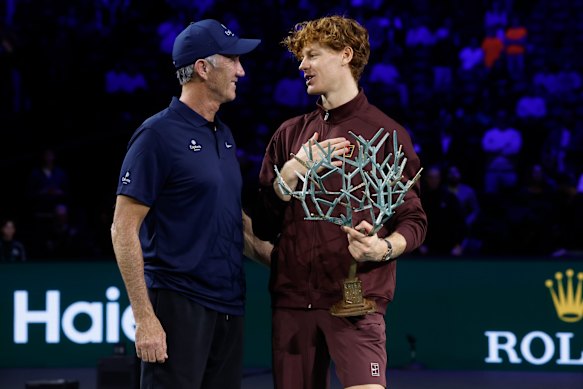
“I feel very, very lucky and happy to be his last player on tour,” says Jannik Sinner (with Cahill at last year’s Paris Masters).Credit: Getty Images
His stature, success and philosophy undeniably influenced his son’s coaching, too. “It starts with work ethic,” Cahill told The Sydney Morning Herald and The Age, shortly after Sinner won the first of his back-to-back Australian Open titles in 2024. “Dad also taught me that no one in the team is more important than anyone else – something that has more application in tennis entourages now than ever before – and that communication is very important.”
Cahill wasn’t entirely lost to footy, serving on Port Adelaide’s board from 2018-23, but he opted to pursue tennis mainly because he was better at it, although also, in part, to avoid the pressure of following in his father’s footsteps. Cahill snr is a sprightly 85 years old these days, and remains immensely proud of his son’s achievements, as both a player and coach, and the humble and respectful way he does his business. But he takes no credit for Cahill’s tennis accomplishments, revealing that they rarely discussed the art of coaching.
“He’s his own man, and has always trusted his instincts,” Cahill snr says. “I’ve always had belief in Darren; in his ability to work hard, stay committed, and do things the right way. From early on, I told him, ‘Don’t overthink it, don’t take pressure – go with your gut and trust your instincts.’ One of Darren’s real strengths has always been his ability to spot talent and see potential in people; to recognise not just where a player is, but where they can go.”
That talent-spotting ability was helpful soon after his playing career ended, after returning home to Adelaide. As Cahill puts it, a knock on the door from Hewitt set him on the path to be a tennis coach. He first met a 12-year-old Hewitt when he was 28, having known the future champion’s father, Glynn, a well-known footballer in South Australia. But it was not until five years later, in 1998, that Cahill began coaching Hewitt.
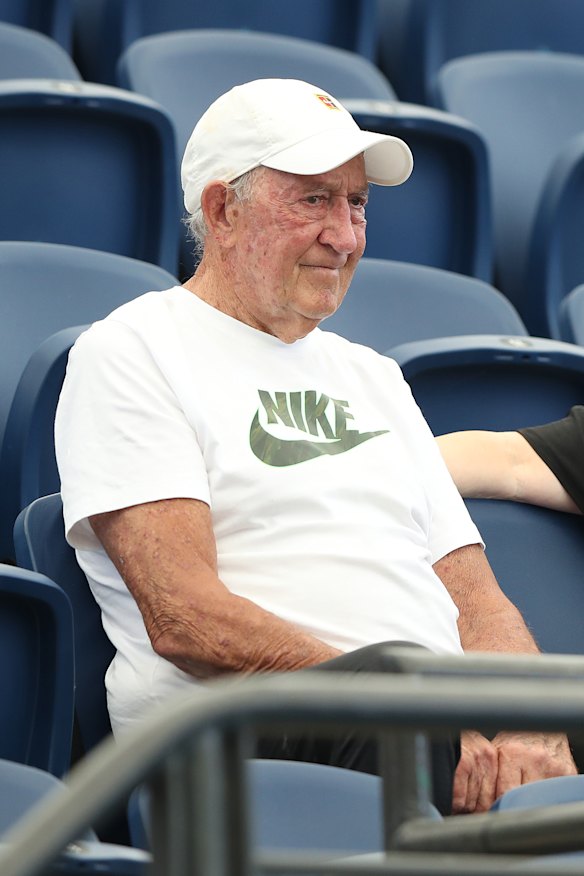
Cahill’s father, AFL legend Jack Cahill.Credit: Getty Images
“We related incredibly well to preparing for matches and going out there and giving it everything, leaving nothing on the pitch, leaving no stone unturned,” Cahill told The Sydney Morning Herald and The Age in 2024. “My job with him was to teach him how to play what shot from what part of the court; how to break down opponents, how to find weaknesses, how to utilise your strengths. And with that approach, he won the [2001] US Open. He was a player who could always find an extra gear, and the bigger the match, the more gears he could find.”
Loading
Hewitt upset Pete Sampras in that final, and soon after became the then-youngest No. 1 in ATP Tour history. The Cahill-Hewitt union ended a month later, but it wasn’t long before other players started calling. Russian firebrand and 2005 Australian Open winner Marat Safin was close to securing Cahill’s services until Agassi intervened. The latter was about to turn 32 and looking for a new coach after parting ways with Brad Gilbert, his coach of eight years. Cahill informed the American he was a fair way down the road with Safin – but didn’t actually say no before they each hung up the phone. Agassi rang him back 10 minutes later, and “threw the kitchen sink at him”. There were two compelling selling points: Agassi told Cahill he intended to do everything possible to scale the tennis world again and that the Australian could bring his young family along for the ride.
“I don’t think Lleyton ever made a bad decision on the court in his tennis career,” Agassi says. “His shot selection, in my opinion, was as good as anyone who played the game … [but] the first thing that made me want to call Darren was I knew he had been to the top with somebody who he had basically worked with from a child – you had to respect it.”
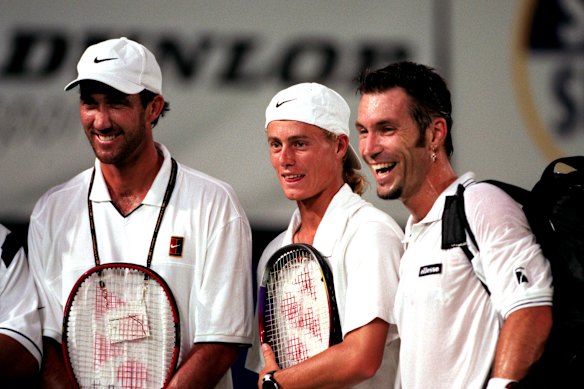
Darren Cahill with Lleyton Hewitt and Pat Cash before a charity match.Credit: PA Images via Getty Images
Cahill’s wife, Victoria, initially thought her husband was mad for picking Agassi over the far younger and richly talented Safin. But remember what Cahill’s dad said about him seeing people’s potential?
Cahill agreed to a trial period that started in February 2002 and eventually became permanent. Their partnership ended only when Agassi retired after losing his third-round match at the 2006 US Open – but not before he returned to No. 1 and claimed his eighth grand slam title at the 2003 Australian Open. In true Cahill style, he believes Agassi taught him more about coaching than vice versa.
Their impenetrable bond extended beyond the court, including the time their respective families spent with one another. Agassi and Cahill would even stage friendly competitions when their sons – Jaden and Ben, respectively – were still bottle-feeding, to see which of them finished their milk first.
“Darren lives with such a beautiful balance between his head and his heart,” Agassi says. “When I look at him as a person, a father, a friend, and a coach, I see somebody who lives that delicate balance that is so required to live a life that is full on all fronts.”
Cahill’s next move was to join Adidas’s player development program, where he worked at various stages with the likes of Andy Murray, Ana Ivanovic, Fernando Verdasco, Daniela Hantuchova and any number of promising juniors. But it was the last player he worked with at Adidas who became a significant part of his journey: Simona Halep.
Halep split with her then-coach Wim Fissette in November 2014 and worked with Cahill in the interim before announcing a year later that they were officially joining forces. It was the start of another brilliant collaboration. Halep was already an outstanding player, evidenced by reaching the Roland-Garros final the previous year. But she went to a new level with Cahill, reaching No. 1 and claiming her maiden major title on Parisian clay in 2018.
“I knew from the first days he’d be perfect for me; we had a great connection,” Halep tells Good Weekend. “He helped me open up as a person first, then he brought that little extra I needed to become No. 1 and win a slam. I trusted him 100 per cent – and I’m happy I did. He knew how to handle me, how to talk to me, when to be tough, when to give me credit. He has great qualities that can turn a player into a champion.”
Cahill approached the early weeks with Halep in similar fashion to how he did with Agassi, preferring to simply learn from and listen to Halep, rather than forcing his ideas upon her. He also made an impression when, after a particularly tough loss early in their association, he told Halep she had nothing to prove to anyone but herself.
“It was simple but powerful, and it completely changed my perspective. That’s Darren: always calm, thoughtful and able to say exactly what you need to hear at the right moment,” Halep says. “The player is always his priority; he adapts himself to them. He doesn’t come in saying, ‘These are my rules, and you have to follow them.’ No, he listens, and at this level, that’s the most important thing.”
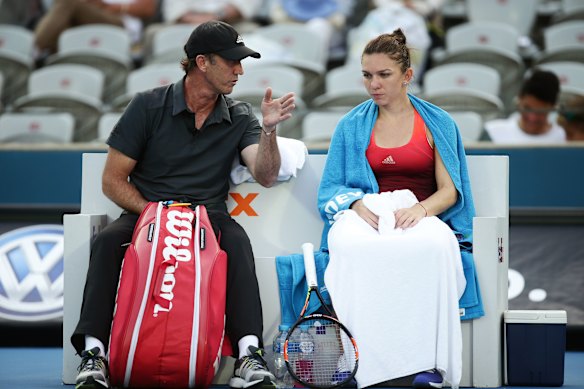
Cahill with Romania’s Simona Halep. “He helped me open up as a person,” she says.Credit: Getty Images
That knack for saying the right thing was precisely what Sinner needed after his heartbreaking five-set Roland-Garros final defeat to Alcaraz last year, after having three championship points. Cahill and the rest of Sinner’s team said little to the tall Italian in the immediate aftermath, offering only their empathy, a hug and even shedding a few tears together as they absorbed the disappointment in an emotional 20-minute period in the locker room. They let him know they were proud of him, too. In Cahill’s own words, on Roddick’s Served podcast: “That’s not the perfect time to give him a speech about what we can learn from it.”
Cahill joined the Sinner camp in mid-2022 with a specific job description: to work on Sinner’s mental and emotional wellbeing, and relay his extensive experience in various situations. Co-coach Vagnozzi’s primary focus is the technical and tactical part of the game. It was unsurprising, then, that Cahill rather than Vagnozzi accompanied Sinner to Halle, in his first tournament after the Alcaraz loss in Paris.
Loading
“My role with Jannik is a little bit different to the other coaching roles that I’ve had, and 99 per cent of the credit for the coaching goes to Simone. He’s done an incredible job with Jannik,” Cahill said of the team dynamics ahead of the 2024 Australian Open final. “I’m more overseeing everything. Certainly, we discuss tactics and the technical [side] and everything, but Simone is the voice. He’s the guy driving a lot of what you see in the improvements of Jannik.”
When Sinner went on to claim his maiden slam title from a two-set deficit against Daniil Medvedev two nights later, Cahill quietly stepped aside and let Sinner’s mostly Italian team celebrate with him first. It was par for the course for a man beloved across the tennis globe.
At some stage, not even Sinner will be able to convince Cahill to keep extending his career, but he has already achieved what most can only dream of doing. The people who know him best will tell you it’s no coincidence, either.
Get the best of Good Weekend delivered to your inbox every Saturday morning. Sign up for our newsletter.