
 2 months ago
59
2 months ago
59
Higher calling
By Katrina Lobley
Sometimes I pretend to be the outdoorsy type. So when I’m asked if I want to go trekking in Nepal, my fingers type “Yes” as my head says “Are you crazy?”
My fitness isn’t the best. I have an aversion to Gore-Tex and gaiters and sweat-wicking socks. And I really don’t enjoy schlepping, especially uphill. Yet here I am, disembarking at Lukla’s Tenzing-Hillary Airport (the mountainside runway regarded as the world’s most dangerous), boots laced and ready (well not exactly ready, the training was non-existent) to tackle those challenging high-altitude trails. Yikes.
Or more like, yaks. If they can do it, so can I. The lumbering shaggy beasts are carrying loads that put pretenders like me to shame; fully laden Sherpas are also practically sprinting up the forest-shaded path towards the bustling trekking hub of Namche Bazaar, 3440 metres above sea level.
Between gasping lungfuls of thin but crisp mountain air, I marvel at the physical prowess on display around me (did I mention my group includes 10-year-old twins who are bounding along like Himalayan musk deer?). Each time I pause to catch my breath, I also catch myself contemplating the Big Question: what brought me here? Certainly, there are delights and distractions along the way, such as mantra-inscribed Mani stones – a source of comfort to Buddhists – prayer wheels and ramshackle teahouses.
My question is finally answered when, out of the blue, our guide points through a gap in the vegetation to a distant peak. “Mount Everest,” he says. The summit of the world’s highest mountain in itself isn’t as remarkable as you might imagine, almost blending in with its lofty neighbours. Yet the sight represents something gargantuan to me. It’s a place I always imagined was out of my reach; now here it is, practically at my fingertips. I’m unexpectedly emotional.
Sign up for the Traveller Deals newsletter
Get exclusive travel deals delivered straight to your inbox. Sign up now.
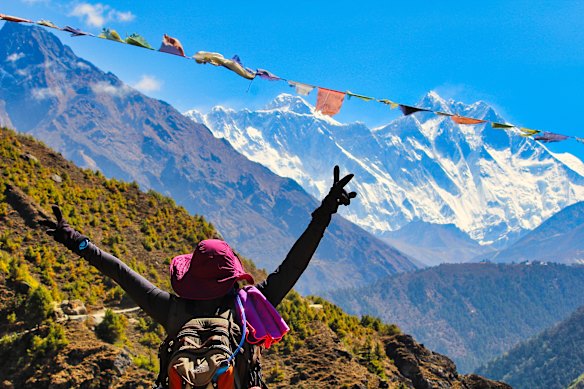
Imagining this will be the only time I see Everest in my lifetime, I sear its silhouette into my memory, hoping it won’t fade with age. The other thing that’s stuck with me is the kindness of our guides: one day, as I straggle and struggle through sleet and wind, I give up on my dripping nose. Noticing, my guide wipes the drip with his finger. Now that’s going above and beyond – it’s the definition of peak performance.
Details
World Expeditions offers an introductory-level, 12-day Everest trek, from $4090 a person.
See worldexpeditions.com
The writer travelled as a guest of Aurora Expeditions.
Australia, but not as you know it
By Andrew Bain
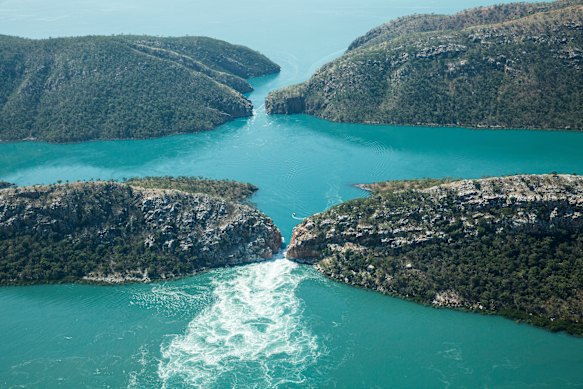
Part of the enduring and beautiful mystery of Western Australia’s Kimberley region is that so few people have seen much of its vast coastline. Roads reach the shores only around Broome, Derby and Wyndham, leaving more than 13,000 kilometres of coastline accessible only by ship.
To see this coast most intimately means to come on an expedition cruise, with days largely spent ashore or along the waterways that vein the coast. I’ve cruised in Alaska, Greenland, Iceland and Norway, and a Silversea expedition cruise along this coastline close to home remains the most memorable of all.
Travelling between Broome and Darwin, it’s a glimpse at an Australia I barely knew existed. Tidal ranges around Derby are among the largest in the world – up to about 12 metres – creating phenomena such as the Horizontal Falls, when up to one million litres of ocean sucks through a narrow break in the land every second. But anchored in Talbot Bay, just offshore from the Horizontal Falls, it’s the tawny nurse sharks that swim about exploring the ship that seem most captivating. Another day, riding the tender ashore at Raft Point, we’re halted for a time by the most unusual of traffic jams – a crocodile patrolling the beach.
Experiences along this coast are as singular as they are superb. In the King George River, King George Falls thunder over red cliffs in a wide wishbone of water. There’s the chance to scale the cliffs for a swim in the crocodile-free waters above the falls before the tender operators inevitably begin the trip back to the ship by nosing their Zodiacs into the waterfall, letting the water pummel us like a sports masseuse.
And even if you could somehow reach parts of this coast by land, there’d still be no other way to access a place like Montgomery Reef than by ship. At high tide, the reef that Sir David Attenborough has described as “one of the greatest natural wonders of the world” sits hidden below the Indian Ocean. At low tide, around 400 square kilometres of reef emerges like a benign sea monster, complete with deep water channels through which the ship’s tenders can explore.
For much of the time along this coast, it feels almost as though humanity is absent, but there are intermittent reminders, such as the wreck of a WWII C-53 plane or, most memorably, the Wandjina Aboriginal art that decorates caves and rock overhangs along the coast.
It’s Australia, but not as you might know it.
Details Silversea operates 10-day expedition cruises between Broome and Darwin, with prices starting at $17,400. See silversea.com
In from the cold, Antarctica
By Kristie Kellahan

The first time I’m invited to visit Antarctica, I refuse. It’s too cold, too far and too dangerous. I’d heard that cruise passengers sometimes had to be strapped into their beds while crossing the infamous Drake Passage, and that rough swells could cause heinous seasickness.
“I’m not brave enough,” I tell my editor. “Send someone more adventurous. I’d rather go to Paris.”
He wisely advises me to sleep on it. “I really think you should go,” he says the next morning. “It’s the trip of a lifetime.”
He’s right, of course. I finally agree, but with trepidation. My suitcase stuffed with merino wool layers and enough Kwells to bring down a giraffe, I fly to Buenos Aires and then on to Ushuaia, the southernmost city in the world.
I board a ship equipped with a hot tub, a sauna and a plentiful supply of steak and wine, luxuries of modern Antarctic travel that intrepid early explorers could only dream about.
It takes a couple of days to cross the Drake Passage; it’s so calm, it is more like the Drake Lake.
An announcement on the PA tells me we have arrived at the whitest, driest, coldest continent in the world. It feels momentous, a travel memory never to be forgotten.
Pulling back the curtain in my stateroom and staring through the porthole on that first morning, it’s a stunning vision of ice-blue glaciers, snow-capped mountains, and hundreds of gentoo penguins.
It’s unlike anything I have ever seen before. Most places we travel to have some semblance of familiarity, or at least enough to use one as a point of reference for the other: South Korea is hyped as the new Japan; people suggest the Albanian Riviera if you’re priced out of a Greek Islands holiday.
But nothing compares to this spectacularly wild continent, where you are truly a guest in nature’s cathedral.
The second time I’m invited to Antarctica – almost 15 years after that first voyage – it’s to experience Viking’s Polaris expedition ship, an ultra-luxury vessel that doubles as a science laboratory. This time, I don’t hesitate to say yes.
It’s an extraordinary ship, a floating cocoon of contentment where the bathrooms have underfloor heating, the spa rivals the best you’d find on land and the lobster tails never run out.
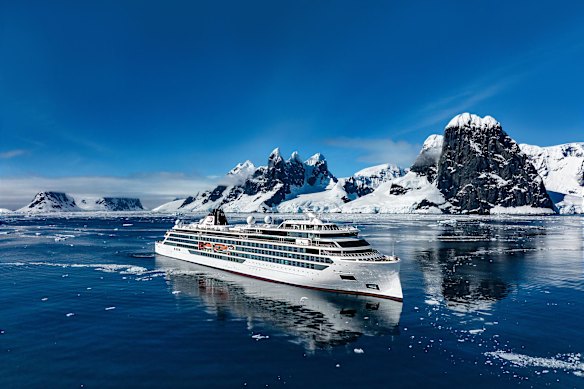
In addition to 189 luxurious staterooms (each equipped with a pair of binoculars), the ship carries two yellow submarines, Special Ops Boats, science research labs, and a prestigious roster of expert academics in fields of study ranging from plankton to glaciology and cetology (whales, dolphins and porpoises).
By day, I zip around in Zodiac inflatable boats to visit penguin colonies and track whales with the sort of focus normally applied to tracking down impossible-to-get restaurant reservations. By night, I revel in a historian’s tall tales of the heroic age of Antarctic exploration, and savour the finest wines.
It’s an incredible privilege; it’s estimated that less than 0.01 per cent of the world’s population has made the trip to Antarctica, and few in such grand style. Truly, a trip I’ll cherish forever.
Details Viking’s 13-day Antarctic Explorer voyage costs from $18,345 a person in a Nordic Balcony Stateroom. See vikingcruises.com.au. The writer was a guest of Viking.
Breaking the ice (Greenland)
by Lee Tulloch
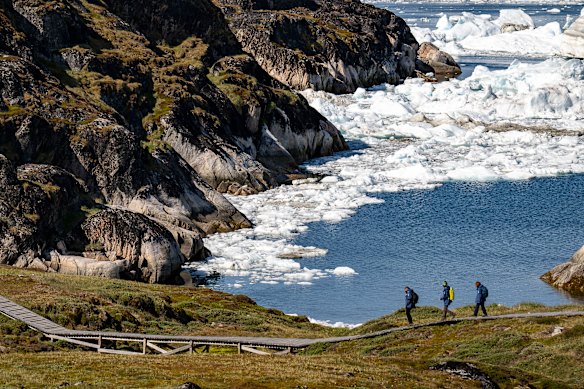
In my wildest imagination I didn’t see myself in a shed near the North Pole learning how to skin a seal. But that was just one indelible moment of many on a 14-day cruise to Greenland and the remotest communities on Earth, aboard HX Expeditions’ beautiful vessel Fridtjof Nansen.
Greenland itineraries are now big business for the world’s cruise lines, for good reason. The landscape of icebergs as they calve off ancient glaciers is awesome in the truest sense of the word. But few ships have the capacity to go as far north as this one. We reached Sioropaluk, Greenland’s northernmost inhabited civilian settlement, and the world’s most northerly Inuit community, which has a population of only 34.
What made the cruise exceptional was the community of Greenlanders who accompanied us on the voyage and facilitated our meetings with their families and communities, notably Aleqatsiaq Peary (Aleq), HX Expeditions’ cultural ambassador for Greenland, who is part of a family of great hunters from Qaanaaq, a major northern settlement.
Through them, I came away from the cruise enlightened, with a precious understanding of and empathy for the people of the ice, their traditional hunting culture and their determination to continue to live this way despite threats on many sides, from colonialism and climate change to an American president’s territorial ambitions.
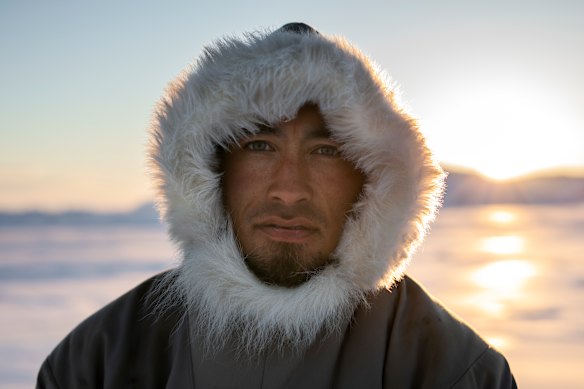
We were immersed in Greenland’s history, culture and ecosystems with a profoundness that was beyond anything I’ve experienced on any other cruise or tour. Greenlanders believe that controlled, low-impact tourism combined with warm cultural exchanges helps keep their traditions alive. HX, with its fully hybrid expedition ship, approached the local community and natural environment with great respect.
Our arrivals on shore were always staggered so as not to overwhelm the locals, who were genuinely delighted to see us, offered us morning tea, introduced us to their sled dogs and even played soccer with us.
I loved every aspect of it: the opportunity to go out on Zodiacs with scientists on their daily research trips and hang out with them in the onboard laboratory; the program of lectures on everything from bird life to growing up on a US military base; the culinary dive into Greenlandic cooking and produce, designed in partnership with Greenland’s most celebrated chef, Inunnguaq Hegelund.
I didn’t become an instant expert on wielding the ulu, the traditional curved blade the Greenlandic Inuit use to cut fat from a seal’s pelt, but I did depart the voyage with the strongest connection I’ve ever felt to the people who so graciously hosted me.
Details
HX Expeditions Grand Greenland Cruise: Mythical Lands of the North departs in 2027 on July 13–29 and July 27–August 12. From $18,490 a person. See travelhx.com/en-au
The writer was a guest of HX Expeditions.
Another green world
By Catherine Marshall
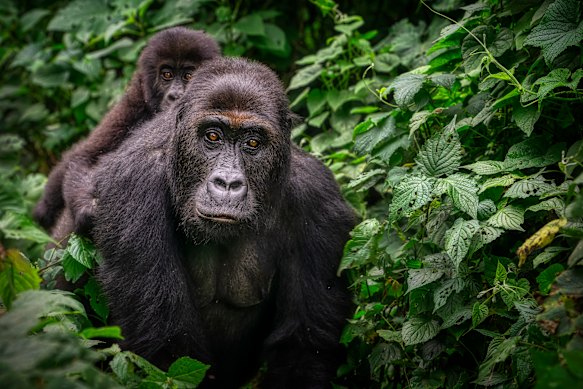
The journey I’m unlikely to ever repeat is one I’d take again at the drop of a (rain) hat, if only I were presented with the opportunity. Central Africa’s Congo Basin is not your everyday destination. Sprawled across the continent’s belly, it’s a largely uninhabited expanse covered by the world’s second-largest tropical rainforest and fed by the Congo River and its manifold tributaries.
A blank space on the map, it’s remote both physically and psychologically: travel to and from is laborious; foreign assumptions and noves like Joseph Conrad’s Heart of Darkness conjure a forbidding environment; too often, the fraught Democratic Republic of Congo is the only recognisable nation in a basin straddled by myriad countries.
But the challenging of stereotypes is fundamental to travel. Departing Sydney, I take a three-leg flight to Brazzaville in the relatively peaceful Republic of Congo, and a bush plane to Odzala-Kokoua National Park in the country’s north. A muddy road tunnels through the thickets to Ngaga Camp, a few hours’ drive away.
Cloistered within millions of hectares of rainforest, I feel adrift and insignificant. Herein lies the catalyst: if the trip of a lifetime is by definition so life-changing it can never be replicated, then this vast and inscrutable greenbelt is the foundation stone for a transformative journey.
I’ve stepped out of my comfort zone – but only in the intellectual sense. Ngaga is luxe, an oasis enfolded by foliage and showered with warm, silvery rain. Meals are superlative, sleep easy in my stilted hut. All night long the forest hums a lullaby.
At dawn, I follow African Parks eco-monitor Dieudonne Bocka and tracker Zepherin Okoko through forests towards the indistinct snort of western lowland gorillas. I’m both grounded and exalted as a silverback crosses our path and pauses to look at me. His dignity and kinship score my soul.
But it’s the people who change me: Bocka, whose parents and grandparents extracted salt from the bais (pans) mottling the clearings; Okoko, who can detect the distant scent of gorillas and a faraway forest elephant’s footfall; the staff at Ngaga, who live on the park’s fringes and make their living as its custodians. They turn my stay into a singular journey by flooding that blank space on the map with radiant light and vanquishing the ghost of past assumptions.
The writer travelled as a guest of the Classic Safari Company.
The details
The Classic Safari Company’s 9-night Odzala Discovery with Kamba trip costs from $21,300 and includes seven nights in Odzala and two nights in Brazzaville, visas, charter transfers and park, community and conservancy fees. See classicsafaricompany.com.au
My Trip of a Lifetime (Ethiopia)
by Sue Williams
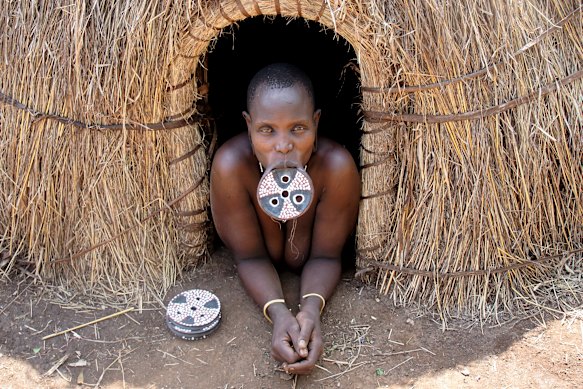
Never before have I met people so startlingly different to me – and never since.
The men have faces streaked with white clay, ears stretched long to fit ornate handmade jewellery, incredibly elaborate headdresses of bones and beads and fruit, raised patterns of scars on their arms and shoulders, and tiny scraps of bark cloth for modesty.
Their women, however, are not to be outdone. Many have an optional extra: a large terracotta plate inserted into their lower lip, stretched massively from adolescence.
But, fair’s fair, the people of the Mursi tribe of southern Ethiopia are equally bewildered by me.
They touch my blonde hair, finger my (regular) earlobes, giggle at my everyday traveller clothing and roar with laughter when my well-padded western rump becomes wedged in the tiny opening to one of their wood and mud huts. It’s an absolutely equitable exchange of cultural wonder.
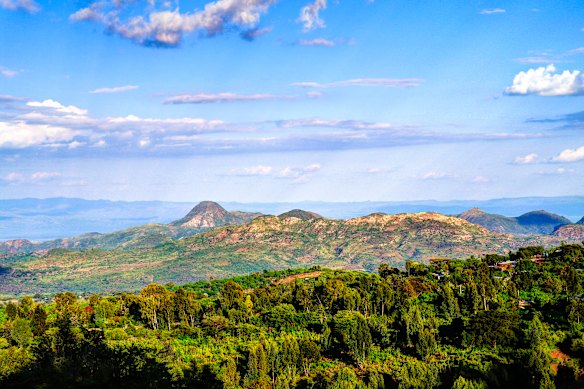
Visiting the east African nation of Ethiopia, in nearly 50 years of criss-crossing the globe, was my personal trip of a lifetime. As one of only two African nations never colonised by the west, and proudly idiosyncratic, with a riveting history tracking all the way back to the Queen of Sheba, and more recently to the ‘King of Kings’ Haile Selassie, it sets the bar high on travel thrills.
Physically, it’s simply stunning. The Great Rift Valley creates magnificent mountains, gorges and valleys through the length of the country, giving Ethiopia its nickname, ‘The Roof of Africa’, while the Blue Nile idles through verdant pastures.
The people are the main show, though, encompassing Christians, Muslims and Animists.
In the north, where the capital Addis Ababa lies – also the home of the landmark fistula hospital started in 1974 by Australian doctors Catherine and Reg Hamlin – they’re mostly members of the Ethiopian Orthodox Church which began at the dawn of Christianity. There’s a vast number of striking World Heritage-protected rock-hewn churches from the 11th and 12 Centuries to see, as well as monasteries, mediaeval forts, burial chambers and palaces
In the less developed south, meanwhile, the population is divided into no fewer than 80 different ethnic groups, many of whom are captivating in their dress, body decorations and customs.
Dancing with some of the elderly women of the Mursi, having kids run up to hold your hand as you walk around the village and conducting conversations in sign language with the men and finding common ground … It’s those kinds of brief encounters that make travel to Ethiopia, my favourite destination on earth, so stunningly memorable, rich and rewarding.
The details
Tour Ethiopia with companies like Forward Travel or World Expeditions. Forward has trips visiting the wildlife and tribes of Ethiopia for 13 days from $6,830 a person twin-share, forwardtravel.com.au, while World Expeditions has a special 12-day southern Ethiopia trip from $5,290 a person, with some fundraising involved for the Hamlin organisation. See worldexpeditions.com

















































