3 months ago
16
3 months ago
16
The government planned to build 1500 homes in Sydney – so why did it quietly quit the projects?
The state government’s own development agency has quietly abandoned plans to build up to 1500 homes on Sydney’s western fringes, admitting the projects were no longer commercially feasible.
Landcom, a NSW government-owned business responsible for developing land across the state for new homes, had since 2021 been planning housing projects for Tallawong and Rooty Hill in the north-west and Austral in the south-west. But, in December, all information on the projects disappeared from Landcom’s website, with the developer posting one final update: “Development not proceeding.”
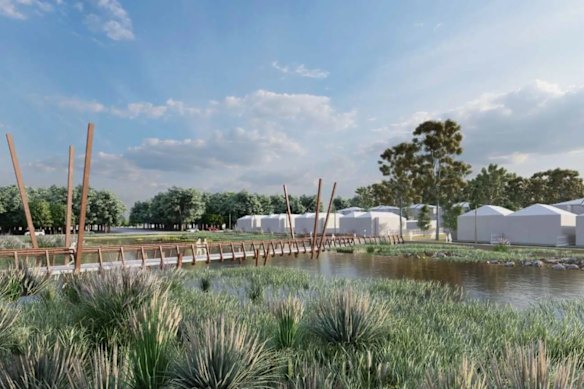
An artist’s impression of the planned housing development in Austral that Landcom has now abandoned.Credit: Landcom
After “technical investigations and feasibility assessments”, Landcom said in its update that it had decided to “instead focus on opportunities at other sites in metropolitan Sydney and regional NSW that can support the NSW government’s housing agenda”.
Its decision not to proceed with the large-scale low-density housing projects highlights the growing difficulties developers are facing when building in western Sydney. It underscores a central irony of the government developer’s task to build homes in areas that require more housing and to make a profit on them. Often, the reason those areas have a limited housing supply is that developers don’t build there because they cannot make a profit from it.
The ditched projects were all in the early planning stages: a development application for the subdivision of the Rooty Hill project was expected to be lodged with Blacktown City Council in late 2025 for construction to begin in 2026, but it was never submitted. The project would have delivered 300 to 500 homes opposite the Blacktown International Sports Park.
The Tallawong development off Guntawong Road began as a 2022 development application to Blacktown council to create five “superlots”, but it was withdrawn shortly after. According to the timeline on an archived version of the project’s webpage, Landcom planned to submit a new development application to Blacktown council and begin selling housing lots by the end of 2025. Neither occurred.
As recently as October 2025, Landcom was championing its 38-hectare Austral site as a future “benchmark for a sustainable, highly liveable neighbourhood”. The 334-home proposal received development approval in 2023 and an archived version of the Landcom website said that construction and landscaping works would continue throughout 2025, pending further approvals. But just two months later, the project was scrapped.
Despite the projects no longer proceeding, Landcom says it remains committed to western Sydney, with a total of 17 projects scheduled for delivery over the next 20 years.
“Landcom has been stepping up its activities to support housing supply targets through a diverse and extensive portfolio of projects in western Sydney and across NSW,” a spokesperson said. “Our current pipeline in western Sydney alone includes more than $3 billion investment in projects delivering more than 30,000 homes over the lifetime of our developments.”
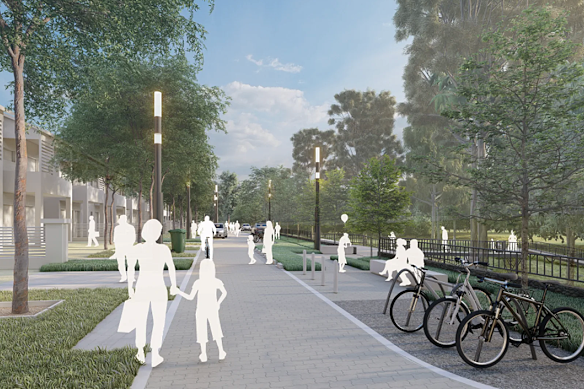
The Tallawong development would have delivered about 700 homes.Credit: Landcom
Planning Minister Paul Scully did not answer questions about the feasibility of development in western Sydney. A government spokesperson said Landcom played “a critical role” in housing delivery.
Concerns about western Sydney development grow
Landcom joins a string of developers that have recently found it difficult to build in parts of Sydney’s west. In 2025, the Herald revealed western Sydney developers had begun steering towards the city’s north shore and eastern suburbs, citing high material and labour costs, increasing government levies and taxes, and planning delays.
“It confirms what the industry’s been saying for some time: that building in outer ring suburbs is incredibly difficult,” said Ross Grove, the western Sydney regional director for the Property Council of Australia, of which Landcom is a member. “The maths just isn’t mathing.”
Grove said lenders for new developments typically aimed to recover 18-20 per cent of the cost of projects in profit. But the profit margins quickly become “wafer thin” when there are delays due to weather and in the planning system, or interest rates fall.
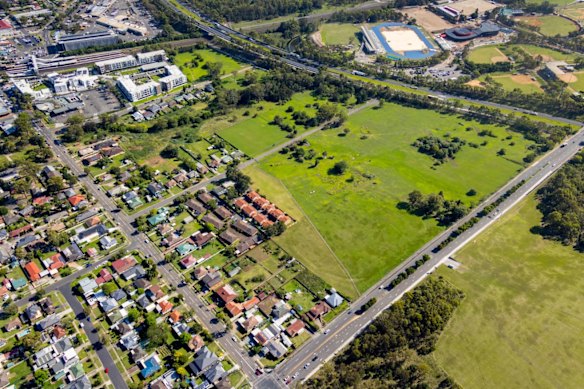
The Rooty Hill site where Landcom had planned to build up to 500 homes.Credit: Landcom
“Businesses make prudent decisions to reallocate their resources to regions that can provide that buffer,” he said, adding that large chunks of western Sydney did not meet the criteria for “attractive propositions” for development.
“That’s why you’re seeing a lot of our members, western Sydney developers, looking at places like Crows Nest and some TOD [transport oriented development] release areas. They know they can make a profit with that buffer.”
Loading
Last year, developer ALAND, which has historically focused on building in the west, shifted east.
“It is disheartening that I’ve had to move away from where our bread and butter has been,” its founder, Andrew Hrsto, told the Australian Financial Review.
“We’re moving close to the city, we’re looking at where the sales are higher, so we’ve got a half a chance of making some money. [We’ve] still got works in progress, but just going forward, we just can’t keep doing it. It’s just too hard.”
The Sydney Morning Herald has a bureau in the heart of Parramatta. Email [email protected] with news tips.
Most Viewed in National
Loading