3 months ago
37
3 months ago
37
Solving the Jannik Sinner riddle is far from just an Alex de Minaur problem.
Besides Carlos Alcaraz, Sinner routinely defeated everyone else in recent times, including winning 131 matches and losing only 12 in the past two years. Alcaraz was responsible for seven of those defeats.
However, de Minaur’s 0-13 head-to-head record against Sinner has become a gorilla on his back during his impressive rise into the top 10, and as he increasingly ventures to the latter stages of grand slams.
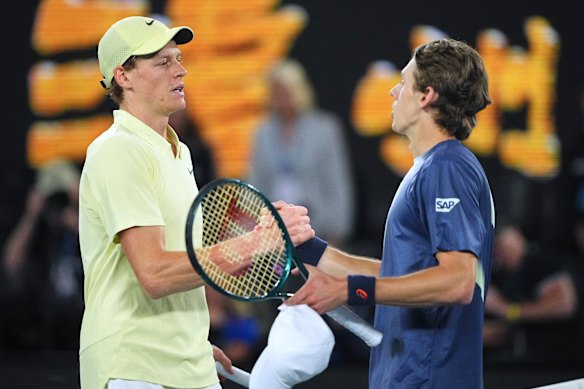
Sinner and de Minaur at last year’s Australian Open.Credit: AP
It was Sinner who put a brutal ending to the local hero’s career-best Australian Open run to the quarter-finals last year. De Minaur was frank after winning only six games against the dual Melbourne Park champion: “He’s probably my worst match-up.”
The positive is de Minaur will not face Sinner for a 14th time unless they both advance to this year’s final, a scenario that Australians are desperate for, given 50 years have passed since Mark Edmondson’s triumph in 1976.
ATP coach and analyst Craig O’Shannessy believes the only way de Minaur can turn the tables on Sinner is by getting uncomfortable – and he urged the world No.6 to use Alcaraz’s US Open final strategy against the Italian as his blueprint.
“What you’re trying to do against Sinner is not give him the ball that he wants, and not give him the same ball all the time,” O’Shannessy told this masthead.
“The whole key in the US Open final was variety – a lot of slice backhands, but hit in a way where the rotation on the ball was more than normal, and the speed on the ball was less than normal. By the time it reaches the other side; it’s going very slowly, and gives Sinner nothing to use back at him.
“The other thing we saw [Alcaraz do] was hitting high-rolling forehands – three or four racquet lengths above the net – to get the ball out of his strike zone, and again, not giving him something he can step into.”
We dived into the de Minaur-Sinner match-ups to uncover the themes and see how the Australian’s tactics have evolved, with the help of advanced statistics from Tennis Australia’s game analysis team, the ATP Tour and Tennis Abstract.
Blunting Demon’s strength
De Minaur’s combined performance across several metrics ranks him as the sixth-best returner on the ATP Tour across the past year, but he was previously No.1.
The 26-year-old has remarkable hand-eye coordination and reflexes, which enable him to stand close to, or inside, the baseline to return serves and subsequently rush his opponents.
Sinner is now top of the returning charts, but also No.1 in serving and pressure situations, which explains why de Minaur (and basically everyone else) has so much trouble with him. He is as complete a player as anyone not named Novak Djokovic.
On career statistics, only Lleyton Hewitt among Australian men can claim to be a better returner than de Minaur.
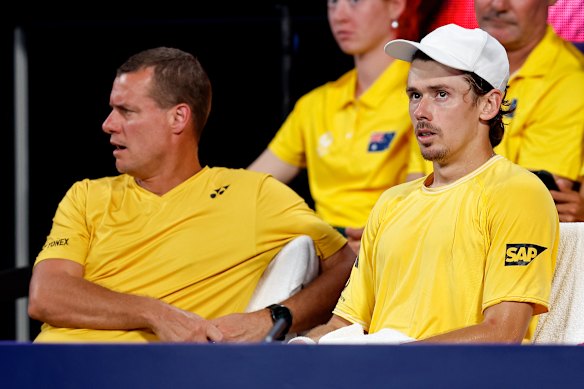
Lleyton Hewitt and de Minaur at the United Cup earlier this month.Credit: Getty Images
The former world No.1 edges de Minaur out in first-serve return points won (32.1 per cent to 31.7), second-serve return points won (53.7 to 52.7), break points converted (43.2 to 42.6) and return games won (29.9 to 27).
But Sinner’s considerable improvement on serve – long heralded as a key part of his ascension into a four-time grand slam champion – holds up against de Minaur’s elite returning skills.
The Italian’s serving numbers in match-ups with de Minaur are only slightly down compared to his performance across the past year against everyone, including first-serve points won (78.1 per cent to 79.4), second-serve points won (54.3 to 59.1) and hold percentage (90.8 to 92).
De Minaur has shown a willingness to vary his return position across their clashes in the past two years.
In their Beijing showdown in September, the Aussie stood way inside the baseline to return Sinner’s second serves, with the world No.2 winning only 45.7 per cent of those points.
Attacking Demon’s serve
Where de Minaur struggles most against Sinner is holding serve.
It is the part of de Minaur’s arsenal that draws most opinions and criticism, with Australian greats Pat Cash, Todd Woodbridge and Mark Philippoussis among those having their say.
He holds serve only 61.5 per cent of the time against Sinner, compared to 84.5 per cent against the tour across the past 52 weeks. Sinner has a knack for breaking de Minaur early in sets, too, as he did in their Australian Open contest last year, which makes it difficult for the Aussie to build pressure the other way.
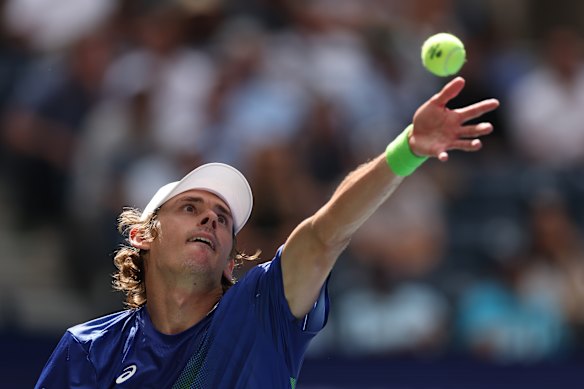
De Minaur struggles with his serve against Sinner.Credit: Getty Images
That number was only 56 per cent in the aforementioned Beijing clash, even while pinching the middle set, whereas Sinner went at 82 per cent – and did not dip below 74 in any of their four matches in 2025.
De Minaur sacrificed a higher first-serve percentage in the past few years, hunting for more power and cheap points, but is among the least-accurate servers and below tour average for unreturned serves. He was equal-98th on the latter metric at Wimbledon last year.
Why rally length matters
Sinner is the master at ending points early, a skill that holds true when he plays de Minaur.
That at least partly owes to him hitting roughly 10km/h harder than de Minaur on both wings, but the spin advantage is even greater: the gap is about 1200 revolutions per minute between their forehands and about 900 on their backhands.
Zeroing in on their past three matches tells the story: Sinner won 202 of the 345 points (59 per cent) on rallies lasting fewer than nine shots, but was only 42-40 ahead when the exchanges went beyond that.
That says plenty about how good de Minaur is, but the problem is those shorter points are what win tennis matches because there are so many more of them.
This fact was rammed home in their Beijing clash, where Sinner won 68/113 of the rallies lasting four shots or fewer. De Minaur claimed 16/30 of the five-to-eight-shot rallies, and they split the even longer ones (15/30) – but there were almost double as many zero-to-four-shot rallies compared to the rest.
What de Minaur has tried
The Australian snatched a set off Sinner for just the second time in the Beijing semi-finals in late September, after which the Italian said it was “a different match than usual against him”.
Sinner beat de Minaur 6-3, 4-6, 6-2, but conceded afterwards that it was a close match and his rival created more chances in the second set.
Data reveals that de Minaur used his backhand slice more often – 28 per cent of the time, at least four per cent higher than in any of their other matches – to try and disrupt Sinner’s rhythm and keep him off-balance.
For comparison’s sake, de Minaur used his backhand slice only 16 per cent of the time in all matches across the past year, and the tour average is 19, so it was a clear tactic against Sinner. That was also successful for Alcaraz in the US Open final that O’Shannessy referenced.
De Minaur typically went out wide on both sides with his first serve, and crucially landed 68 per cent of them in the second set while winning 65 per cent of those points, up from his average of 61.9 against Sinner.
Loading
The other key tactical approach, which paid off particularly in the second set, was to step well inside the baseline to receive Sinner’s second serve. The Italian won only four of his 14 second-serve points in that set.
Worth noting, too, is that only once in de Minaur’s past six face-offs with Sinner on hardcourt – in Toronto – did he dip below his ATP performance rating, which combines the “In attack”, “conversion”, “steal” and “shot quality” data into one metric.
That tells us de Minaur is playing at a high level against Sinner. The issue is that he is coming up against a player bound to go down as an all-time great.
Follow our live Australian Open blog each day from January 18 for results, news, analysis and interviews.
News, results and expert analysis from the weekend of sport sent every Monday. Sign up for our Sport newsletter.