3 months ago
24
3 months ago
24
Opinion
January 14, 2026 — 7.00pm
January 14, 2026 — 7.00pm
Leonard Stretton, a County Court judge renowned for his lyrical turn of phrase, described with evocative imagery Victoria’s dangerously parched landscape in the days leading up to the Black Friday fires of 1939.
“The rich plains, denied their beneficent rains, lay bare and baking; and the forests, from the foothills to the alpine heights, were tinder. The soft carpet of the forest floor was gone; the bone-dry litter crackled underfoot; dry heat and hot dry winds worked upon a land already dry, to suck from it the last, least drop of moisture.”
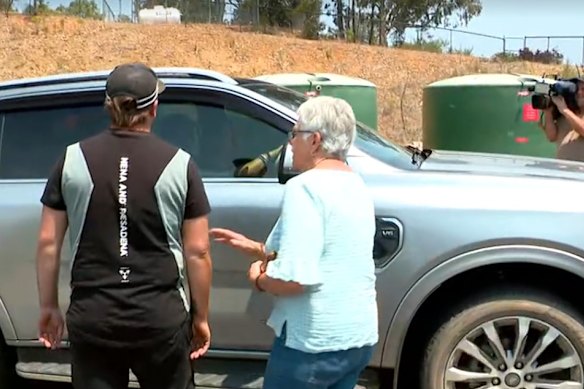
Nine News reported a group of locals tried to corner the premier’s car after the press conference, but they appeared to have the wrong vehicle.Credit: Nine
Stretton’s royal commission findings into what, at the time, were the state’s deadliest fires on record, captured the sense of foreboding country people felt towards their surrounds as they went about their business at the height of a terrible summer.
As Victoria endures another destructive fire season, his description could also apply to the political topography confronting Premier Jacinta Allan and her long-term government, particularly in rural and regional communities, at the start of an election year.
Tuesday’s angry scenes in Alexandra, where Allan was heckled by townspeople and landowners aggrieved by her government’s resourcing of the CFA and, more broadly, the imposition of the unpopular Emergency Services and Volunteer Fund and perceived neglect of regional communities, reflect a febrile mood in the bush.
This was hardly a mass protest, with perhaps a dozen or so people gathering outside the Alexandra hospital to give the visiting premier an earful. But a harried Allan ducking through a back door to avoid the very people she was in town to support – like former prime minister Scott Morrison being refused the hand of a firefighter in the NSW town of Cobargo six years ago – is likely to become a defining image of her government’s response to the fire crisis.

The Premier makes a hasty exit as protesters gather.Credit: Nine News
Johanne Appleby, a local horse breeder who evacuated her property as the Longwood fire threatened Alexandra, was among those who greeted Allan. She said CFA crews were having to operate in 30-year-old trucks with no air-conditioning, didn’t have the supplies they needed to fight the fires and not enough fuel reduction burning had been done to reduce the risk of an uncontrollable fire. “Shame on you, shame on your government,” she shouted at the premier.
It is deeply unfair to accuse Allan of not understanding what fire-impacted communities need and are going through. She lives on a rural property on the outskirts of Bendigo. Like Appleby, her home was subject to an evacuation order in the face of approaching fire.
She knows what it means to live, in the words of Stretton, in “the shadow of dread expectancy”.
Loading
Allan denies her government has cut funding to the CFA and that fire services were not prepared and properly equipped for this summer – a position backed by the CFA senior management and board. “We’ve given them additional funding,” she says. “To say anything to the contrary is false.”
However, Allan’s further insistence that “now is not the time for politics” about CFA resourcing rings hollow.
There are fires still burning in Victoria and will be for weeks to come. There is also simmering resentment across CFA volunteer ranks and the communities they serve about whether their fire defences are as strong as they should be.
The people holding the hose are the ones questioning whether all additional property tax collected through the renamed Emergency Services Volunteer Fund is being spent where it should be. This is the pivotal issue around which other rural grievances are coalescing, whether it be high grass left unmowed on the verge of a highway or potholes in local roads.
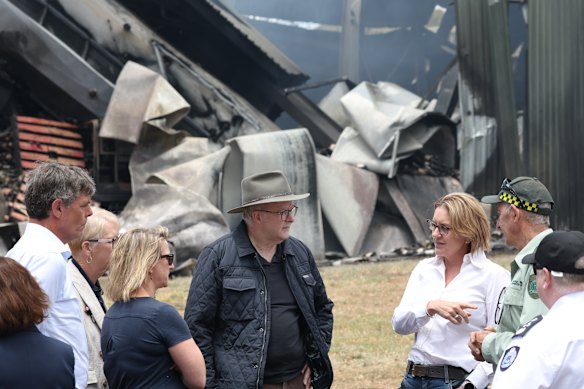
Premier Jacinta Allan in the fire ravaged town of Harcourt with Prime Minister Anthony Albanese earlier this week.Credit: David Crosling
John Houston, the captain of the Grassmere CFA brigade and president of the CFA volunteers group, scoffs at the notion that a fire crisis is the wrong time to debate Victoria’s fire preparedness.
“Politicising it? She is out there, in the papers and on camera, grabbing every photo opportunity she can,” he says of Allan. “Sorry, you are the politician, we are the firefighters. Our job is to put the wet stuff on the red stuff. Your job is to raise the funds so we have the equipment we need. We don’t need cuddles.
“Has the budget increased? If you look at the CFA figures they clearly show it hasn’t. But whether it has gone up or down a poofteenth is irrelevant. The budget hasn’t kept up with inflation.”
United Firefighters Union Victorian secretary Peter Marshall says the average age of the CFA truck fleet – 230 of the trucks are more than 30 years old, according to the union – means that people are driving into fires uncertain whether their equipment will hold. Warracknabeal CFA group officer David Drage, a volunteer responsible for 13 brigades, says there are also serious problems with the fleet’s newer trucks.
Recent episodes of overheating and brake failures prompted CFA command to instruct crews to avoid driving trucks through heavy crops and grassland. Drage says this directive would make it impossible to fight a fast-moving grass fire like the one that destroyed properties in Natimuk and threatened Horsham last week.
Loading
Drage says the bigger issue for the CFA, particularly its volunteers, is autonomy lost since the creation of Fire Services Victoria and structural changes to the state’s country and metropolitan fire agencies. “That feeds back into a lot of the issues we are having with appliances and resources,” he says.
This is not a new political issue. CFA volunteers channelled their anger towards the state government in both the 2018 and 2022 election campaigns. At both elections, Labor was returned with increased majorities.
But if we think of voter grievance as fuel on the forest floor, there is a point in any long-term government where the cumulative build-up reaches combustive levels. This summer points to a long, hot, election year ahead.
Chip Le Grand is state political editor.
The Opinion newsletter is a weekly wrap of views that will challenge, champion and inform your own. Sign up here.
Most Viewed in Politics
Loading