3 months ago
26
3 months ago
26
Sydney Water will spend about $3 billion over the next decade to upgrade the city’s ageing sewerage network to avoid a repeat of the debris balls that were washed up on beaches in 2024, and allow hundreds of thousands of new homes to be built in south-west Sydney.
The plan will produce recycled water that Water and Housing Minister Rose Jackson said could be used by data centres or other industry under a user-pays model, as the state seeks to harness the expected data centre boom without burdening the city’s drinking water supply or the environmental health of rivers.

The biosolid processing facility’s capacity will be increased at Sydney Water’s Glenfield water resource recovery facility.Credit: Sitthixay Ditthavong
The program will start with major upgrades to water treatment plants in Glenfield, Liverpool and Fairfield. The purpose is to reduce the wastewater that needs to be treated and discharged via the Malabar deep ocean outfall, which was identified by the NSW Environment Protection Authority as the likely source of the grimy black balls that closed Coogee and other Sydney beaches in October 2024.
“We do have the opportunity to service the sewage being produced in south-west Sydney now, but if we’re talking about hundreds of thousands of new homes in that community over coming years, that’s going to become almost impossible,” Jackson said.
“We’ve been talking about the need to accompany housing growth with infrastructure for the last few years, so this kind of thinking was already in the works, but the experience of the debris balls and the work with the EPA really did bring to the fore the need for this investment quite urgently, and move it right up the to-do list.”
The Malabar plant serves 2 million Sydneysiders as far inland as Camden. In dry weather, it handles about 450 megalitres of effluent a day, but it can peak at 1200 megalitres a day in wet weather.
Leaks between the stormwater and sewage systems means that in heavy rain, the sewage often overflows upstream and pollutes the Georges River and Botany Bay.
Sydney Water chief executive Darren Cleary said the state-owned company had awarded a $750 million contract to the Malabar System Alliance, a grouping of Acciona Construction, Acciona Agua and SMEC.
“Historically, just at the raw numbers, certainly over the last few decades, we haven’t had a program that big, so it is significant for us,” Cleary said.
The $750 million will be paid by Sydney Water customers, with the expenditure already approved by the Independent Pricing and Regulatory Tribunal. The Minns government estimates the Malabar System Investment Program will cost $3 billion over 10 years in total, and has not allocated taxpayer funding at this stage.
Cleary said this first phase of work for the three plants along the Georges River would take four or five years, and other projects to improve the network of pipes would overlap with that. The next phase of work could reduce the outflow at Malabar by 85 megalitres a day, subject to EPA approval.
Sydney Water is also upgrading the North Head biosolids processing facility, which serves one million Sydneysiders.

Black balls washed ashore at Gordons Bay in Sydney in October 2024.Credit: Janie Barrett
Sydney’s ageing sewerage system is regularly clogged by fatbergs – an unholy pairing of fats, oils and greases poured down drains, combined with baby wipes and other hard objects flushed down toilets.
The EPA’s expert working group concluded that the debris balls were likely to be fatberg materials that evaded the screens at the Malabar plant, entered the deep ocean outfall pipe, and formed or reformed into balls.
There were several incidents with debris balls washing up on beaches in late 2024 and early 2025, including dark balls on the eastern beaches and light grey balls that later appeared on the shores of the northern beaches, South Coast and Central Coast. Independent testing found the balls were a mix of cooking oil, soap scum, human faeces, medication, recreational drugs and plastics, and the EPA also identified hydrocarbons consisted with the heavy industry in the Malabar catchment.
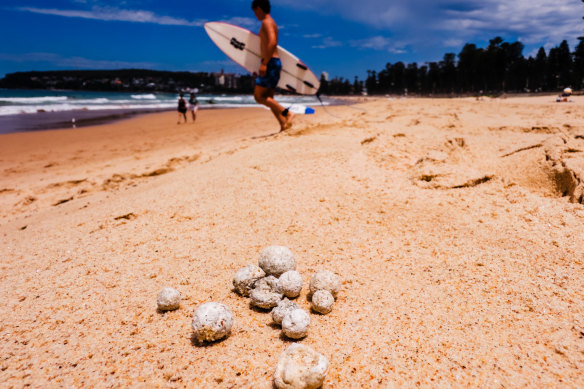
Nine beaches from Manly to North Narrabeen were closed in January 2025 after potentially hazardous ball-shaped debris was found.Credit: James Brickwood
In the short term, Sydney Water has increased cleaning and inspection of the ocean outfall screens and is trying to prevent the fatberg ingredients from entering the network by tightening trade-waste controls for high-risk customers and increasing public education.
Sydney Water is keen to add purified recycled water back to the dams to bolster the city’s drinking water supply, but this would require a change of law by the NSW government. However, Cleary said this could not be properly considered until the infrastructure work was completed.
Jackson said this was not on the table right now, though she acknowledged it had been done in other jurisdictions and could be part of Sydney’s future.
“When you’re trying to make the case for quite significant infrastructure investment, you have to think about what’s the most pressing issue right now,” Jackson said. “When the dams are very full, and we’ve had a period of quite a lot of water in the system, that’s not the most pressing to me. The most pressing is supporting housing growth and lifting some of those environmental outcomes.”
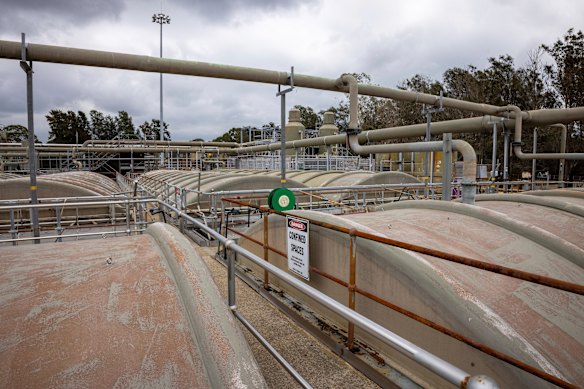
The sedimentation area will be extended at Sydney Water’s Glenfield water resource recovery facility.Credit: Sitthixay Ditthavong
The default option is for the treated water to be returned to creeks and streams near the inland water treatment plants while biosolids are repurposed for agriculture. However, Jackson said she was keen to explore industrial uses for recycled water, especially data centres, which require water for cooling.
Loading
“The principle is that we want data centres in operation, but they’re going to have to consider the cost of water infrastructure as part of their investment decisions,” Jackson said.
“We certainly don’t want them using potable water, drinking water because we want that water reserved for drinking and for growth purposes. We want them to be using water that is otherwise of not as much use to us, and recycled water is a great example.”
Jackson said Infrastructure NSW was working on the regulation of data centres, including water, energy and land use.
Cleary said there were “active discussions” with data centre developers about water usage. Sydney Water already produces recycled water in Quakers Hill.
Most Viewed in Environment
Loading