3 months ago
28
3 months ago
28
There appears to be something of an existential crisis unfolding in Test cricket: the quest to preserve the idea of the five-day Test match, with its attendant plot twists and uncertainty, while at the same time confronting the modern realities of aggressive tactics, commercial imperatives and pitches that seem to conspire against the format they are meant to serve.
But there is something unbalanced about the idea of engineering a five-day contest. Sport should be gloriously uncertain; and anyway, that’s what insurance is for. David Beckham once insured his legs for £100 million; surely there’s a market for insuring against losses triggered by two-day Tests.
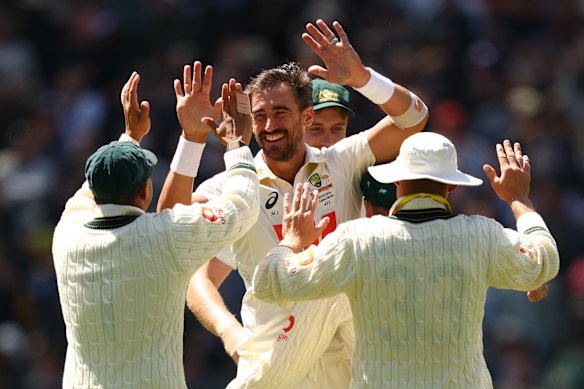
Mitchell Starc celebrates a wicket at the MCG.Credit: Getty Images
But this isn’t merely about the bottom line. It’s about the soul of Test cricket: the intertwining of skill and strategy and the meandering arc of uncertainty that sustains suspense. Yet the very conditions that should nurture that uncertainty – the pitch, the central stage upon which bat and ball do battle – fall victim to blame like never before.
The Cruising Yacht Club of Australia, which organises the Sydney to Hobart, has no influence regarding the direction from which the wind blows, let alone how strong. The Royal & Ancient can’t control the weather conditions for The Open Championship. But the rules that govern the preparation of Test cricket pitches warrant inspection.
The Marylebone Cricket Club remains the custodian and determinator of The Laws of Cricket. Sitting alongside those Laws is, relevantly, the International Cricket Council’s Men’s Test Match Playing Conditions.
You’d think that for Tests played in Australia, Cricket Australia would be conferred with the power as final decision-maker on how cricket pitches must be prepared. But the MCC’s Laws and the accompanying Playing Conditions make for instructive reading.
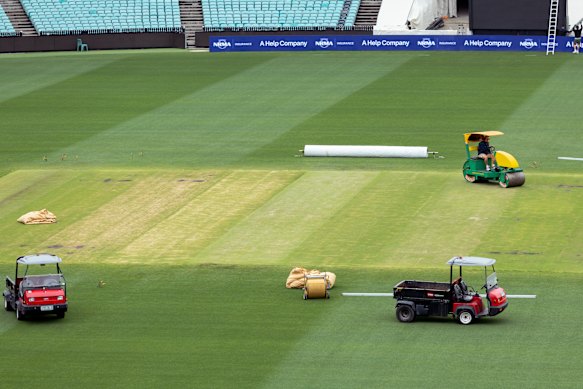
SCG ground staff prepare the wicket for the fifth Ashes Test.Credit: Dominic Lorrimer
Law 6.3 determines the “Ground Authority” is responsible for the selection and preparation of the pitch, but that for the duration of a match, the umpires control the use and maintenance of it.
The term “Ground Authority”, defined in the Playing Conditions as “the entity responsible for the selection and preparation of the pitch and other functions relating to the hosting and management of the match, including any agents acting on their behalf (including but not limited to the curator or other ground staff)”, could be read to be CA, the Melbourne Cricket Club, or the curator of the MCG.
Neither the Marylebone Cricket Club nor the ICC enforce standards for the preparation of pitches. Much is left to the discretion of the Ground Authority and curators, and their experience gained over time. Which plays to the fact that cricket is sport, not science.
The vagaries of a Test cricket pitch add to the allure and uncertainty of the pursuit. In 2026, it’d be all too easy to mandate the manufacture of a uniform and predictable surface, with the turf wicket then rendered an anachronism just like the almost-extinct grass tennis court. But at what cost?
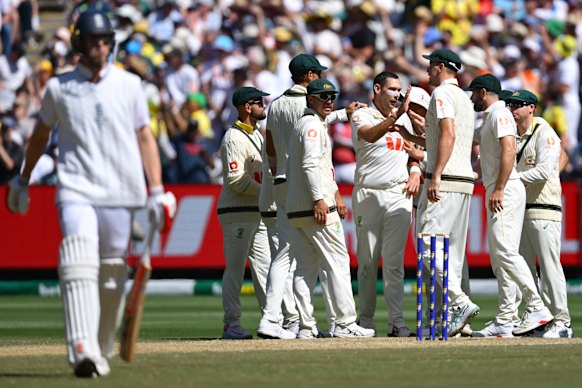
Scott Boland dismisses Zak Crawley in the Boxing Day Test.Credit: Getty Images
Do you want glorious uncertainty, or fashioned and maintained predictability? Test cricket doesn’t need a metronome. It doesn’t require a guarantee. And it certainly doesn’t need a five-day warranty card, stamped in advance by agronomists and administrators who confuse control for quality.
The most dangerous phrase in modern cricket is this: a good Test match is one that lasts five days. It sounds responsible. But it also sounds like something muttered by bean counters and a committee in a room with tartan carpet, Perrier and a PowerPoint slide titled “Fan Engagement Metrics”. And it’s completely wrong.
Test cricket’s soul lies in its refusal to behave. The game wasn’t conceived to satisfy broadcast schedules or justify hotel bookings. It was invented to ask a single unreasonable question: can you survive this? Sometimes the answer takes five days. Sometimes it takes two. Sometimes it takes less time, a gust of sea breeze, and a ball with malicious intent.
To demand predictability of Test pitches is to misunderstand what uncertainty actually does. It doesn’t cheapen the contest. It sharpens it. A pitch that cracks early or crumbles wickedly doesn’t rob batsmen of justice; it demands excellence sooner. Thirteen millimetres of grass isn’t an ambush. It’s an examination you must sit immediately, without crib notes. If one fails, that is not the pitch’s fault – even if it is rated “unsatisfactory” by some esoteric measure. That’s sport.
The idea that every Test should unfurl in the same reassuring arc – bat, bowl, bat, bowl, draw – classifies Test cricket like a 10-part Netflix drama. But sport isn’t a television product. Sport is live theatre with no promise of a third act.
The obsession with five-day pitches is, really, an obsession with risk management. Administrators fear embarrassment and red ink. They fear headlines about matches ending too quickly, as though duration were a moral virtue or the point of the whole exercise.
But Test cricket mustn’t be about safe options. It’s the format that dares you to lose badly, publicly, and with consequences that echo for decades.
Loading
To be honest, predictability doesn’t make Test cricket, or any variant of any sport, more compelling. Runway-flat pitches produce run-gluts so bloated they feel like inflation statistics. When scoring centuries is rendered de rigueur, centuries lose meaning. When every match meanders politely to tea on day five, the tension evaporates somewhere around session three on day two.
Uncertainty isn’t the enemy of Test cricket. It’s the oxygen. It’s the reason captains sweat at the toss. It’s why openers age five years in five balls. It’s why a tailender with a crooked bat can suddenly become immortal. Remove that, and you do not preserve Test cricket – you embalm it.
Test cricket doesn’t need to be protected from chaos. Chaos is the point.
Most Viewed in Sport
Loading