
 2 months ago
73
2 months ago
73
In early 1996 the Sydney property market began to pick up after a year in the doldrums – by June that year the city’s median house price hit a record $214,719.
No one could have known it, but Sydney was on the cusp of a three-decade property super-cycle, a term used to describe a big run-up in asset prices that lasts an unusually long time.
Had prices risen in line with inflation from that mid-1996 mark of $214,719, Sydney’s median would now be around $465,000, according to the Reserve Bank’s inflation calculator. Instead, it stands at $1.79 million – an increase of 734 per cent since June 1996, Domain’s house price time series shows.
Price growth for Sydney apartments has not been quite so stratospheric – but it still far outstrips inflation and wages. The city’s median apartment now costs $848,227, up 385 per cent since mid-1996. Had unit prices risen in line with inflation over the past 30 years Sydney’s median would be about $380,000.
Domain’s chief economist Nicola Powell says the Sydney property market has had periods of “extreme” house price growth since the mid-1990s but few serious setbacks.
“When you look back over that 30 years the core thing is that we’ve spent a lot more time in an upswing than we have in a downturn,” she says.
Two great economic shocks that rocked the world economy during that period – the global financial crisis in 2008 and the COVID-19 crisis in 2020 – had little effect on Sydney’s property values. Rather, those upheavals were followed by periods of strong price growth because the Reserve Bank slashed interest rates to support the broader economy.
Domain’s figures show Sydney’s median house price surged 38 per cent between June 2020 and December 2021 after official rates fell to “emergency” levels near zero amid the disruption of the pandemic.
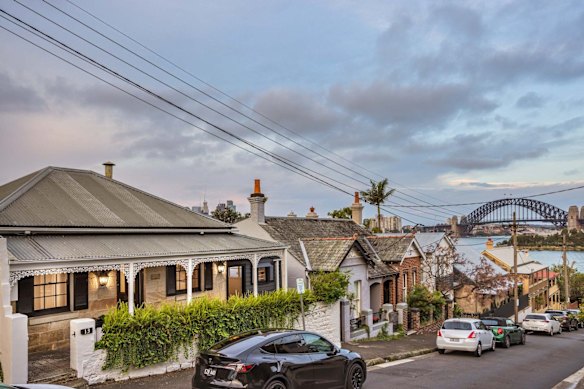
The 30-year super-cycle has reshaped Sydney – property values in the city now compare with the world’s most expensive cities. But the cost of shelter has become a persistent source of public anxiety: opinion polls of NSW citizens show housing affordability has ranked among their biggest worries for more than a decade.
But Sydney’s property market dynamics may be shifting. A combination of trends including persistent inflation, political demands for lower immigration, state government efforts to lift housing supply and the federal government’s changes to property tax concessions have prompted some experts to ask: could the three decade super-cycle be fading?
What has driven the super-cycle?
Perhaps the most important factor underpinning Sydney’s super-cycle has been what economists call the “great moderation” – a structural shift in inflation during the 1990s and early 2000s that paved the way for interest rates to remain relatively low and stable.
In 1990, the Reserve Bank’s benchmark cash rate was 17 per cent, but by 1997 it had fallen to 5 per cent, and stayed around that mark for an extended period. The highest the cash rate has gone since 1997 is 7.25 per cent for a brief period in 2008; between 2013 and 2022 it was below 3 per cent.
That enabled home buyers to borrow more and pay more for homes.
Greater competition in the home lending industry during the 1990s led to more choice and lower borrowing costs, especially for investors. This followed reforms to deregulate the financial system.
Between 1996 and 2003 Sydney’s median house price, as measured by Domain, rose by 165 per cent and topped the half-million dollar mark for the first time.
Demographic change also supported Sydney’s super-cycle. Between 1985 and 2025, female workforce participation in NSW climbed from 45 per cent to 63 per cent – the growing prevalence of two-income families added to how much households could borrow, and pay each other, for homes.
Sydney’s popularity as a destination for migrants arriving from overseas also bolstered demand for housing, albeit with a pause during the pandemic. The city added around 1 million people between 2000 and 2016, lifting the population above 5 million for the first time.
Another contributor to the super-cycle has been the growing presence of investors in the housing market.
Independent economist Saul Eslake, who researches property taxation, says investor activity began to rise during the early 1990s when lenders reduced the cost of taking out investment loans.
The 50 per cent capital gains discount introduced by the Howard government in 1999, combined with negative gearing, gave investor demand for housing an “almighty kick along”, says Eslake, especially in Sydney.
This has been one contributor to a deterioration in affordability for first home buyers.
“Every time a property investor buys an established house they are in effect outbidding someone who would otherwise have been able to buy it,” he says.
Analysis by NSW Treasury shows “lending to investors was not that much larger than to first home buyers in 1994, but is now substantially higher”.
The latest figures, for the year to March 2026, show investor lending in NSW hit a new peak $59 billion, which was $40 billion more than lending to first home buyers.
The NSW Treasury paper, submitted to a federal parliamentary inquiry earlier this year, said the impact of the CGT discount has had a disproportionate impact in NSW compared to other states because of the state’s higher property values.
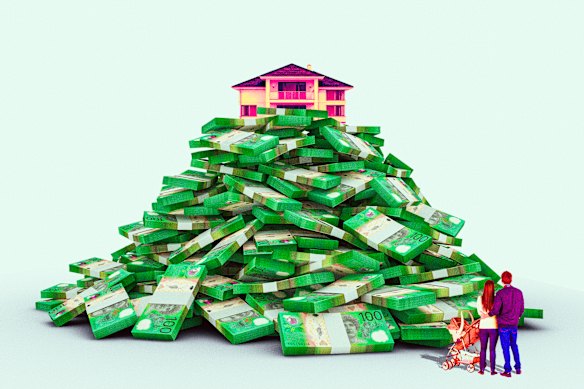
“The impact of the CGT discount is particularly relevant for NSW, where individual taxpayers reported approximately 38 per cent of Australia’s net capital gains on average between 2018-19 to 2022-23,” it said. “This exceeds NSW’s population share of around 31 per cent, reflecting the state’s higher property values and investor activity.”
AMP chief economist Dr Shane Oliver says a chronic undersupply of housing, especially in well-located Sydney suburbs, has helped sustain the super-cycle.
“Other countries have had low [interest] rates and tax breaks too, but they have kept housing more affordable because of a better balance between supply and demand,” he said.
A guide developed by AMP to assess whether property prices are overvalued or undervalued relative to long-term trends in prices and rents shows detached homes in Sydney are 41 per cent overvalued (it also shows home values across Australia’s major capital cities are overvalued by an average of 36 per cent).
Is the super-cycle coming to an end?
Oliver says several key drivers of Sydney’s super-cycle appear to be fading.
First, lingering trade tensions, higher tariffs and elevated geostrategic risk means the world may have entered a more inflation-prone period. That suggests the decline in interest rates that started in the 1990s and continued into the early 2020s has bottomed out.
“The trend to ever-lower mortgage rates driving ever-higher amounts of money people can borrow enabling ever-higher home prices may be over,” says Oliver.
Second, future population growth is likely to be lower than in recent decades, and that will moderate demand for housing. Immigration numbers are already trending down and political pressures, highlighted by recent popularity of One Nation, point to further reductions.
Another demographic shift may also have an effect: Oliver points out two-income families have now become the norm in Sydney, so that long-term support to housing demand “likely doesn’t have much further to go”.
Third, federal government reforms passed last month, which introduce a less-generous method for calculating capital gains taxes, as well as curbing negative gearing, will affect housing investors and housing demand.
“If you say the capital gains tax discount introduced in 1999 was a big factor in the property super-cycle, then logic would say now that we’ve removed that and removed negative gearing from those properties, you’d have to conclude that that’s going to be a big negative, and a factor leading to the end of the super-cycle,” says Oliver.
Property prices in Sydney began to fall earlier this year and the federal government’s changes to capital gains tax are already being blamed for the weaker conditions, alongside the Reserve Bank’s three interest rate increases between February and May.
Property analysis firm Cotality estimates prices in the city have fallen 3.7 per cent from a peak in January, partly reversing last year’s 6 per cent rise.
Finally, the NSW government has recently overhauled planning rules in a bid to lift the supply of homes in Sydney. The federal government has also made the construction of new dwellings a priority.
If successful, these policy changes will put downward pressure on dwelling prices. Although, so far, ambitious annual targets for new dwelling supply have not been met.
Oliver says efforts to lift housing supply is the “big unknown” for the future of property prices.
“It may be premature to call an end to the property super-cycle boom of the last 30 years until the supply shortfall comes under better control,” he says.
Start the day with a summary of the day’s most important and interesting stories, analysis and insights. Sign up for our Morning Edition newsletter.

















































