3 months ago
38
3 months ago
38
Millennial women are turning to a date-rape drug – available online for less than the cost of a pint of beer – for its euphoric and aphrodisiac effects, resulting in a surge in emergency department presentations at one of Victoria’s busiest hospitals.
St Vincent’s Hospital in Melbourne recorded more than 350 emergency department presentations related to the drug GHB last year, up from 140 presentations in 2014. Total ED presentations grew by just 15 per cent over the same period.
GHB, an acronym for gamma-hydroxybutyrate, has previously made headlines for its links to sexual assault. It is commonly called liquid ecstasy and has been around since the 1960s.
However, experts say the substance’s popularity has surged, including among women in their 30s and late 20s, who use it recreationally. This trend is draining hospital, police and ambulance resources, according to those working in the field.
The spike in Melburnians seeking urgent medical care for suspected GHB poisoning has prompted experts to call for a mass education campaign, given the drug’s potential to induce comas and even trigger life-threatening withdrawals.
St Vincent’s director of emergency medicine, Dr Jonathan Karro, said there was a “very fine line” between a dosage that achieved the user’s desired effects and an overdose that rendered someone unconscious.
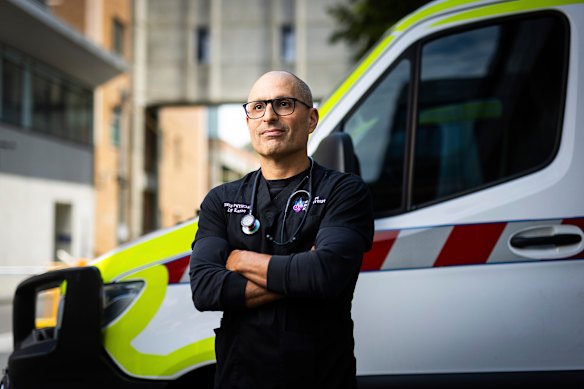
Dr Jonathan Karro noticed that patients presenting with GHB poisoning tended to skew older than they were 10 years ago. The data backs up his experiences.Credit: Paul Jeffers
“It’s a daily occurrence for us,” he said.
The emergency physician said that patients were skewing older than they were 10 years ago, suggesting the drug’s popularity had broadened.
“There were patients who came in today with GHB overdoses. One was a young woman who collapsed at work, and the other was a person who was recently incarcerated and having a significant withdrawal syndrome.”
Loading
Karro added that the median age of patients with symptoms of GHB poisoning at St Vincent’s emergency department was 29. The overwhelming majority were brought to the hospital via ambulance, while one in eight patients were accompanied by police.
Most cases were rushed to the emergency department on Sundays, with Saturday the second most common day for presentations.
The data was first published in the peer-reviewed journal Emergency Medicine Australasia. In his first interview about the findings, Karro – who was a co-author of the academic paper – said the drug’s availability and low cost were to blame for its newfound popularity.
“People are able to seemingly purchase GHB by the litre. It’s costing around $5 a dose.”

Rowan Ogeil says there’s also been a national surge in GHB-related presentations.
The Age was able to find GHB and similar chemicals available online from popular online retailers – which this masthead has chosen not to name – after a simple internet search.
Dr Rowan Ogeil, the strategic lead of addiction research centre Turning Point, said there had been a more than 60 per cent increase in GHB-related presentations nationally between 2022 and 2023.
“It does put strain on the health service, on paramedics, on emergency services, and community health. Every ambulance attendance that is GHB, alcohol or drug related is a potential tragedy.”
The Monash University senior research fellow added that Geelong had become a particular hotspot, possibly due to the region’s string of summer festivals.
“It’s now surpassing some of the metropolitan LGAs (Local Government Areas), which traditionally have a higher number of bars and clubs.”
Pru Tellegen, the acting chief operating officer at Windana – which runs residential detox services – said about eight out of 10 referrals included current or recent GHB use.
Tellegen said some used GHB as a party drug, while others used it to improve sleep and relax. Some used it to soften the comedown from other substances like methamphetamine.
“Part of the problem is that it’s really challenging to determine how much GHB people are actually using and therefore there’s no one evidence source about how we draw up a sort of standardised plan.”
GBL, an industrial solvent that metabolises into GHB when it enters the body, is often sold as GHB as it is more readily available, but it is stronger and faster-acting than GHB.
Loading
“The clients often don’t know how much they’re consuming. It’s very much uncharted waters.”
She said that community services were often not equipped to deal with patients taking high doses of GHB, so they were often referred to detox services and the emergency department, where they would take up beds.
“Harm minimisation starts with education, and that’s what we did in the 80s, and that’s what it did in the late 90s for meth, and that’s where it’s really got to start with GHB.”
She said any harm reduction measures should include awareness around spacing the use of GHB, using a plunger to be able to track dosage, and avoiding mixing it with benzos or alcohol as those substances operate on the same pathways in the brain.
Karro, from St Vincent’s, agreed that an education campaign was needed.
“Addiction seems to be developing in these people quite commonly, and would be very useful for community to know about that, and also to know how terrible the withdrawal syndrome is. Patients feel awful, and it can actually be a life-threatening withdrawal syndrome.”
Crime Statistics Agency data from September shows GHB accounted for 11 per cent of drug dealing and trafficking offences.
A state government spokesperson said Victoria’s free and confidential pill testing service was able to test the make-up of most pills, capsules, crystals and liquids, including GHB.
“We’re getting on with addressing drug harm in the community – rolling out the $95 million statewide action plan, pill testing, naloxone vending machines and launching the Victorian alcohol and other drugs strategy, a 10-year plan to reduce alcohol and other drug-related harms and stigma,” they said.
National Alcohol and Other Drug hotline 1800 250 015
Start the day with a summary of the day’s most important and interesting stories, analysis and insights. Sign up for our Morning Edition newsletter.
Most Viewed in National
Loading