3 months ago
18
3 months ago
18
Streaming films was supposed to save us time. I’d rather take the long way
Opinion
November 14, 2025 — 10.01am
November 14, 2025 — 10.01am
Lately, I’ve been thinking about how much time we spend trying to save time. Streaming made it possible to watch anything instantly, but mostly I find I spend longer deciding what to press play on. So I’ve started going backwards: back to the slower, more deliberate way of watching movies. The kind that requires you to leave the house, make a choice, and live with it for a week. It’s inconvenient and time-consuming, but that’s kind of the point.
Earlier this year I was tasked with hosting a Q&A event with the indie director Alex Ross Perry, whose two new documentaries were screening as part of Melbourne International Film Festival. One was a meta-textual story of the ambivalent and anti-corporate band Pavement, and the other was a filmic essay on the brief, significant existence of the video store.
After watching the latter, Videoheaven, I felt a deep nostalgia for the hours I’d spent wandering the racks of my hometown Blockbuster, searching for something that could cause the fewest arguments between my sisters and me while still supporting whatever fleeting teenage identity I was grasping onto at the time, like when I rented The Craft and began tight-lining my eyes with black kohl pencil.
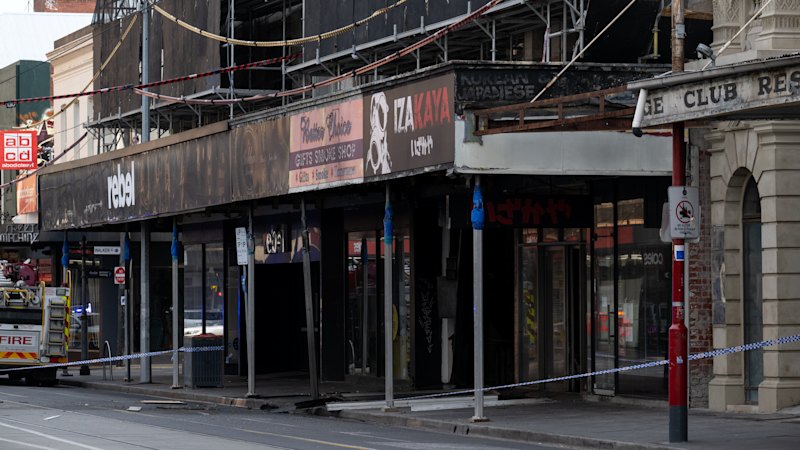
I moved to Melbourne to study cinema at uni. My first share house, where I furnished my bedroom with IKEA’s cheapest mattress and milk crate shelving, was in Richmond. For $110 a week I lived five minutes from the video store that would completely expand my horizons. Picture Search was a cramped maze with towering, rickety wooden shelves teeming with every movie I could imagine. Like the Platonic ideal of the independent video store, it remains Melbourne’s last bastion of movie rentals, a relic from the pre-streaming era.
This was 2009, a full six years before Stan and Netflix launched in Australia. As they began to jostle for market share with all the other players in the streaming space, my DVD player got less and less airtime, until eventually it got unplugged for good.
Streaming really fools us into thinking we have infinite choice. Surely, if we’re all paying $15 for each of the half a dozen services that splinter off and divvy up the market, we should be able to find anything we could possibly want to watch? We all know how laughable that idea is.
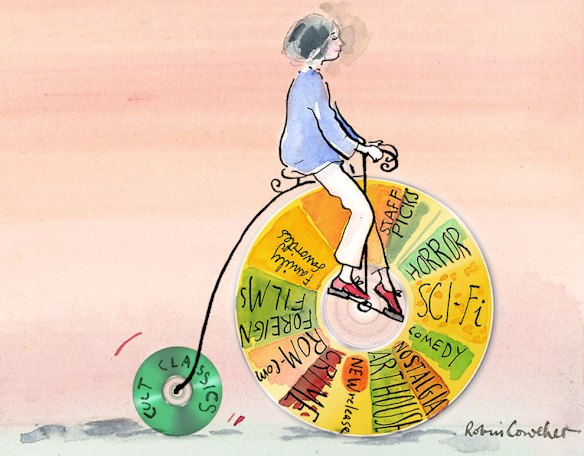
Credit: Robin Cowcher
A few months ago I decided to opt out. I couldn’t stomach the thought of paying hundreds of dollars a year for the possibility that I might enjoy one or two movies. Not when the running list I’ve been keeping of movies I’ve always wanted to see and never got around to was growing year-on-year.
Inspired by Videoheaven, I made a return to Picture Search. On top of the $12 I paid for the four Alex Ross Perry movies – most of which aren’t available on streaming – that I rented to prepare for my Q&A with him, I had an outstanding late fee from the last time I’d been there. I was impressed that, in 12 years, it hadn’t accrued any interest.
Loading
Choosing this option is less convenient than scrolling through endless thumbnails on my TV, but I’m not the only one eager to return to the days of the video store. My friend Alexei Toliopoulos hosts the movie podcast The Last Video Store, where he offers suggestions to his guests on what videos to rent. At the Immigration Museum’s Joy exhibition, artist Callum Preston built the installation Videoland, a life-size recreation of a ’90s video store. Both tap into a similar sentiment in Perry’s documentary: the video store was less a delivery mechanism than a place where joy was delivered in little plastic sleeves, in finite quantities, for a night or a week at a time.
Recently, after another visit to Picture Search, I spent a weekend ticking off other movies I’d always said I’d eventually get around to seeing – Francis Ford Coppola’s The Conversation, Terrence Malick’s Badlands and Panic in Needle Park. I also revisited Magnolia, Paul Thomas Anderson’s ambitious three-hour film that I watched three times in one weekend when I was 20.
Renting that DVD – likely the same copy I’d rented 15 years earlier – was when I truly felt like I was in a time machine. And it made me realise that what we had before were fewer options, but more time to seek out the cultural relics that affirm or challenge our taste. I’m not the first person to realise that the technology that promises to do everything faster and simpler hasn’t really given us any more time or opportunity or access.
So I’m committing to the inconvenient route. To wandering and reading the back cover of a title, of carrying a stack of physical things to and from my apartment, and relishing the time I spend with that little disc in my hard-working new DVD player.
Most Viewed in Culture
Loading