3 months ago
36
3 months ago
36
Beirut: The fishing boats are empty in the ancient harbour of Tyre when we walk along a low wall toward a group of men talking quietly at the end of a jetty.
The wind is down and the sea is a calm turquoise, so the conditions are perfect for the fishermen here in southern Lebanon. But most are staying in port. And word is spreading that Israel is planning another airstrike on their city this morning.
It is safer to stop fishing, says Mehdi Istambouli, who owns a small timber boat moored a few steps away. He and his wife have enough food for themselves and their four young children for the moment, but the attacks have put everyone on edge.
We are talking next to a large statue of the Virgin Mary watching over dozens of boats. This port is a Christian enclave in Tyre, a city mentioned in the Gospels and known in Arabic as Sur.
“I’m a Muslim, and this is the Christian area, but we are all Muslims and Christians living on very good terms together,” says Istambouli. “We are well and we are peaceful.
“What we are scared of is if any people from outside this area come over here – like from villages or the surrounding areas because we don’t know them, and we don’t know their affiliation.
“Otherwise, we’re fine.”
Outsiders are a danger in this war. The Israel Defence Forces (IDF) are flying surveillance drones over Beirut and other cities day and night, watching for targets linked to Hezbollah, the militia that began firing rockets into northern Israel on March 2.
Tyre has a large Muslim population and is only 20 kilometres north of the Israeli border, making it a regular target for attack now that Lebanon has been dragged into the wider war on Iran. The al-Bass archaeological site, whose ancient ruins have world heritage status, is closed.
“The enemy knows us – how we move around and everything,” says Istambouli. “They know more about the people than the Lebanese government knows about us, because of the drones.”
After speaking with the fishermen, we walk along the wall that protects the harbour from the sea. We can see the city across the vivid blue of the bay, and we can see snow on Mount Hermon in the distance.
Then we hear the Israeli jet. We watch a puff of smoke rise over the buildings, and then hear the explosion. Black smoke drifts over the city.
The airstrike came exactly as everyone at the port expected. This one has destroyed apartment buildings in a complex that has been hit before and has since been evacuated. There are no reports of dead or wounded.
Such strikes demonstrate that Israel can destroy what it wants when it wants. Some come with a warning to evacuate, some do not. Determined to eliminate Hezbollah once and for all, the IDF tracks senior members of the group and kills them or their allies with kamikaze drones or missiles.
Every strike leads to speculation about the target. Sometimes it is said to be a senior member of Hezbollah, or the Hamas group based in Gaza, or the Islamic Revolutionary Guard Corps from Iran. The rumours fuel the fear of strangers in a country with a long culture of opening the door to visitors.
At a house demolished by a missile last week, neighbours told us of their suspicion that some of the homeless people who were given shelter there were loyal to Hezbollah. By taking in outsiders, they thought, the owner turned it into a target.
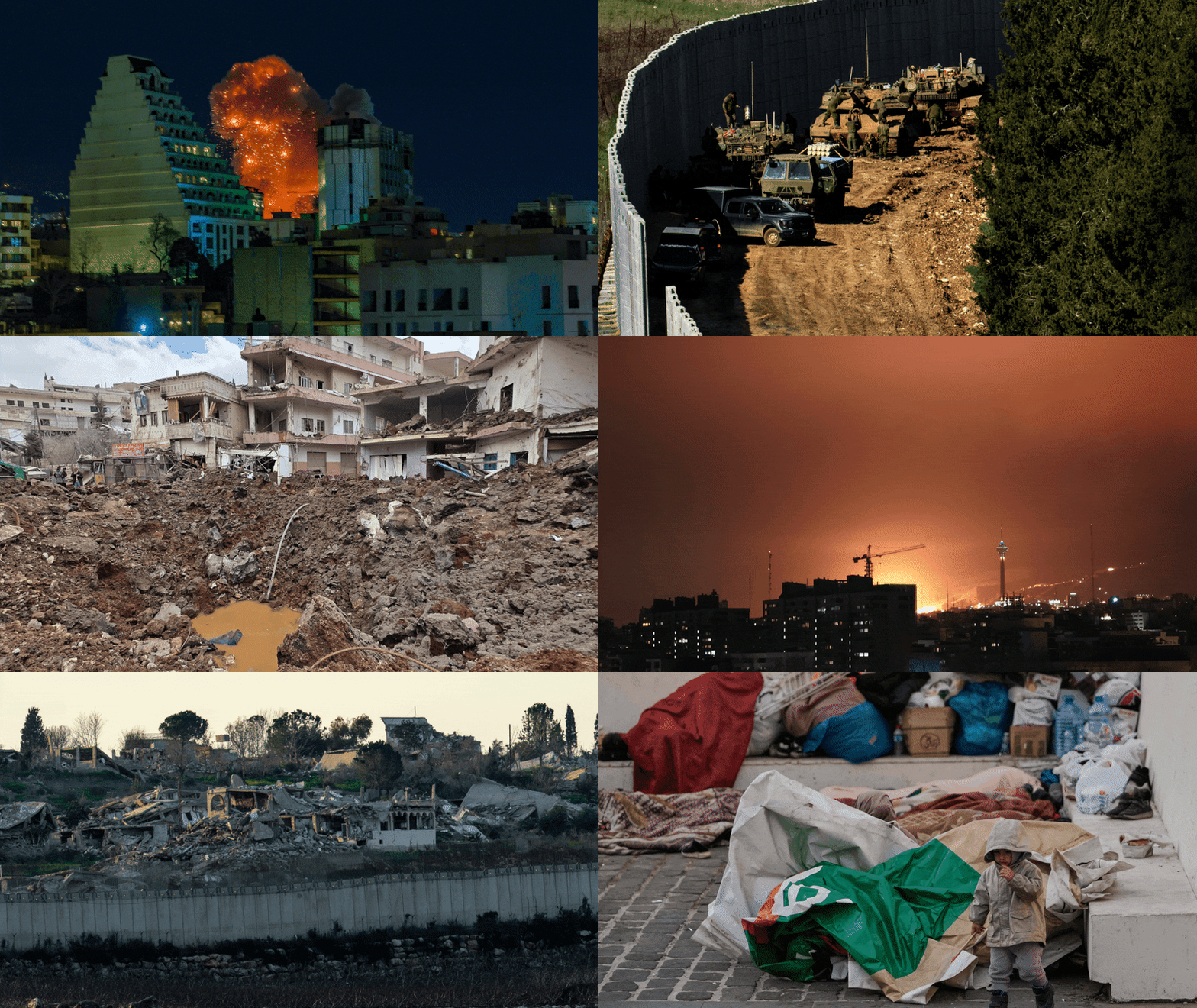
At the beachside in Beirut, the IDF bombed two parked cars in the Ramlet al-Bayda district last Thursday morning. There was no word of the intended target, but the strike killed at least eight and wounded 31 in an area crowded with people living in tents.
Civilians are collateral damage in this campaign. The IDF sends missiles into residential neighbourhoods and turns large houses into craters of broken concrete. There may be a Hezbollah loyalist in the lounge room, but there can also be an innocent child next door.
Israel says it uses precision weaponry, but it cannot contain the damage. In the capital’s upmarket Raouche district last week, a drone strike killed five members of Iran’s revolutionary guard at the Ramada hotel. In surrounding rooms, 10 people, including three children, were wounded.
Meanwhile, civilians on the Israeli side of the border take shelter from Hezbollah rockets. Hundreds of rockets have fallen on Israel over the past week, while Iranian missiles and drones also hit civilian targets. At least 15 people have been killed and more than 2000 injured in Israel since the attacks on Iran began on February 28.
In Lebanon, the death toll rose to 773 on Friday. The country’s health ministry said 1933 people have been injured in the attacks since March 2. More than 800,000 are registered as displaced from their homes.
Many blame Hezbollah for bringing this destruction on Lebanon by choosing to attack Israel after the Iran strikes. All the religious and ethnic groups within Lebanon, ranging from Maronite Christians to the Druze, now suffer from the decision made by Hezbollah leaders who are loyal to the Iranian regime.
East of Beirut, in a region that has long supported Hezbollah, residents tell us they are determined to fight Israel after seeing homes destroyed when a warplane fired a missile into a house.
The blast was so powerful it destroyed several homes in Douris, south of Baalbek, and injured five people. When we visit on the day after the strike, a toy elephant and the pages from a child’s Arabic language lessons are lying in the debris.
The owner of one of the homes, Adam Shreif, tells us the strike came without warning. He was not at home at the time, and he does not want to talk about any sorrow for the loss of the building. He wants to talk about what he calls the terrorism from Israel.
“I’m happy to give this house for the sake of the resistance, for the country,” he tells us.
“After this war, Israel should be gone.”
The rubble where his house once stood is now decorated with a Hezbollah flag.
Get a note directly from our foreign correspondents on what’s making headlines around the world. Sign up for our weekly What in the World newsletter.