3 months ago
23
3 months ago
23
By Alex Burchmore
December 23, 2025 — 5.30am
Marking almost two decades since the inaugural National Indigenous Art Triennial – Brenda L. Croft’s Culture Warriors (2007-08) – After the Rain, the fifth show in the series, is an exhibition dedicated to reflection, the forging of new connections, and a celebration of legacy. Artistic Director Tony Albert acknowledges the influence of Croft’s curatorial vision in his opening wall text, sparking a familiar and inviting dialogue with this and other precedents, as well as with viewers, which continues throughout the exhibition.
This feels in many ways like a passing of the torch to a new generation – Albert and five of the participating artists were born after 1980. The work of the two youngest contributors, Aretha Brown (b.2000) and Dylan Mooney (b.1995) – focusing on the role that public art can play in encouraging a self-reflexive critique of entrenched injustices and “a celebration of queer love among people of colour”, respectively – establishes a clear Gen Z presence.
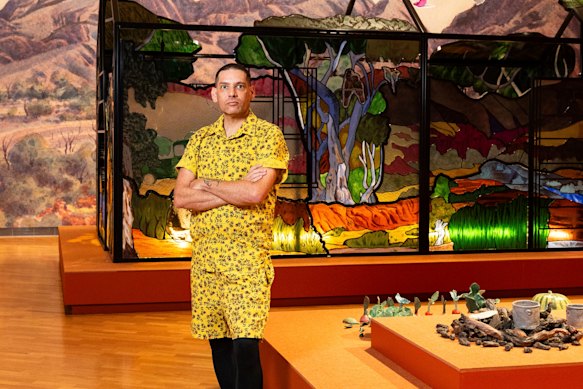
Tony Albert, artistic director of the 5th National Indigenous Art Triennial in front of House of Namatjira.Credit: Alex Ellinghausen
Yet these generational legacies are not presented as a one-way street. “We stand today on foundations laid by giants,” Albert reminds us, “those like-minded people who have fought incredibly hard for our opportunities.” In addition to Croft, the late Birri Gubba and Darumbal artist Gordon Bennett (1955-2014) is cited as a guiding inspiration for Brown’s The Teach Blak History Project. The dazzling House of Namatjira, at the exhibition’s heart, pays tribute not only to the incomparable Albert Namatjira (1902-59) but also to the Hermannsburg Potters and Iltja Ntjarra artists who continue to build on his example.
Elsewhere in the exhibition, Alair Pambegan (b.1966), Naminapu Maymuru-White (b.1952), and Thea Anamara Perkins (b.1992) each dedicate their work to the memory of a close family member. Pambegan’s spectacular installation Kalben-aw story place of Wuku and Mukam the flying fox brothers pays homage to his father, artist Arthur Koo’ekka Pambegan Jr (1936-2010), who notably featured in Culture Warriors. Maymuru-White’s Milŋiyawuy (Milky Way) invites us to share the knowledge of the stars she learned from her father’s younger brother Narritjin, and which it is now her responsibility to keep alive and teach to her children. Finally, Perkins’ deeply affectionate tribute to her family in Still I Rise explores the blurring of public and private roles in the illustrious lives of her mother, curator and writer Hetti Perkins, and grandfather, activist Charles Perkins (1936-2000).
Loading
The turning of generations is presented in these works, and in After the Rain as a whole, as an ongoing conversation between the present, a still living past, and a future that remains open to change. Those who came before have not only laid a foundation for those who follow, but continue to embody an ethical example of responsible and respectful co-existence.
Pambegan dramatises the disastrous consequences of refusing to heed the Elders, capturing in red, white, and black ochre the metamorphosis of two men who indiscriminately butchered a colony of flying foxes and were subsequently transformed into the same animal. Jimmy John Thaiday (b.1978), in his captivating video and sculptural installation Just Beneath the Surface, envisions a comparable embodied identification with the Waumer (Frigatebird) of the Torres Strait, as well as with the marine life forced to endure rising sea temperatures and the snares of “ghost nets” abandoned by careless fishing trawlers.
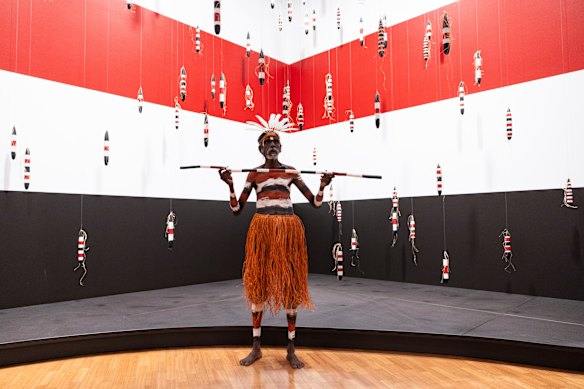
Alair Pambegan with his installation dramatising the fate of two men who butchered a flying fox colony.Credit: Alex Ellinghausen
Warraba Weatherall (b.1987), too, compels us to acknowledge the wounds inflicted on both the world around us and the bodies of those who dwell within that world, including ourselves and our loved ones. Mother-Tongue, a haunting installation of stainless-steel mortuary tables, centres a Kamilaroi understanding of the equivalence between our anatomy and that of a tree – “legs as trunk, arms as branches, and tongues as leaves” – dissected and desecrated by the ongoing atrocities of exploitative and extractive regimes. A parallel equivalence is also central to Thaiday’s work, in which shots of the artist’s body in extreme close-up are paired with aerial perspectives of polluted ocean waters and bleached coral reefs.
The watery theme of Just Beneath the Surface is echoed in Mooney’s towering yet affectionate digital portraits of queer couples in the adjoining space. Diverse in appearance and desire, the lovers immortalised in his Resilience in Bloom are nevertheless united by their adornment with iridescent drops of water, described in the accompanying caption as “glistening jewels, sweat and tears,” highlighting the entanglement of the personal and political.
Such nods to the exhibition’s underlying theme are picked up again, and even more explicitly, by Grace Kemarre Robinya (b.1942) and Yarrenyty Arltere Artists in Kukawarra kwatja, pmara nhanhanama marra inthurra, soft rain, strong Country. Both Robinya’s paintings in acrylics on canvas and Yarrenyty Arltere Artists’ fabric sculptures rejoice in the elemental power of rain, as a life-sustaining and transformative force for Culture and Country. Beautiful Ulkumanu (old woman), after the rain, a composite avatar of maternal protection rising from sewing machine feet and carrying a bumper harvest of kangaroo tails and bush tobacco, stands “with that good feeling ... for what is going to grow and come and be re-born ... looking after Country, looking after family”. Connecting the sky above, the land below and the oceans in between, rainfall is identified as a recurring motif and animating theme for the exhibition.
Loading
At first glance, the installations commissioned for After the Rain seem relatively independent. Each artist brings their own deeply personal vision, offering an eclectic range of responses to Albert’s guiding premise. As visitors move through the space and engage with both the works on display and the generous accompanying texts, however, moments of resonance like those outlined above emerge, softly at first, then ever more impermeably. The rain brings the flood, crisis and devastation, but also fosters new growth and soothes open wounds. The rain brings cleansing and renewal, mingling the sweat, blood, and tears of the past with the hopes of the present and the promise of the future. Above all, the rain brings us together, individual drops accumulating into a roaring torrent that will engulf and uplift all in its path.
The 5th National Indigenous Art Triennial: After the Rain is at the National Gallery Australia, Canberra, until April 26.
Dr Alex Burchmore is an art historian at the Australian National University, Canberra, specialising in the study of Chinese art.
Most Viewed in Culture
Loading