3 months ago
14
3 months ago
14
Juna Moon,BBC Korean, Seouland Fan Wang,BBC News, Singapore
Watch: Yoon Ga-eun talks to the BBC about her film, The World of Love
Yoon Ga-eun was not a name many would have recognised in South Korea.
That is until her movie about a teenager who is a survivor of sexual violence became a dark-horse hit.
"It hasn't really sunk in yet," indie filmmaker Ms Yoon told BBC Korean at a studio in Seoul in late November. "Now I just feel almost blank - just grateful, and also a bit scared."
The World of Love has been dubbed the "movie of the year" by Korean media for its touching, empathetic portrayal of life after trauma. Instead of recreating the crime, the movie tells the story of what comes after: the everyday life of high-schooler Joo-in, from school to romance to family and friendships, and all the moments of conflict and joy that go along with it.
It has earned the praise of critics and audiences, and more than $1.1m in box office revenue since its debut in October. Viewers have given it a 9 out of 10 on South Korea's largest search portal, Naver.
"Simply a masterpiece," is how Bong Jun-ho, director of the globally acclaimed film Parasite and the first Korean to win an Oscar, described it. He called himself the "head of the Seoul branch of Yoon Ga-eun's fan club".
The film has resonated in a deeply patriarchal country, where women say they fight hard just to be heard. And its surprising success is a sign of the growing willingness to engage in conversations about sexual violence and how survivors are treated.
'That's not all I am'
The World of Love may not seem like an obvious choice for movie-goers.
The Korean title, "Joo-in of the World", says little about the plot. While it stars Parasite actor Jang Hye-jin and K-drama star Go Min-si, the lead is played by Seo Su-bin, a new face on the big screen.
At its heart, this is a story about the the life of 17-year-old Joo-in.
Everything is going well for her. She is popular at school, has a devoted boyfriend, and lives with a caring mum and adorable younger brother.

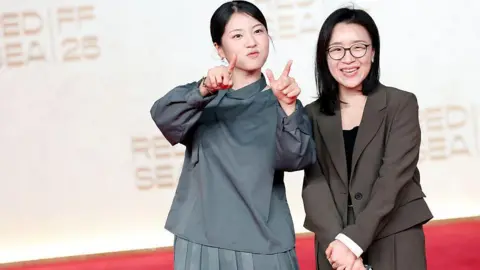 Getty Images
Seo Su-bin (left) debuts in the film's lead role as high-schooler Joo-in
Tension begins over her refusal to sign a petition at school. A man who assaulted a 10-year-old child is about to be released from jail into her neighbourhood. So a fellow student starts a petition calling for the suspension of his release. Joo-in is the only one who refuses to sign.
She objects to a single line in the petition: "Sexual violence leaves deep wounds that never heal and completely destroys a person's life and soul."
"I can't agree with this statement," Joo-in tells the student who drafted it.
The standoff ends up revealing her secret: she was raped by a relative when she was younger.
Despite the harrowing theme, Ms Yoon is determined to explore the fullness of Joo-in's life, whose name means "owner" or "master" in Korean, alluding to the autonomy Ms Yoon envisioned for her character.
Journalists who attended the media screening received a hand-written letter from Ms Yoon asking them to avoid mentioning sexual violence while covering the film.
"The story is more about how we look at her," Ms Yoon explained to the BBC, adding that she didn't want to pin a label - childhood sexual abuse survivor - on her protagonist.
"Because Joo-in herself refuses that. It's one part of her identity and it shakes her, but she insists, 'That's not all I am'."
When she decided to make a film about sexual violence, Ms Yoon was clear about one thing. She did not want it to be predictable.
During her research, she said she "watched pretty much everything that was out there" on this subject. She spoke with survivors and consulted activists. Those conversations shattered the "prejudice" she carried, an ignorance that "reduces a person entirely to their wound".
"We spent so much time talking about completely ordinary concerns," she said. "Worries about work, family, friendships and romances, about needing to lose weight or gain weight or exercise more. I think those moments dissolved even that last tiny bit of prejudice I still had."
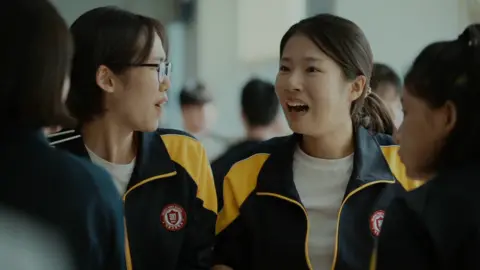 Barunson E&A
The World of Love is South Korea's highest-grossing indie film of 2025
This touched audiences.
Those who liked the film say it challenges the stereotypes we project onto survivors of sexual crimes, encouraging audiences to see them differently - people who are part of society and trying to live their lives like everyone else.
When Seo Jinwon, a children's book editor watched the film in Seoul, she said, the cinema "fell completely silent" as the film ended.
"No-one rushed to leave. I stayed and watched the end credits. I walked out of the cinema thinking, 'I want to be a good adult who can stand beside all the children and teenagers who are trying so hard to grow up'."
A sexual violence survivor who wished to remain anonoymous said she had an urge to "stretch my arms and cheer" when she walked out of the cinema.
"Joo-in gave me so much. At the end, it felt like she was smiling at me and saying, 'I am living well, so let's keep living well together'."
The right moment
The World of Love is doing what activists have long worked towards, according to Cho Eunhee, director of Korea Sexual Violence Relief Center who worked as a consultant on the film.
The timing, she added, "is incredibly right".
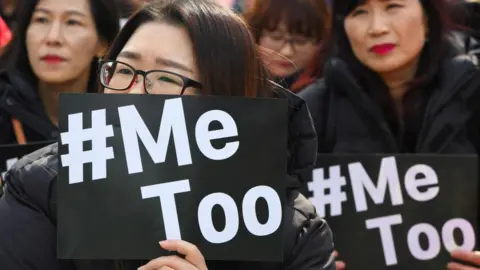 AFP via Getty Images
South Korean women at a demonstration on International Women's Day in 2018
After the 2017–2018 MeToo movement, it became easier for survivors to share their stories, and the country grew more protective and understanding towards them. By 2025, when Ms Yoon's film was released, "people were more prepared to empathise with a story like this," Ms Cho said.
She wonders if, even a few years earlier, the film would have "found this level of public understanding".
While the MeToo movement sparked conversations about harassment and assaults in workplaces and outside the home, exposing abuse within families, she said, is still widely seen as "spitting in one's own face" - but this movie has made more room to talk about it.
The World of Love is not without its critics. Some viewers, including survivors, said it felt unrepresentative of their reality because it downplayed the fear and lasting damage of abuse, portraying families as more supportive than they often were.
But criticism does not overshadow the film's value, critic Min Youngjun said, adding that The World of Love has created a healthy space for talking about sexual violence and its victims.
"The mark of a good film is not how many people liked it versus didn't like it. What matters is whether it creates a space in which we can talk to each other about what it has put on the table."