3 months ago
28
3 months ago
28
Since World War II, Sydney’s commercial fishermen have been overwhelmingly of Sicilian or Calabrian origin. Their fishing boats could be found anchored west of the Harbour Bridge at Hen and Chicken Bay, Iron Cove and, in earlier years, Darling Harbour.
For decades, scores of Italian fishing families lived in Woolloomooloo, where they moored their small boats. In 1970, Fish Trades Review reported that “the Woolloomooloo fishing fleet has been kicked out at last and is now domiciled at Blackwattle Bay”.
Concerns about where Sydney’s fishing fleet would berth soon faded into insignificance because of an existential challenge facing Sydney’s fishermen. By the 21st century, Sydney Harbour-based commercial fishing was in serious and inexorable decline.
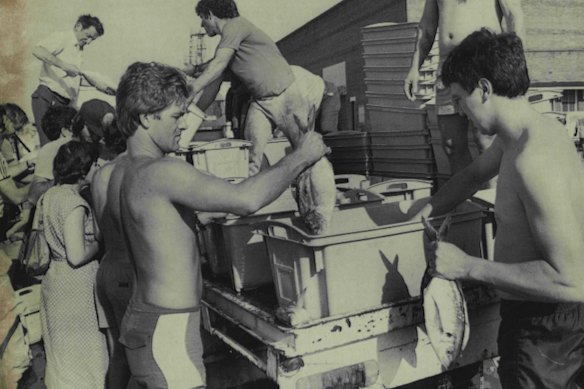
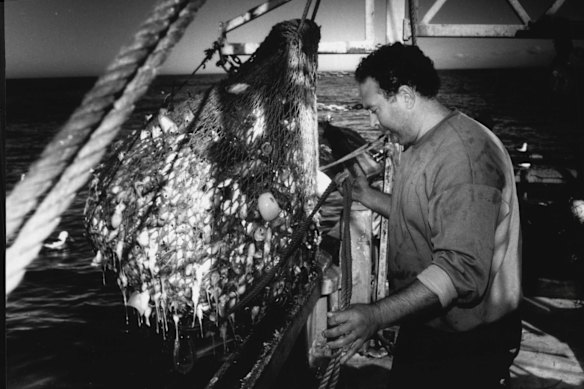
Domenico Bagnato in the 1980s.Credit: Fairfax Media
The 2006 ban on all commercial fishing in Sydney Harbour meant a total loss of livelihood for Italian fishermen working in the harbour. The secretary of the Commercial Fishermen’s Association, Graeme Hillyard, responded to the ban by stating that 13 fin fishermen and 17 prawn fishermen and their families were “now in pretty drastic situations”. He wanted compensation. “They’ve got no income. They’ve got no prospects. Obviously, you can’t sell the business.”
Only seagoing net trawlers operating outside the Harbour remained viable. Only one family of fishermen continued in the commercial net trawling industry based in Sydney: the Bagnato family.
Home for the Bagnatos was originally Bagnara Calabra, a Calabrian fishing village on the Tyrrhenian Sea coast. The family had been fishermen for 10 generations: “If you’re born a Bagnato, you’re born a fisherman.” Diego was the first Bagnato family member to arrive in Sydney – in April 1957, aged 29.
By the early 1960s, all of Diego’s six brothers – Vincenzo, Giuseppe, Paolo, Domenico, Rocco and Salvatore – had arrived in Australia. The Bagnatos proved to be successful fishermen and successful businessmen. After more than half a century at the Sydney Fish Market, the Bagnato family continues to dominate the wharves at Blackwattle Bay and Sydney’s fishing fleet.
At times the Bagnato brothers worked together, other times independently – fishing all the while. The brothers and their families made history along the way. After Vincenzo immigrated to Australia, he joined forces with Diego, first working on the Isabella Star, then building a new trawler, the Immacolata Prima. When the Fish Marketing Authority’s Blackwattle Bay market opened in July 1966, the Immacolata Prima became the first trawler to unload a catch for auction at the new facility.
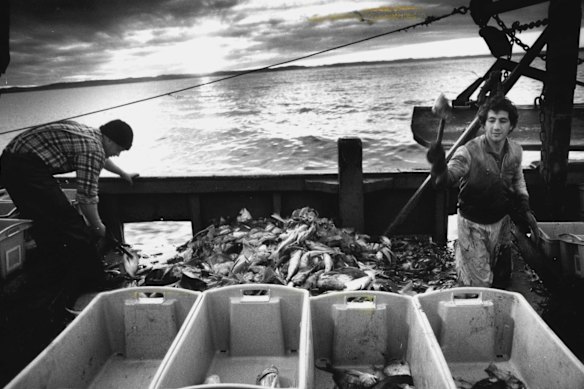
Deckhands on the Arakiwa, a Bagnato trawler.Credit: Andrew Taylor/Fairfax Media
Dozens of fishing trawlers have been bought, sold, handed down the generations or relentlessly worked by the Bagnato family. Giuseppe and Paolo teamed up to buy the Isabella Star from Diego, one of a long line of trawlers and fishing vessels they owned. Salvatore and Rocco established a profitable partnership when they returned to Italy in the late 1970s. While Rocco stayed in Italy, Salvatore was back in Australia five years later to buy and operate another trawler, the Jody Ann.
All the Bagnato brothers faced the dangers of the sea, though nothing was more dramatic than a life-threatening emergency involving Domenico aboard the Leeton Star with Giuseppe: A fishing net got caught at the side of the boat as they were shooting the net to sea. As he moved to free it, his boot became tangled in the net and he was dragged overboard and under water. Luckily, the quick-thinking Giuseppe managed to winch the net back up at top speed, saving Domenico, and the two were back at work within the hour.
Joe Bagnato the skipper/owner of the Arakiwa.Credit: Andrew Taylor/Fairfax Media
Like their fathers, the sons of nearly all the seven Bagnato brothers became fishermen. Many ply their trade on the Hawkesbury River, near Sydney. Others have returned to fish in Italy. The handful of fishermen who own and operate Sydney’s tiny fishing fleet have direct links to the Bagnato family. By 2025 only two trawlers – the Cape Conway and the Illawarra Star – constituted the fleet. After a long working life, the Kirrawa landed its last commercial catch of 1.3 tonnes (82 crates) of product before retirement in mid-July 2024. The three net trawlers provided almost 400 tonnes, 3.6 per cent of the total tonnage of product auctioned at the market in the 2023-24 financial year.
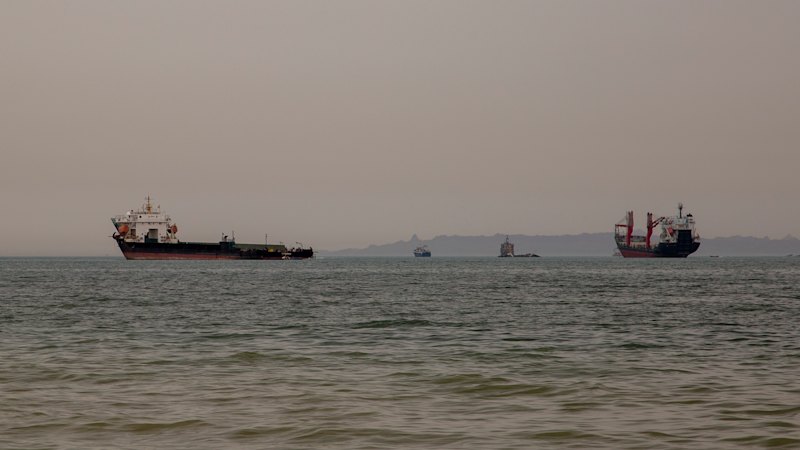
Working vessels berth at the market’s Concrete Wharf, the only wharf in Port Jackson where commercial fisherman are permitted to unload their catch. (Congestion at the Concrete Wharf can occur if longliner tuna boats operating on the east coast of Australia need to unload in Sydney.)
The Cape Conway was purchased by Domenico Bagnato’s son Diego – known to all as “Richie” – in 2014. “It cost me a lot of f--king money,” he said. The vessel worked originally as a prawn and scallop trawler between Esperance and the Gulf of Carpentaria. The Cape Conway’s steel hull means it can handle heavy weather when other fishing boats are unable to leave their moorings. It has a holding capacity of 30 tonnes: with a 20-tonne fresh or frozen fish hold and a 10-tonne brine hold. These days, Richie Bagnato no longer skippers the Cape Conway. As the vessel’s owner, he still makes key decisions about its fishing operations, but from the shore. He believes it doesn’t matter who is at the helm: “Any skipper on the Cape Conway looks good.”
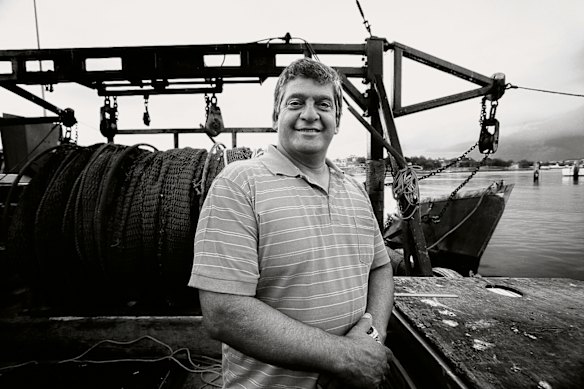
Paul Bagnato has been the voice of the Sydney fishing fleet.Credit: Jennifer Soo
Paul Bagnato, Vincenzo’s son, is the owner and operator of the Illawarra Star. In 1978 it commenced deep sea royal red prawn trawling, based in Wollongong. Paul, who purchased the Illawarra Star in 2021, is justifiably proud: “It’s a beautiful boat. It handles the soup pretty good. She catches very well, thank God.” As an experienced trawlerman, Paul believes the trick of trawling is a heavy boat “so the weather doesn’t knock the boat about”. He is in no doubt about the trawler’s merit: “It’s the strongest timber fishing vessel in Australia.“
Paul Bagnato has been the voice and face of the Bagnato family and Sydney’s fishing fleet since the retirement of his father’s generation. With only two net trawlers left after the Kirrawa’s signing off, his last few words are tinged with sadness: “You know, fish trawling is a dying art, and all that experience is being lost.” The Kirrawa, a 60-foot timber vessel, had a long Bagnato family history. It was purchased by Diego and his son-in-law Antonio Ianni in 1968. Diego’s other son-in-law, Giovanni Tripodi, was their hardworking deckhand. Domenico Bagnato bought the trawler from his brother in 1976. During the gemfish glut of the 1980s, Domenico landed the trawler’s biggest ever catch of nearly 17 tonnes.
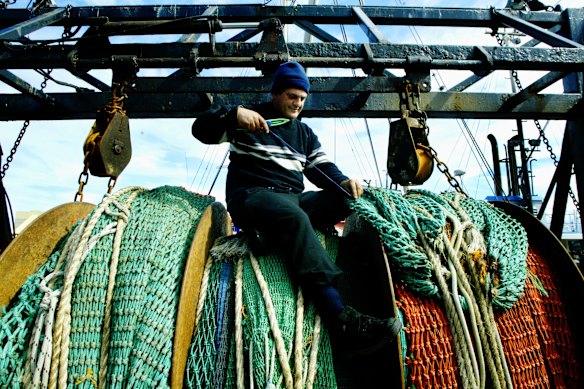
Paul Bagnato on his boat Antonia.Credit: Anthony Johnson
As a teenager, Richie Bagnato followed his father to become the Kirrawa’s skipper. Work was hard. No autopilot. No large hydraulic net drum. Nets were pulled in by hand. Richie recalled: “It was a very old-school boat; it sorted the men from the boys real quick.” The young man who had worked as a deckhand on the Kirrawa in the 1970s, Giovanni Tripodi, bought the boat from his cousin in 2009. By August 2024 the Kirrawa’s working life was over.
The second wharf at the fish market is known as the Timber Wharf, never to be confused with its concrete counterpart. Three small trap and line fishing boats are moored there. They undertake seasonal work. The Jordan’s and the Xanadu are commercial eastern rock lobster fishing boats, with their catch subject to the NSW Fisheries’ quota management system. The Miss Charlotte G has a permit to explore commercial fishing opportunities for the highly prized eastern crystal crab.
These vessels aside, local trawl fishermen are very wary of the Timber Wharf. They quietly say, “Boats go over there to die.” Paul Bagnato is more brutal. He describes the wharf as a “graveyard”. One boat long mothballed on the Timber Wharf is the San Fransisco, the last of the old harbour prawners in Blackwattle Bay. It is a decaying reminder of the vibrant harbour fishing industry that sustained Italian families around Sydney for decades. In addition to the Kirrawa, four other retired net trawlers are mothballed at the Timber Wharf – the Immacolata, the Arakiwa, the Francesca (described by Diego Bagnato as “a beast of the sea; unmatched in Sydney waters for its beauty, stride and class”) and the Seaport.
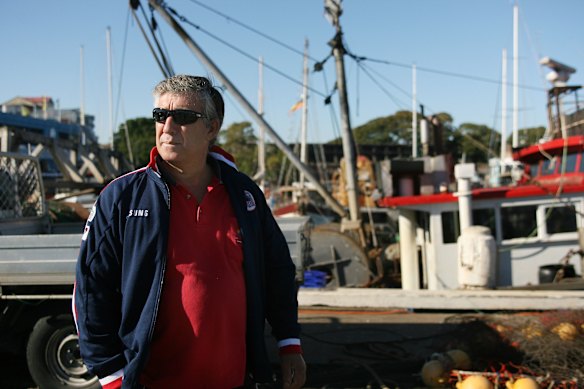
Dick Bagnato had a close call at sea.Credit: Kate Geraghty
Many fishermen will say fishing can be a dangerous game – no matter how experienced you are. The Seaport nearly foundered on Sydney Heads in 2014. Dick Bagnato described the emergency: “My deckhand fell asleep, and we were heading towards the Heads. I was just laying down, and I got up, the steering wheel got jammed, I couldn’t take the autopilot off, so I broke it off. I don’t know how I had the strength to break a chain that thick.
“I broke the chain, turned the wheel, and we were that close I could have jumped on the Heads. A big swell, three or four-metre swell, I think it was, when the wave came up, she washed us close, and then she comes back, the surge of the wave, and she pushed us away.” Dick Bagnato believes he survived that day because of the Madonna. Like all Italian fishermen, Dick gives thanks for his safety to the Madonna, who watches over his shoulder every time he heads out to sea.
The new Sydney Fish Market will open on Monday, January 19. The Bagnato family will berth its vessels at the site, where a new wharf is completed and operational. Removal of the old concrete and timber wharves is being considered as part of the design process for a passenger ferry wharf.
An edited extract of Fishy Business: The story of Sydney and its fish markets (Allen & Unwin) by John Faulkner, available now.