3 months ago
27
3 months ago
27
By Elwely Elwelly
January 2, 2026 — 11.47am
Dubai: Several people were killed as unrest spread across Iran amid the biggest protests to hit the Islamic Republic in years, with the government moving to quell demonstrations fuelled by rising prices, a collapsing currency and high youth unemployment.
The semi-official Fars news agency reported that three protesters had been killed and 17 injured during what it said was an attack on a police station in Iran’s western province of Lorestan.
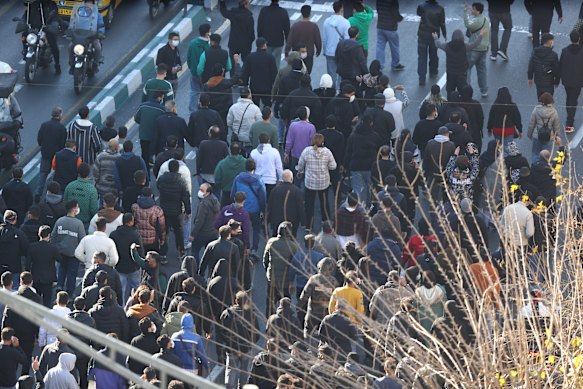
Protesters march in downtown Tehran on Monday.Credit: AP
“The rioters entered the police headquarters ... they clashed with police forces and set fire to several police cars,” Fars reported.
The most-intense violence appeared to strike the Lorestan city of Azna, about 300 kilometres southwest of Tehran. There, online videos purported to show objects in the street ablaze and gunfire echoing as people shouted: “Shameless! Shameless!”
Earlier, Fars said two people had been killed in Lordegan, in the country’s Charmahal and Bakhtiari province, in clashes between security services and what it called armed protesters. Rights group Hengaw said several people had been killed and wounded there by security forces.
Loading
Online videos showed demonstrators gathered on a Lordegan street, with the sound of gunfire in the background. The footage matched known features of the city some 470km south of Tehran.
Authorities also confirmed one death in the western city of Kuhdasht, and Hengaw reported another death in the central province of Isfahan.
The Revolutionary Guards said one member of its affiliated Basij volunteer paramilitary unit had been killed in Kuhdasht and another 13 wounded, blaming demonstrators. Hengaw claimed the man – named by the Guards as Amirhossam Khodayari Fard – had been protesting and was killed by security forces.
Reuters could not immediately verify any of the reports.
The clashes mark a significant escalation in the unrest that has spread across the country since shopkeepers began protesting on Sunday. What started with merchant anger over the government’s handling of the economy soon morphed into broader anti-regime demonstrations, with students from a number of Iranian universities joining in.
As the protests entered their fifth day on Thursday, clashes intensified in several locations, London’s Telegraph reported. Protesters in more than a dozen cities chanted, “this year is a year of blood, Seyyed Ali will be overthrown” and “death to the dictator” – a reference to supreme leader Ali Khamenei.
Shops in Tehran’s Grand Bazaar, where closures have historically signalled political strife for the government, remained shut for a fifth day.
The government shut down much of the country on Wednesday, declaring a holiday due to cold weather.
Loading
The unrest has spread rapidly across Iran on a scale not seen since 2022 protests that followed the death in police custody of Mahsa Jina Amini, 22, who had been arrested for allegedly not wearing her hijab correctly.
Protests also took place on Thursday in Marvdasht in the southern Fars province, the activist news site HRANA reported. Hengaw said demonstrators had been detained on Wednesday in the western provinces of Kermanshah, Khuzestan and Hamedan.
Workers from Tehran’s massive fruits market also joined the protests on Thursday, the Telegraph reported, citing footage online showing crowds demonstrating against rising prices. The market has been particularly hard hit by currency fluctuations that have driven up the cost of imported goods.
Residents in multiple cities told the Telegraph that security forces had blocked roads and maintained a heavy armed presence on the streets.
Siamak, a boutique owner in Nahavand, told the Telegraph that riot squads and protesters clashed on Wednesday night and Thursday morning
“They were shooting pellets without any regard for whether they would kill or blind people. I saw two people soaked in blood,” he said.
Iran’s clerical rulers are grappling with Western sanctions that have battered an economy already reeling from more than 40 per cent inflation, compounded by Israeli and US airstrikes in June targeting the country’s nuclear and ballistic missile infrastructure and military leadership.
The Iranian rial lost about half its value against the US dollar in 2025, with official inflation reaching 42.5 per cent in December. Young people also face high unemployment, even after years of study.
Tehran has in recent years responded violently to protests over issues ranging from high prices, droughts, women’s rights and political freedoms.
Government spokesperson Fatemeh Mohajerani said on Thursday that the authorities would hold a direct dialogue with representatives of trade unions and merchants, but without giving details.
Protesters, however, have vowed not to back down. Houman, an arts student at a university in Tehran, told the Telegraph that he had joined the protests on Tuesday night – knowing he could be killed.
“Most of us understand the risks, yet we still go because we are tired of the regime,” he said.
“They have made our lives miserable just to fund Gaza and Lebanon. We are facing economic hardship, and sometimes I struggle to afford even a pack of cigarettes.
“People reached a breaking point a long time ago, and now they are showing their frustration. We have nothing to lose. I would be happy if they killed me – we will not back down this time.”
President Masoud Pezeshkian has said there was little he could do as Iran’s rial currency rapidly depreciated, but on Thursday he said the government urgently needed to address the concerns.
“According to God’s Koran, if we do not solve people’s problems, we will have a place in hell,” he said in an interview with a local television station during a visit to southwestern Iran, The New York Times reported.
Reuters, AP
Get a note directly from our foreign correspondents on what’s making headlines around the world. Sign up for our weekly What in the World newsletter.
Most Viewed in World
Loading