
 1 month ago
59
1 month ago
59
Jacinta Allan’s abrupt resignation as premier on Tuesday appeared swift, but her political collapse took three years to build. Ultimately, a refusal to confront construction industry corruption stripped her government of oxygen.
Eventually, her colleagues decided she needed to go and her replacement, Ben Carroll, declared the establishment of a royal commission into construction would be his first act.
Below is a visual look back at the road to this point – the Building Bad series, the attempted policy pivots, the gathering political storm and, ultimately, 48 chaotic hours ending in a leadership change.
Allan was at a podium, facing a wall of cameras under harsh fluorescent lights, responding to The Age investigative reporter Nick McKenzie’s question about intimidation on Victoria’s Big Build with one of her own.
“So if I can ask, Nick,” a clearly worried Allan asked McKenzie when he referred to a written warning she was sent, choosing her words so carefully that she almost seemed to freeze. “What, what, what, what have you got that shows that they [allegations] were put to me in writing?”
It was a Monday in July, 2024 and The Age, The Sydney Morning Herald, 60 Minutes and The Australian Financial Review had spent the weekend publishing its first Building Bad stories. Two hundred articles in the series later, Allan is gone and her response to the scandal is at the heart of her political demise.
For nine years as transport infrastructure minister and then-premier, Allan was the public face of Victoria’s $109 billion Big Build. On this afternoon two years ago, she was forced to answer for the alleged corruption that had festered inside it.
Allan is tough and used to staring down questions from reporters. But this press conference was the beginning of the end of her time leading Victorian Labor.
The Age’s joint investigation exposed how outlaw motorcycle gangs and organised crime infiltrated state-funded infrastructure sites. Systemic extortion, workplace intimidation, and kickbacks all operated across major government contracts. All on her watch.
CFMEU chief John Setka resigned on the eve of the series’ publication. Allan attempted to draw a line between her administration and union misconduct – suspending the construction division from the Victorian Labor Party, and insisting many of the allegations belonged in the remit of Victoria Police, anti-corruption authorities and the federal government – refusing demands to establish a broader inquiry.
Ultimately, that strategy of trying to make the problem belong to someone else – and a refusal to take accountability, with no minister or public servant suffering any consequence from the rolling scandal – would become an anchor on her premiership.
When corruption-busting barrister Geoffrey Watson, SC, delivered his report, estimating that union-enforced practices and underworld rorts had cost Victorian taxpayers up to $15 billion, the government ridiculed him.
He would probably not have been surprised given that he had characterised parts of the government’s response to CFMEU outrages as tantamount to a cover-up.
For two years, Allan maintained that existing integrity bodies held sufficient power.
Former ombudsman Deborah Glass and former IBAC commissioner Robert Redlich publicly rejected that stance, describing the Big Build revelations as an unprecedented integrity crisis and calling for a royal commission.
The Queensland government had seen enough by mid-2025 and called its own commission of inquiry. That process has lifted the lid on players and businesses strongly relevant to Victoria and leaving many wondering why the exposure was occurring in another state.
By mid-2026, the issue had turned into a daily siege as The Age revealed countless warnings to the government, the inability of police to tackle the problems, allegations of ministerial intervention, the ongoing payments to the underworld and the very real costs to taxpayers.
For weeks leading into July, every press conference for every minister devolved into the same question: why not hold a royal commission?
As the integrity scandal gathered pace, Allan tried to reshape her standing through a series of rapid policy turns.
The pattern had begun a year prior, in July 2023, when Daniel Andrews scrapped the 2026 Commonwealth Games, citing cost blowouts from $2.6 billion to more than $6 billion.
Two months after Andrews dumped the Games, Allan began her 1036 days as premier, saying she wanted to “chart a future course for the state”.
But as 2024 got underway, and community anxiety over violent youth crime was threatening to overwhelm her government, Allan executed an immediate U-turn.
She abandoned a pledge to raise the age of criminal responsibility to 14 and tightened state bail laws.
Then, in an attempt to reclaim the progressive narrative, her office launched an inquiry into women’s pain, with Allan talking about her own experience of endometriosis (which she also referenced in her resignation speech).
She also opened Australia’s first statewide treaty negotiations with First Peoples, and set about legislating the right to work from home two days a week, among other initiatives.
The government rolled out free public transport for children; then during the 2026 fuel crisis, Allan expanded this free travel for a time to all Victorians.
Through 2025, flagship mega-projects that had once been the life-force of the Andrews Labor government seemed to become less like assets and more of a liability as more questioned their enormous cost.
Infrastructure Australia warned in March that the Suburban Rail Loop’s first stage would likely exceed its $34.5 billion budget, and suggested the government find an “exit strategy”.
On November 30, the $13.5 billion Metro Tunnel was opened to major fanfare, as Melbourne got its biggest public transport capacity boost since the City Loop.
It was a triumphant day for Labor, but one that failed to turn the tide with the increasingly switched-off electorate.
Australians delivered Labor a thumping federal election victory on May 3, 2025. Two days later, Victoria’s budget revealed the state was on track to record debt of $194 billion.
Before the poll, insiders were predicting that a poor result for Labor could end her premiership. Instead, the strong result bolstered her position. She assertively claimed her role in Labor’s emphatic federal win.
“The incredible results for Labor in our state aren’t despite what’s happening in Victoria but because of what’s happening here in Victoria,” Allan told reporters.
A parade of senior ministers stepped before television cameras across late 2025 and early 2026, delivering identical lines of “full support”.
But opinion polls proved voters differentiated between federal and state issues.
By year’s end, Labor’s primary vote had slid to just 28 per cent, according to Resolve, while Allan trailed new opposition leader Jess Wilson 24 to 41 per cent as preferred premier.
Meanwhile, a third force emerged in Victorian politics. Right-wing party One Nation surged from seemingly nowhere as grievance politics found mainstream support, leaping from 11 per cent in the polls in January to 24 per cent support by June, threatening to cut both major parties’ lunches.
By March, Allan was batting off private leaks to media from within caucus calling on her to resign, labelling those voices “scallywags who need a bit of a cuddle”.
Weeks later, her main rival for the leadership, Carroll, was forced to deny he was out for her job after days of speculation.
Awkwardly looking her in the eye before TV cameras to declare his loyalty, adding he wanted his daughter to know he had worked to re-elect Allan in her own right.
Just 26 days ago, seemingly aware that the revelations were spiralling out of Labor’s control, Allan penned this piece for The Age – acknowledging Victorians wanted clear answers on the Big Build and apologising for criminality on government building sites – but, crucially, insisting a royal commission was not the answer.
After months of denials and a handful of half-hearted manoeuvres against her, Allan’s colleagues made their move on Sunday night.
Factional chiefs from left and right met to determine if the premier still had majority support in the party room. Key Allan ally Steve Dimopoulos cut short his overseas trip to return to Parliament House. Despite her attempts to prove otherwise, the consensus was definitive: Allan should go.
Just after 10am on Monday, once-loyal colleagues walked into Allan’s office at No.1 Treasury Place and told the premier she had lost the support of the majority of the caucus and should stand down.
As Chip Le Grand reported, they were led by Gabrielle Williams, a senior minister within the premier’s powerful Left faction. Behind Williams came Left faction convenor Matt Hilakari, Right faction convenor Ella George and ministers Anthony Carbines, Lizzie Blandthorn, Colin Brooks, Ingrid Stitt and Luba Grigorovitch. Dylan Wight, another factional convenor, was stuck in traffic and missed the meeting.
If the premier refused, a spill motion would be moved at the next day’s caucus meeting, Williams told her.
The premier’s response was defiant. She was prepared to fight them all the way. “And I expect you all to resign,” Allan added.
Later that morning, Carroll abandoned his previous pledge. He visited the premier to tell he had agreed to stand against her and posted a public statement confirming he would nominate for the leadership if a spill motion was moved. Allan initially held her position, declaring her intent to fight any ballot.
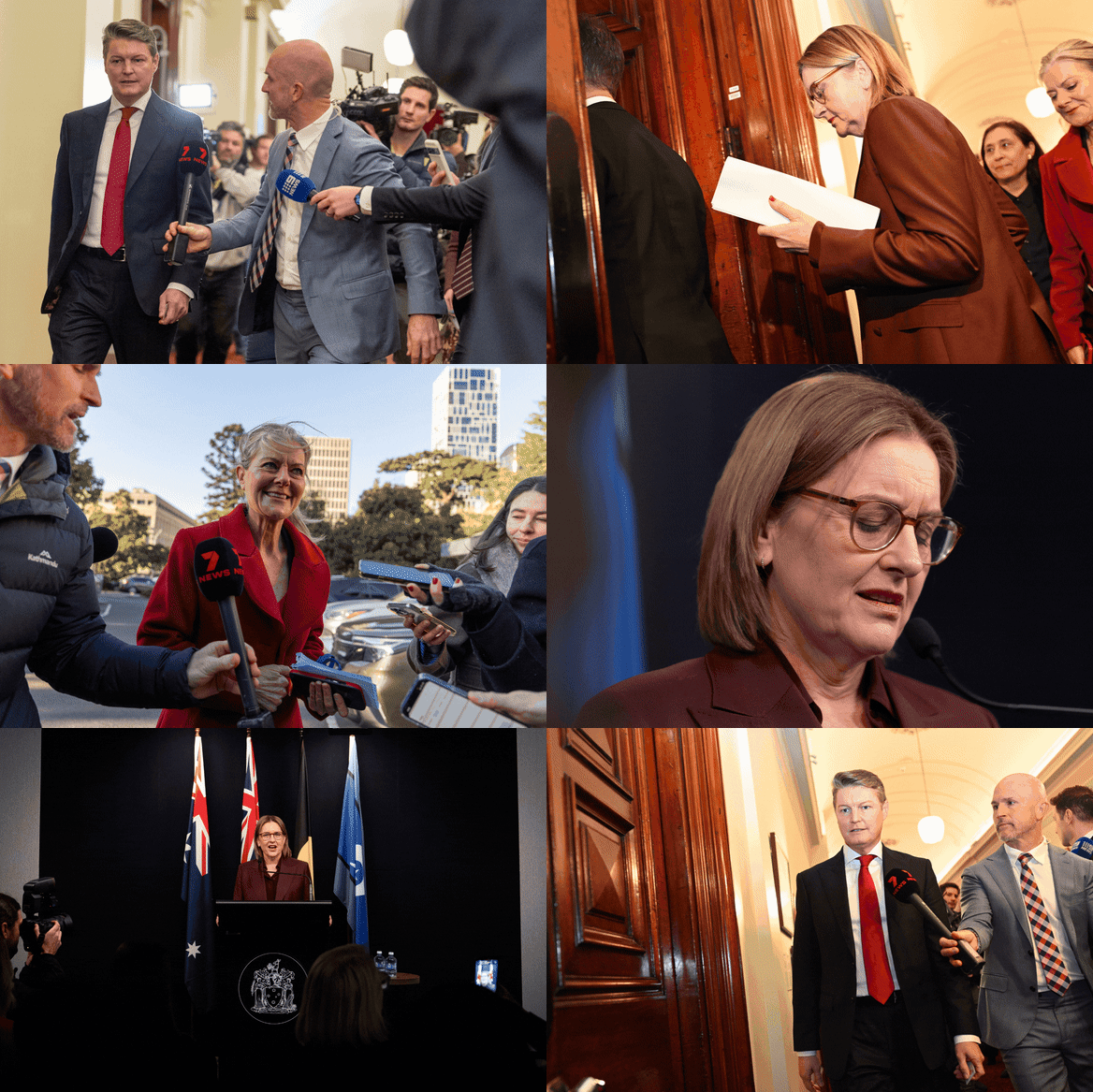
That was followed by an icy cabinet meeting where Allan faced a spirited debate over the merits of a royal commission with several ministers saying the premier’s approach did not go far enough.
The stand-off lasted less than 24 hours. At 9.45am on Tuesday, July 28, 1036 days after succeeding Daniel Andrews and 15 minutes before a scheduled party room meeting, Allan walked into press conference to announce, with some emotion, her resignation as premier and Labor leader.
Allan ended her premiership with a final address to the state: “I have always put the party and the Victorian public first. It is clear to me that to ensure stability and give our government the best foundation ahead of the November election, I must step aside. I leave with pride in our infrastructure record, our historic Treaty steps, and our commitment to Victorian families.”
She barely mentioned the controversy that precipitated her resignation, dismissing attempts to “taint” the government’s infrastructure program as a politically edged push from the opposition.
In striking contrast, Carroll’s first pledge as premier was to call a royal commission into the alleged corruption in the construction sector, the very move Allan had resisted for months.
By 1pm, Carroll had taken his seat in the Legislative Assembly as Victoria’s 50th premier.
Allan was absent from the chamber.
Building Bad: Explore our investigation
Read more about the leadership spill:
Resignation: Reading between the lines of Jacinta Allan’s farewell speech
Inside story: After an icy meeting, she still had hope. Then came a second knock at the door
Leaked secret report: Allan was warned years ago about Big Build corruption
Who is Ben Carroll? New premier’s journey from Kmart to power
Comment: Who on earth can you vote for in this state?

















































