3 months ago
18
3 months ago
18
More students than ever are expected to receive top marks in VCE subjects this year, with the marking of 350,000 papers now complete.
While the proportion of the 92,000 students awaiting results this week who will receive the highest study score of 50 has remained stable compared to last year, there are 3270 more students sitting at least one exam this year. This is set to push the number of perfect study scores to a record high.
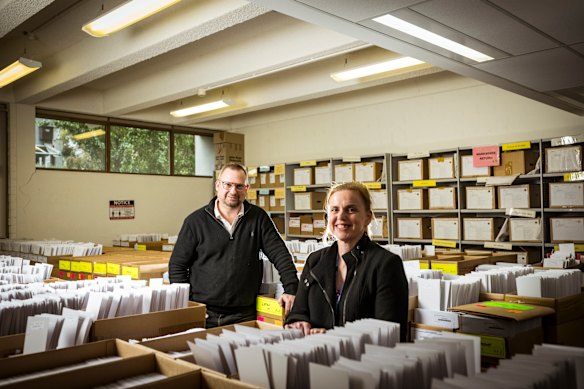
VCE physics chief assessor Andrew Hansen and Victorian Curriculum and Assessment Authority executive director Kelly Jarvis at the VCE exam processing centre in Coburg.Credit: Chris Hopkins
The Age was given a rare glimpse behind the scenes of how marking is undertaken, ahead of VCE results being released this Thursday.
When papers left the exam halls in late October and November, they were securely delivered to a processing site in Coburg, where casual staff scanned and uploaded most papers to a digital system except for several dozen subjects that are yet to make this transition and are still marked by hand.
A small army of 5182 current and former teachers and academics then got to work assessing 13 million answers to questions across 112 subjects.
The assessors don’t mark any papers from their own students, and every question is marked at least twice. If assessors disagree about a mark, a third person grades the question. When that doesn’t break the deadlock, the question goes to a chief assessor or one of their assistants.
In physics, this is the role of Andrew Hansen, a teacher at Ringwood Secondary College who receives about 2 per cent of all the exam questions in that subject, often because the handwriting is barely legible or there are convoluted workings.
“I end up chucking out huge amounts of scrap paper at the end of my marking period, where I’ve actually gone through trying to figure out what’s going on,” Hansen says. If the student has made a mistake in their workings – and therefore has an incorrect answer – this doesn’t prevent them receiving marks for using the correct logic.
For students whose handwriting is indecipherable, Hansen can order a high-resolution copy of their paper to take a closer look.
“At the end of the day, if it’s come all the way to me, this kid needs to be fairly looked at. You don’t want to go, ‘This handwriting is horrible; I’m just going to ignore it.’”
The assessors are tested too – every so often marking a “control question” that checks they are giving consistent marks.
Jacinta Sheridan, a deputy principal at St Francis Xavier College in Melbourne’s south-east and the geography chief assessor, says it is common for assessors to be slightly out in the first few days before their marking becomes highly consistent.
“Part of it is people are nervous,” Sheridan says. “It is an exhausting process because you are spending the whole time trying to be the most professional person you can be.”
Many assessors balance their day jobs with marking after work or at weekends.
“In my house, it is definitely a time that I put on the calendar and I say, ‘This is my marking period; don’t expect me to do anything at that time,’” Sheridan says.
Exams can’t be marked after 11pm, when the online system closes off.
One positive sign from this year’s geography exam, Sheridan says, were the few answers students left blank. “That’s only to their benefit.”
The Victorian Curriculum and Assessment Authority looks into any errors in the papers that might change marks. For multiple choice questions, psychometricians analyse answers to help identify if there could be multiple correct responses or phrasing of a question that could make it invalid.
One issue raised with the authority this year was a blank page in the maths methods exam followed by a question some observers thought students might have missed. But an investigation found no action was required.
Loading
“[Overall] there are some questions invalidated, but not many,” the VCAA’s executive director of assessment and reporting, Kelly Jarvis, said of trends this year.
Some papers can be marked a fifth time if the student’s exam score is out by a whole grade compared with their expected results from their school-based assessments that year.
Now marking is done, the papers stay in Coburg in case a school applies to have a student’s results reviewed. After several months, the exams will be pulped.
Working as an assessor also brings benefits for teachers who enjoy the problem-solving involved in marking and exposure to where students are at.
During the assessment period, Hansen works with other physics teachers who are the only subject-matter experts at their schools and cherish the discussion.
“It’s a meeting of minds,” he says. “They’re very clever people, and we get to pull things apart, talk about them and look at the questions.”
Hansen’s wife even bought him a gavel with his name and “chief assessor” printed on it to signal when it’s time to cut-through the academic debate.
“Sometimes you just need to go, ‘All right, we’ve had enough discussion of this. I’ve heard all your opinions on this question; when you see this response, three marks.’ Bang.”
The Morning Edition newsletter is our guide to the day’s most important and interesting stories, analysis and insights. Sign up here.
Most Viewed in National
Loading