2 months ago
7
2 months ago
7
Six days. That’s the total number England have spent playing Test cricket (out of a possible 10) since they arrived in Australia, officially, on November 10.
Nine is the number of days they have spent playing matches overall, if you include the infamous three-day warm-up they played against themselves at Lilac Hill before the first Test.
Eleven is the number of days they have held training sessions; some optional.
Nine is the number of days off (and travel days) the team has had since their arrival – and that is about to grow as the tourists head to Noosa for some R and R before the third Test in Adelaide. By the time the team begins training for the next match, the total will be 14 days off out of 34.
Coach Brendon McCullum raised eyebrows after England went 2-0 down in the five-Test series on Sunday when he suggested “five intense training days” had taken the edge off his players.
“Sometimes the most important thing is to feel a little bit fresh and make sure your top two inches is completely sound,” McCullum said.
“I think the boys just need a few days off … we’ve got a couple of days in Noosa so we can spend some time together more casually and let the dust settle on what has been a pretty intense couple of weeks and start to plot and plan our way back into the series.”
England skipper Ben Stokes endorsed his coach’s sentiments, saying “just training to train” can be “very, very detrimental”.
The reaction has perhaps best been summed up by one comment from former England fast bowler Darren Gough, who posted on social media: “Over-prepared my arse”.
Gough’s fellow Yorkshireman Geoffrey Boycott concurred, insisting “there is no substitute for competitive match cricket”.
The Noosa trip was a topic on the BBC’s coverage immediately after the end of the Brisbane Test, as the broadcasters highlighted the scrutiny on the tourists.
“The optics will be bad,” ex-England cricketer Jonathan Agnew said on the Test Match Special post-match broadcast.
“And people at home listening must prepare to see lots of photographs of England’s cricketers playing golf. And that is not going to look good.

Some of England’s cricketers, including captain Ben Stokes, hit the golf course in Western Australia. This picture was taken before the squad came together on November 10.Credit: Facebook
“Now, do you do things for optics? And what else could they do? Well, the only thing they could do, alternatively, is to go to Adelaide, to bin Noosa … [but] you don’t practise every day, you can’t practise every day.
“But you can at least be there and preparing yourselves mentally. You go to the Adelaide Oval, you do a bit of work every day, just a little bit, before building it up. But then you can go and play your golf in the afternoon.
“As I’ve said so many times – you can’t train all day. And you can’t sit in your hotel room all afternoon and evening when you’ve finished your training. You’ve got to do something. So playing golf is not the problem. The narrative has kind of built up that suggests that actually all they’re interested in is playing golf. Well, that’s not true.
“It’s unfortunate, I think, for England, and it’s entirely of their own doing, that it’s been allowed to grow while they’re losing games.”
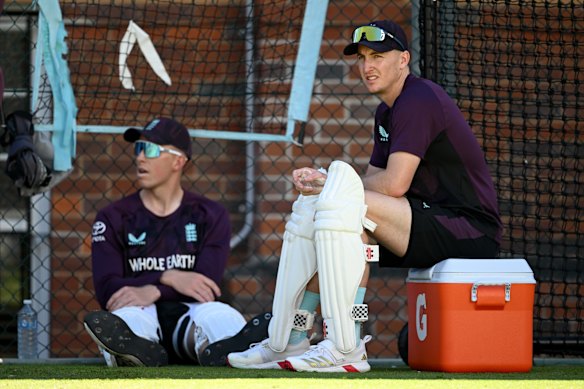
England stars Zak Crawley and Harry Brook at training.Credit: Getty Images
Former England batsman David Gower might be entitled to wonder if history is repeating.
Gower, who scored 8231 runs in 117 Tests between 1978 and 1992, was at the centre of a similar debate during the 1990-91 Ashes when he famously hired a Tiger Moth biplane to swoop over a tour match between his teammates and Queensland on the Gold Coast.
The prank riled skipper Graham Gooch, a renowned disciplinarian and fitness fanatic who was trying to reshape his team with new levels of professionalism.
Gower was fined £1000, but worse was to come. England’s leading scorer in that campaign, with 407 runs at an average of 45.2, including two centuries, was axed when the home series against Pakistan started. He was recalled, averaged 50 in his next three Tests, and was then discarded for good.
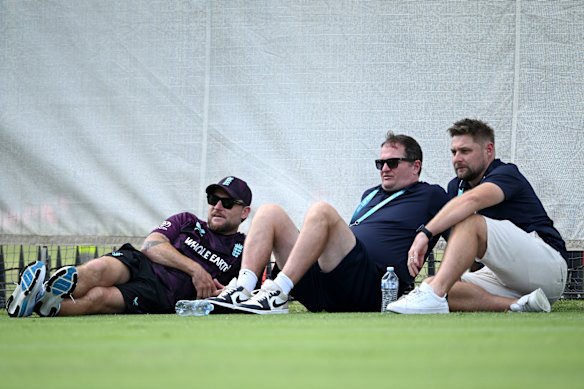
England coach Brendon McCullum (left) runs his eye over a training session on November 20.Credit: Getty Images
The laid-back Gower later recalled in his autobiography that it seemed to annoy Gooch and team management that “I could succeed without conforming to the methods that they laid down”.
Teammate Devon Malcolm later wrote that Gooch’s attitude was: “We’re not playing well, so we’ll just have to keep working even harder until we start to play better.”
The paceman added that such an approach was “ill-judged, short-sighted and unintelligent”.
Loading
That, of course, was more than 30 years ago.
It’s fair to say sports science has come a long way, but there is a sense of deja vu as former players, media pundits and fans put an under-performing team under the microscope.
The main difference is that, unlike Gower’s high-flying faux pas, this time England’s coach and captain are in the cockpit. Even if it’s a Kamikaze mission, they appear unlikely to change course.
News, results and expert analysis from the weekend of sport sent every Monday. Sign up for our Sport newsletter.
Most Viewed in Sport
Loading