
 3 months ago
68
3 months ago
68
2 hours ago
Yogita LimayeSouth Asia and Afghanistan correspondent, in Kabul
Alia - whose name we have changed for her safety - travelled hundreds of miles from her village to Kabul to escape marriage.
The journey by taxi last year with her female cousin - covered from head to toe, only their eyes visible, as the rules decree - was an exceptional thing to do, and risky in Afghanistan, where at any moment they might be caught by the Taliban inspectors enforcing rules banning women travelling long distances without a male relative escorting them.
But Alia, who is 19, and her cousin weren't stopped at any Taliban checkpoints, and made it to the capital.
"I made up an excuse to my family saying I was coming here to meet my friends and former classmates. But that's not true. They are not here. The actual reason is that if I stayed in Daykundi, I would be forced to get married."
Instead, she arrived in Kabul with a plan: she enrolled in an English language course.
These short-term, narrowly-focused private courses - available only to those who can afford them - are, along with madrasas which focus on religious education, the only options for girls to learn past primary school in Afghanistan. But neither are close to being a substitute for formal schooling.
It has now been almost five years since the Taliban stopped girls over 12 going to school, with various reasons given to explain why the ban is still in place.
Years in which girls like Alia have grown up without the education they wanted and needed. Years in which the path to a career has been effectively shut off, narrowing their options until millions of girls in Afghanistan have been left with just one choice: marriage.

 AFP via Getty Images
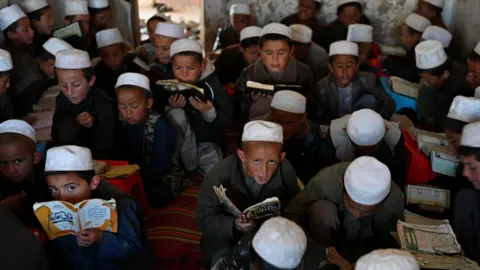
These boys are attending a madrasa, or religious school. Some religious education is available to girls
Alia's story is unusual, not just for her bravery. But she also comes from a family which has the funds to pursue the few opportunities available to young women - a rarity in a country where three in four people cannot meet their basic needs, according to the United Nations.
It's not that Alia's family do not want her to study – they accepted she wanted to stay in Kabul, and are funding her English course even now - but even they are constrained by the realities of life in Afghanistan.
"Before the ban, my parents passionately encouraged me to go to school. They told me you can definitely achieve your dream of becoming a pilot.
"But now they say the best way for me is to get married because I can't go to school, to university, I can't even work."
Alia has been receiving marriage proposals. She is afraid she might have to accept one, afraid that the family she marries into might not give her the freedom her parents do. "Some families can be very restrictive. It's possible they could tell me to forget my dreams. I don't feel positive at all about it."
But her resolve is steely. "If my family don't force me to get married, I will wait. I will resist it until my very last breath."
In a small, bare home in the west of Kabul, we meet Shama.
"If the Taliban had not taken over, I would have almost finished school by now. I would be close to my dream of becoming a doctor. That is what I wanted," says Shama.
Instead, four years ago, aged 18, she was pushed by her mother to get married. Now she is the mother of an infant and a toddler – both girls.
We have changed the names of her and her family for their safety.
 BBC/Imogen Anderson
The BBC is protecting the identities of all the women who contributed to this article
Her mother Kamila - who worked as a cleaner to put her daughters through school after her husband died six years ago - felt she had no choice. She feared that her daughter – a young woman of marriageable age – would attract negative attention and face difficulties if she stayed single.
"I was fearful that they [foot soldiers of the Taliban government] will question why I'm not getting her married," Kamila tells us.
"I had wanted her to be educated, work and contribute to society. I am illiterate so I am like a blind person. But I wanted my girls to learn. She [Shama] had so many dreams. But it didn't happen for her."
The Taliban government's ban on education has already had an irreversible impact on the lives of countless women and girls. According to the United Nations, if the ban continues until 2030, "more than two million girls will have been deprived of education beyond primary school in a country that already has one of the lowest female literacy rates in the world."
"Having a husband is not the only dream a woman has. She needs to stand on her own two feet first, become independent and then she can marry and start a family. But I went into this new life with none of that. My dreams remain unfulfilled," says Shama.
Before the Taliban takeover, Shama turned down many marriage proposals.
"I refused them because my education was more important to me than anything. What I wanted for myself was not what they [prospective husbands] wanted for me," she says.
Now she says she is constantly stressed, triggered even when she watches movies in which female characters are depicted as working or studying.
She is treated well by her husband, but the grief of not having had the chance to achieve her potential never leaves her. "It is really difficult for me. I feel like I am trapped in my home. I only live for my children," she says.
Her 18-year-old sister Nora now fears she too will face the same fate.
"I'm too young to get married. I want to continue my education. It's like being in prison. I fear going out because of the government, and at home my mother tells me I must get married," Nora, who often dreams of being back in school, says.
But she doesn't believe she will ever return to school under a Taliban government.
"The Taliban government said that schools are closed for girls until further notice. But it has been four and a half years now. We have been waiting for that message every day."
Since 2021, the Taliban's government's response to the question of when school will reopen for girls has veered from one reason to another, landing now on deflection and silence.
Back in September 2021, in our first interview with a Taliban spokesman after they seized power, the spokesman said schools for girls would open, adding they were "working to improve the security situation".
A year later, the answer was that "religious scholars have issues with the safety of girls travelling to and from school", but they were working on the problem.
In 2024, the Taliban government's deputy spokesman Hamdullah Fitrat told me: "We are awaiting the decision of the leadership."
This month, I once again met Fitrat, who didn't want to be pictured with a woman or sit across from me. I asked how they can continue to justify the ban on secondary school and university education for women.
He answered, pointing out "that around seven million boys and five million girls are currently studying".
"The restriction on education beyond grade six is a separate issue," he said, directing us to the ministry of education who would "hopefully… provide a satisfactory response".
When I pressed further, saying women and girls in Afghanistan have told us they do not believe education will ever open under the Taliban government's watch, his response once again was to ask the education ministry.
We did ask the education ministry the same question. They did not respond.
There are divisions within the Taliban government on the issue of women's education which have been evident to us, but the supreme leader has only hardened his stance through the years.
The women and girls remember the day schools closed for them as clearly as it was yesterday.
"All I did was cry and sob the whole day and night," Alia recalls. "I could not sleep for a week. I felt like I was walking around like a dead body."
"When I see men my age who have graduated and are going to university - I feel very bad, I feel like I am burning in hell," she adds.
Women face a slew of other restrictions imposed by the Taliban's supreme leader, vigorously enforced in some places, with a bit more freedom in others.
But the diktats evoke fear among people. The collective impact of government enforcement, and in some cases self-imposed restrictions, is that women are all but absent from public life.
Defending his government, Fitrat says "We have issued thousands of permits to women to run businesses which is a positive step."
He also claimed that the Ministry for the Promotion of Virtue and Prevention of Vice – the Taliban government's morality police – resolved more than "2,000 cases in which women had been denied their rightful share in inheritance" and "2,500 women who were being forced into marriage, or underage were assisted".
But in this past week, the Taliban government has written into law rules that imply legal approval of child marriage, and in which a minor girl's silence is allowed to be interpreted as consent to marriage.
And the evidence on the ground suggests otherwise – that the prevalence of underage and forced marriages is increasing because girls are barred from studying.
Among the women and girls we spoke to there is a sense that one of the most severe forms of institutionalised discrimination does not trigger as much shock or outrage any more. They feel abandoned by the world.
"If we hadn't been forgotten, then something would surely have been done by now," says Alia.
"I often think: why were we born in Afghanistan?" says Nora.
Her mother Kamila has a message for mothers around the world.
"In a world where your daughters are allowed to study and work, let them do it. Let them become independent.
"Here in Afghanistan, it's over for us."
Additional reporting by Imogen Anderson, Mahfouz Zubaide and Sanjay Ganguly

















































