3 months ago
23
3 months ago
23
By Jesse McKinley
January 1, 2026 — 7.30pm
New York: It was the kind of piece that rarely lands on an editor’s desk, both completely raw and perfectly realised.
A November essay in The New Yorker by Tatiana Schlossberg, the environmental journalist and scion of the Kennedy family, was not assigned or even expected by David Remnick, the magazine’s editor, when it arrived in his inbox earlier that same month. He was moved as he read Schlossberg’s tender, terrifying and unsparing account of her battle with cancer, one she lost on Tuesday, dying at the age of 35. The essay was accepted immediately.
“It was such an extraordinary, extraordinarily honest, in a thousand ways, piece of writing,” Remnick said after news of Schlossberg’s death. “It was so loving and generous that obviously, it was a privilege to publish it.
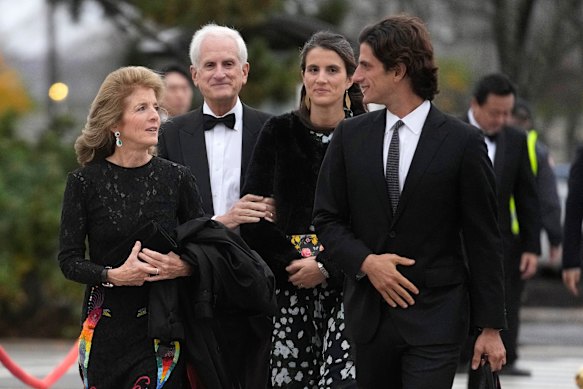
Then-US ambassador to Australia Caroline Kennedy, her husband, Edwin Schlossberg, and children, Tatiana and Jack Schlossberg, in 2023.Credit: AP
“It just had so much heart and intelligence and honesty. On every level.”
Schlossberg’s essay, spun out in a little less than 3300 words, fast became one of the magazine’s most popular pieces of the year, topping its year-end list. She also joined a small pantheon of writers who had written eloquently about their own looming mortality, including Peter Schjeldahl, The New Yorker’s long-time art critic, who died in 2022.
And on Tuesday, Schlossberg’s death prompted an outpouring of grief and condolences on social media and from political leaders in both parties. Her life was also memorialised on national news broadcasts and in pained postings from friends and family members.
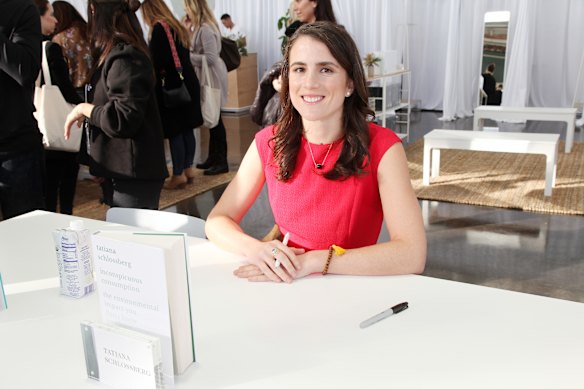
Tatiana Schlossberg attends a book signing in San Francisco in 2019.Credit: Getty Images for goop
“I cannot make sense of this,” wrote Maria Shriver, Schlossberg’s cousin and a fellow journalist, on Instagram. “I cannot make any sense of it at all. None. Zero.”
The essay’s impact seemingly came from both its personal tragedy – Schlossberg leaves behind two young children, and discovered her diagnosis after the birth of her second, a daughter, in 2024 – and the recurring calamities that have befallen the Kennedys. (The November 22 essay was published online exactly 62 years after her grandfather, then-president John F. Kennedy, was assassinated.)
In pure journalistic terms, Schlossberg’s essay also broke news – her terminal diagnosis of acute myeloid leukemia – and contained a concise critique of current events. She took to task the actions of her cousin, Health Secretary Robert F. Kennedy Jr, a known vaccine sceptic who has overseen cuts in federal medical and science funding.
Loading
“As I spent more and more of my life under the care of doctors, nurses and researchers striving to improve the lives of others, I watched as Bobby cut nearly half-a-billion dollars for research into mRNA vaccines, technology that could be used against certain cancers,” Schlossberg wrote, also noting, at another point, that Kennedy had never “worked in medicine, public health or the government”.
Especially affecting was the essay’s explorations of the wrenching reality of a young woman dealing with her own pain as well as the agony of her family. She reflected on her children – who Schlossberg wrote would most likely not remember her – and her mother, Caroline Kennedy, whose life had already been rived by the assassination of her father and her uncle – Robert F. Kennedy, in 1968 – and the loss of her brother, John F. Kennedy Jr, and her sister-in-law, Carolyn Bessette Kennedy, in a 1999 plane crash.
“For my whole life, I have tried to be good, to be a good student and a good sister and a good daughter, and to protect my mother and never make her upset or angry,” Schlossberg wrote. “Now I have added a new tragedy to her life, to our family’s life, and there’s nothing I can do to stop it.”
Remnick had met Caroline Kennedy and knew of Schlossberg’s career and writing, including as a reporter for The New York Times. He said the essay she submitted to The New Yorker had only minimal editing before it appeared online and then in the magazine’s print issue on December 8. By that point, the piece – credited for raising awareness of the disease – had already been widely praised and shared by readers.
Yet when Remnick suggested that perhaps Schlossberg would want to talk about the piece on The New Yorker Radio Hour, a weekly program, she said she was unsure.
“She quite sensibly said, ‘I’ve really said all I have to say about it; What else would I say?’” Remnick recalled. “I remember her saying that. ‘What else would I say?’ ”
This article originally appeared in The New York Times.
Most Viewed in World
Loading