3 months ago
34
3 months ago
34
It’s a muggy evening in Fukuoka, even warmer poolside, and the smell of chlorine clings to the air on the fourth night of swimming at the 2023 World Aquatics Championships. In the stands, fans bang together long, white inflatable clappers as the venue hums ahead of the most anticipated race of the evening.
I’m a late call-up as Channel Nine’s poolside interviewer, standing five metres from a gleaming 50-metre drop-in pool and waiting to chat with Michael Phelps, the most decorated Olympian of all time with 23 gold medals and arguably the greatest athlete of his generation. Standing 193 centimetres, Phelps is surprisingly tall in the flesh and dressed in a crisp white shirt, navy-blue jacket and Nike Dunks, with an impressive man bun that’s impossible to ignore.
Swimming royalty isn’t just in front of me, but in my earpiece, too. Back in the North Sydney studio of Nine, a stablemate of Good Weekend, Australian swimming icon Ian Thorpe is explaining to viewers exactly why tonight’s women’s 200 metres freestyle final is so significant.
It’s a brutal four-lap showdown between two Australians from the same Brisbane training stable: 22-year-old Olympic champion Ariarne Titmus and 19-year-old Mollie O’Callaghan, who stands just beyond Phelps and is about to step out for the biggest race of her life.
I’m keen to get Phelps’ thoughts on Titmus – who, three nights earlier, had taken out the 400m freestyle in world-record time. If time permits, I’ll sneak in a question about O’Callaghan: the dogged redhead from Logan who went from not even watching the 2016 Rio Olympics on TV to becoming the youngest member of Australia’s Olympic swimming team five years later in Tokyo. The floor manager, somewhat predictably, offers an apologetic shrug of the shoulders. US TV network NBC needs Phelps back in the stands for commentary duties.
The swimmers walk past a six-foot Yakult bottle stationed poolside. Lane eight … lane one … seven, two, six. All offer a smile or a wave to the camera.
O’Callaghan, in lane three, does not. Usually chatty with her competitors in the marshalling room, her face has now hardened into a mask of pure focus. There is also no smile from Titmus, in lane four, or Canada’s teenage prodigy Summer McIntosh in lane five. All three are chasing the same prize: a gold medal – and perhaps Federica Pellegrini’s world record, a mark that has remained untouched for almost 14 years.
Each swimmer has their goggles resting neatly on their forehead. O’Callaghan’s hands tremble as she fumbles with hers.
O’Callaghan has always been a doubter – prone to tears, riddled with insecurity. (Before her maiden world title, a year earlier in the 100m freestyle in Budapest, she almost didn’t make it to the blocks due to debilitating nerves.) Yet under the tutelage of her coach Dean Boxall, she is learning to weaponise her fears.
The race begins and the arena crowd roars. The Australian pair leap off the blocks, recording identical reaction times of 0.72 seconds. At the first turn, O’Callaghan is in second place behind Titmus. At the 100-metre mark, she is a full metre behind Titmus. With one lap to go, the gap is 0.74 seconds.
Then O’Callaghan begins to surge, defying the lactic acid screaming in her muscles. The crowd noise lifts in intensity and fans rise as Titmus, the Olympic champion, begins to fade. O’Callaghan hits the wall in 1:52.85. “World record!” Thorpe bellows. “Amazing!”
Titmus takes silver and McIntosh bronze. O’Callaghan’s remarkable final lap (28.11 seconds) was faster than Romanian sensation David Popovici’s, who would go on to win Olympic gold in the event a year later.
O’Callaghan is usually too exhausted after a race to offer a theatrical celebration. When she doesn’t win, viewers often mistake the blankness for her being angry – a perception that annoys the young star. Tonight she squeals – once as her lifetime best time flashes on the big screen, and again after she leans in to hug Titmus, her training partner under Boxall at St Peters Western swim club.
O’Callaghan’s parents, Toni and Nick, are waving in the stands. She looks up at Boxall, who is being congratulated by several Italian coaches after the fall of swimming’s longest-standing women’s world record. Not bad for someone whose parents once considered pulling her out of the sport because money was tight. She makes a beeline my way, and I tell O’Callaghan she has just broken her first individual world record.
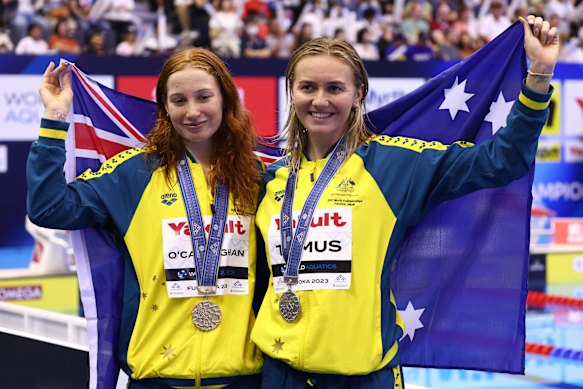
“I was not expecting that at all,” she says, adrenaline masking exhaustion. “I just wanted to have fun and give it a crack, and I was really nervous leading up to this. I didn’t know how I was going to race, and the lead-up has been so up and down, like a roller coaster – and to do that is just incredible.”
Minutes later, she stands on the dais to receive her medal, and it feels like the arrival of a champion. But as the national anthem plays and Boxall gives a double thumbs-up from the stands, the question lingers: how did a girl who nearly quit the sport at 14, whose parents ran meat raffles to buy her swimsuits, become one of her country’s greatest swimmers?
Two years later, I’m sitting with O’Callaghan at Brisbane’s St Lucia Golf Links. Meeting a champion swimmer in a golf clubhouse feels like asking a fish to go for a walk, but it’s the most convenient venue around her brutal training schedule.
“I am so bad at golf. It’s so embarrassing,” she says, sipping a choc honeycomb protein smoothie. Coffee, she explains, is a luxury reserved for Wednesdays and Fridays, a treat between double sessions. “I have no coordination on land. I’m better off doing mini putt or just driving the cart.”
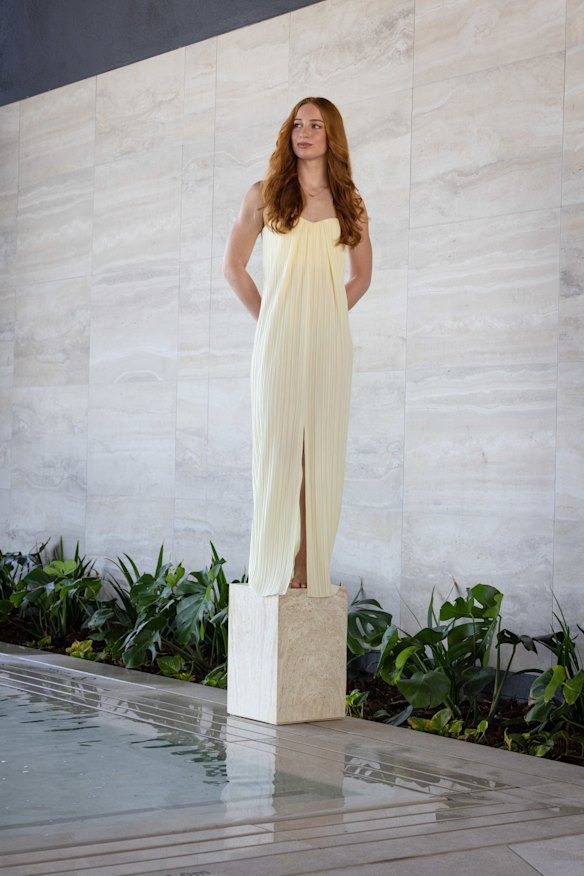
O’Callaghan is 21 now and looks it, too, with a dolphin tattoo peeking out from under her grey tracksuit sleeve, “lucky race nails” painted light blue with a chrome finish, and six earrings in each ear.
We’re an 11-minute downhill walk from the fabled St Peters Western swim club, where she’s just knocked out a “light” four kilometres of work.
The pool deck there is a place of eccentric motivation. There is a rusting replica Eiffel Tower in the corner – installed by Boxall in 2024 to remind his athletes of Paris in the lead-up to the Olympics – and a shipping bell from 1896, the year of the first modern Olympics in Athens, which is rung when standout training efforts occur.
After every session, swimmers must rate their performance from one to 10 and walk 70 metres to post the score in a letterbox inside the Eiffel Tower – a psychological audit that keeps them accountable. Boxall also wanted Olympic rings, but was worried the International Olympic Committee wouldn’t allow it.
I’ve interviewed O’Callaghan close to 100 times – sometimes just a single question after a race, once for over an hour – in Australia mostly, but also England, Japan, France and, most recently Singapore, where she equalled Thorpe’s Australian record of 11 world titles last July. In the middle of a competition, fulfilling media duties is not an easy task. She tends not to give a lot away, always focused on the upcoming race. This is by far the most relaxed I’ve seen her.
“The 200 freestyle in Fukuoka was probably the best I’ve performed in terms of one race,” she says. “I do really appreciate what I achieved at the Olympics in Paris [where she won five medals], but I feel like performing well in Japan set me up for the Olympics.”
The comparisons to Thorpe – a dominant storyline throughout last year’s world championships – are humbling, she says. It’s a question she handles often and without fuss, even if her body language suggests she’d rather not linger on it – shifting slightly in her chair with a flicker of a smile before peering down at her smoothie. “I always get a little bit gobsmacked,” she says. “I just don’t really think as myself as anything. I just swim.”
An Ipswich girl at heart, O’Callaghan’s current patch in south-west Brisbane, lined with eucalyptus trees, feels more like home now. She has paid a deposit for an off-the-plan apartment in St Lucia’s neighbouring Taringa and is about to begin renting a one-bedroom place three minutes from the pool – close enough to cut out the long drives from her family home in Ipswich.
As for Boxall, he’s nowhere to be seen. This is not surprising for a man who’s spoken of having more than 10,000 unread emails and more than 1000 unanswered text messages. It’s been more than three years since he granted an Australian reporter on the swimming beat an interview.
In August last year, when O’Callaghan swam the 100m freestyle final in Singapore – a win would have taken her past Thorpe’s tally – whispers ran through the media centre that Boxall might speak if she won. When she took silver instead, he disappeared.
Two weeks later I texted Boxall, urging him to break his self-imposed media ban and explain what makes O’Callaghan so special. Perhaps a look at training? It’s not an environment where journalists are welcome. “Yes I would like to help,” came Boxall’s reply. “Speak soon.”
But O’Callaghan isn’t even training this August afternoon. She’s off to a Gold Coast beach with some friends, preferring salt water to the chlorine she spends most of her life in. A budding surfer and artist, she spent her afternoons knitting in the sun during her two-week quarantine in Darwin after the Tokyo Olympics.
“Dean has actually flown to Wollongong,” O’Callaghan says, to my surprise.
A day later, that’s where I end up, a 90-minute drive south of Sydney, gripping an elderly stranger’s shoulder in the Sage Hotel’s grand ballroom. The MC of the Wollongong and South Coast Club’s Legacy Business & Community Lunch has us invading each other’s personal space, demanding we shake our neighbour like maracas, and chant in unison of the upcoming guest speaker: “Dean Boxall is here! Dean Boxall is here!”
The rev-up is nowhere near as theatrical as Boxall’s now infamous poolside gyrations when Titmus won 400m freestyle gold at the Tokyo Olympics.
Before those Games, Boxall had essentially “stalked” US swimming legend Katie Ledecky – in a purely professional, obsessive sense – gathering intelligence from breakfast tables, bus rides and pool decks. Today, I’m the one on a fact-finding mission. Boxall doesn’t know I’m here, and I want to see him in his element.
When O’Callaghan first joined Boxall’s squad as a 14-year-old, she saw a mountain she wasn’t sure she could climb. She arrived with world-class underwater skills, meaning sharp dolphin kicks and clean push-offs – the part of the race where swimmers travel the fastest. She had a supreme aerobic base but not so much gym work under her belt, making the prospect of nine sessions a week even more daunting. “My body went into shock,” she says.
Back in the ballroom, Boxall marches onto the stage wearing a faded 2018 Australian Commonwealth Games jacket. He is as ocker and patriotic as they come, despite being born in South Africa and moving to Australia at age seven. His energy – surprising, given this is usually the hour of his sacred afternoon nap – makes you want to jump in a pool and bang out some laps.
“He’s high-energy and he’s intense,” says Tim Kotzur, the head of St Peters Lutheran College, the Queensland school that houses arguably the most successful swimming program on the planet. “One of Dean’s gifts is when he talks to you, you feel like you’re the most important person in the world.”
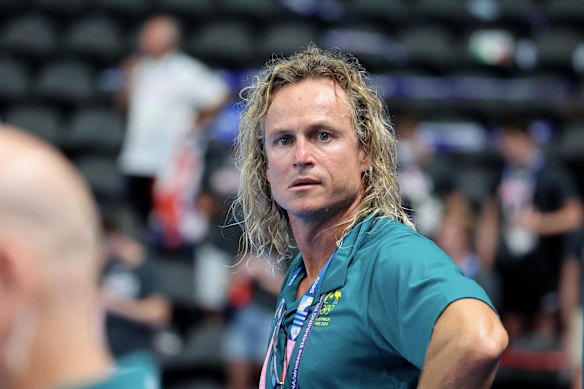
Boxall rises at 4.15am, but requires a full hour of internal revving-up before he can face the world. He rides his e-bike to the pool to get the blood moving. O’Callaghan, by contrast, wakes at 5.30am and is out the door in five minutes – something Boxall says is “absolutely ridiculous”.
He mentions the amusing revolving door of cars that O’Callaghan has driven over the years, courtesy of sponsorship deals – from a Suzuki Swift to a Ford Ranger, Ford Mustang and now a Ford Everest – as she pulls into early-morning training alongside fellow Olympians like Elijah Winnington and Shayna Jack.
By now, Boxall has the room in the palm of his hand. How to manage a rivalry like that of O’Callaghan and Titmus? “People say to me, ‘Dean, don’t coach two girls fighting against each other to win Olympic gold. It could implode,’ ” he says, before raising his right index finger. “I love when they say that. I love when it’s impossible. Nothing is impossible.”
The room falls silent as he describes the culture at St Peters. It is not a place for the faint of heart. “Our training standards are brutal,” he says. “They have got to be tough. I tell my guys: ‘Foot on the throat. You want to give your opponent a Christmas present they open and think, I can’t beat that.’ ”
Thirteen days after my Wollongong trip and 45 minutes past our scheduled interview time, Boxall’s name finally flashes on my phone. He is in Brisbane, huffing and puffing as he pedals his trusty e-bike. “I’ll be home soon, mate,” he says, before telling me about his upcoming visit to the bank this afternoon. “Mollie was there today at training,” he adds. “She’s got a little bit of a shoulder issue but that’s fine. Beginning of the season, she’s just trying to get back into it. Tendons are a funny thing, but she’s fine. There’s no issue with the shoulder.”
I didn’t even ask about an injury. Maybe if Boxall had let me watch training, it might have been noticeable. Anyway. Can we start from the beginning? First memory of O’Callaghan?
“She was 14 and came over from the Springfield Waterworx Swimming Club,” Boxall says. “Very, very quiet, mate. I don’t think she spoke to me properly for nearly five years.”
Boxall is portrayed as Australian swimming’s mad scientist, but he prefers the metaphor of a locksmith. He believes every elite swimmer is a different type of lock. His job is to carry a ring with 1000 keys and try them one by one until something clicks.
Managing personalities is also an artform, which is where his degree in human resource management comes in handy. “Mollie got in, put her head down, and found a way,” he says. “She just worked her backside off. She’s very dogged. It wasn’t until 2022 when our relationship really flourished.”
He recalls, for instance, her dreaded “evil eyes”. In swimming parlance, a set is a specific block of laps designed to push a body to the brink of exhaustion. When Boxall served up a particularly tough set, O’Callaghan would greet him with a patented look of disdain. “I joked with Mollie that I reckoned she had five voodoo dolls of me at home and just pierced them at night.”
‘If I’m hurting, then it’s bloody great. I’d rather be dead than thinking I could have done more.’
Mollie O’Callaghan on trainingShe once harboured ambitions of being a police officer or detective, which makes perfect sense when she explains her training philosophy: “I’m not there to f--- around.” The expletive is jarring from such a reserved athlete, but it’s the key to her dominance. O’Callaghan’s turns are among the best in the world, built on flexible ankles and an exceptional range of motion, while her other edge is an impressive tolerance for pain.
Boxall doesn’t subscribe to the cliché that athletes “rise to the occasion”, noting that under the ultimate pressure, you don’t rise – you lower to the level of your training.
O’Callaghan trains with that in mind. “Give me anything. I won’t slack off. When I get sick, I always get told to calm down,” she says. “If I’m hurting, then it’s bloody great. I’d rather be dead than thinking I could have done more.”
Boxall has his ways of sharpening edges, too. At the 2019 world junior swim championships, O’Callaghan finished fourth in three events, just outside the medals. For two years, Boxall twisted the knife in at training, putting O’Callaghan in lane four, making her dive into the water fourth during a set, and asking her over and over and over if she was happy being the girl who came fourth.
“It was light-hearted, but I was annoyed,” O’Callaghan says. “Without that, I don’t think I could have got this far.”
As her performances evolved, so too did the nickname Boxall settled on for her, going from “White Horse” (her timid phase, when she dyed her hair blonde) – to “Red Dragon” (when she was “on” and back to her natural colour) to the current moniker: “Mol-doggy” (responding to any challenge).
“She actually dug in deeper,” Boxall says. “She wanted to prove me wrong. Mollie is incredibly mentally tough.”
O‘Callaghan and Boxall both trace her resilience back to her parents. Her mother, Toni, is of Croatian heritage and works in a wholesale nursery. She has always been her daughter’s logistical stalwart, handling the early-morning drives to training – including the hour-long commute to St Peters – and organising interstate swimming trips.
Her father, Nick, is a knockabout Brit who runs a consultancy business, and has a firm handshake and a habit of collecting memories. Midway through the world championships in Singapore, he emailed me, asking for a hard copy of The Sun-Herald, the Sydney Sunday newspaper, with quotes from Thorpe about his daughter.
“We are very proud of her and we are always supportive of her through her highs and lows,” Nick wrote in an email to Good Weekend, before noting that the best reflections would come from Boxall. “It would give insight on the dedication, sacrifices, devotion, struggles, highs and lows and rewards Mollie and our swimmers go through to represent their country and to be a role model for all children and adults.”
There is, however, a parallel version of this story where O’Callaghan never makes it to the Olympics. At 14, with her funding cut, quitting the sport was a live option.
Toni and Nick had always helped their daughter stay in the water. In 2014, for instance, they raised $5000 to send 10-year-old O’Callaghan to Melbourne for the Australian schools championships and help pay for a new swimsuit. Raffle tickets and chocolate boxes at coffee shops, RSLs and Bunnings barbecues made a major difference.
“I have a different background to a lot of these swimmers,” O’Callaghan says. “The easy route was to pull me out of swimming. Mum and Dad were completely open and honest, but they didn’t give up on me. They knew I had the potential to possibly do something great. I used that as fire to show that no matter your background, or what difficulties you have, you don’t give up.”
Her older siblings, Sophie and Matt, have also been a source of motivation and guidance. “My brother is bonkers,” she says with a laugh. “He has no idea what’s going on but just tells me to win. My sister used to beat me in training. Now she says I’m living out her dream.”
Boxall knows the family has had difficult times, but they never applied any pressure for her to win this title or that honour. “Watching their daughter achieve greatness and make a good income from this,” he says, pausing, “I’m just super proud, mate.”
Boxall traces the making of O’Callaghan back to the COVID-19-affected Tokyo Olympics – where she won two relay gold medals, yet never stood on the dais. In the heats of the 4x200m freestyle, O’Callaghan, then 17, made a case for selection – shattering the junior world record and slashing a full second off her personal best. But Boxall – the Australian selector for the race – opted for four fresh swimmers in Titmus, Emma McKeon, Madi Wilson and Leah Neale. Australia were heavy favourites in the final, but claimed bronze in a major upset.
“It makes no sense to us,” Toni said at the time.
And for her daughter, it lit a fire inside. “I knew she’d be upset,” Boxall says. “But we spoke about the plan. After that, she became even more dogged and unyielding. She just wanted to prove everyone wrong.”
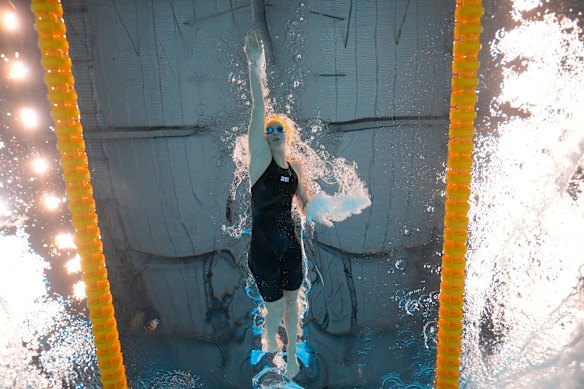
Eleven months later, she did. At the 2022 world championships, O’Callaghan won the 100m freestyle and took silver in the 200m to announce herself as a force in the sport. She left Budapest with three gold and three silver medals.
O’Callaghan dislocated her knee five weeks before her breakthrough 200m freestyle win in Fukuoka in 2023. But few know it popped out again, for about an hour, in the months leading up to Singapore last year. “It did have quite a bit of damage,” she says. “It just caused us to have a very, very long rehab. It wasn’t until the world championships where I felt normal through the water.”
Of course the step-up – and the spotlight that came with it – brought its own challenges, from panic attacks to sleepless nights. Boxall says he had never seen O’Callaghan as anxious as she was before the Olympic trials in 2024. A second-place finish behind Titmus in the 200m freestyle final at trials prompted her to later admit she suffered an anxiety attack the night before qualifying for her second Olympic team. “She really gets herself worked up, but she fights that and uses that as motivation,” Boxall says. “She doesn’t want to fail.”
Those close to her also note her kindness. Take Jamie Perkins, whose heat in the women’s 4x200m relay in Paris didn’t go the way she would have liked. Australia still qualified and won gold in the final, meaning Perkins would receive her gold medal at a Swimming Australia function after the competition ended. Instead, after the medals were presented, O’Callaghan put her own Olympic gold around Perkins’ neck. “I was shocked that someone can be that selfless to recognise somebody else when you’re on top of the world,” Perkins says. “It’s a rare thing.”
O’Callaghan’s best friend is Chelsea Hodges, another Australian Olympian, and the pair are “inseparable” to the point they have matching cherry tattoos. “She’s the most down-to-earth person I’ve ever met,” Hodges says. “She never takes herself too seriously.”
At the recent world championships in Singapore, a 12th career gold medal for O’Callaghan was within reach, before Australia’s mixed 4x100m freestyle relay team faltered in the heats. O’Callaghan didn’t get a chance to race the final. But she will have further opportunities to take down Thorpe’s record at world championships in 2027 (Budapest) and 2029 (Beijing), and perhaps beyond. For now, the comparison alone still feels surreal.
“We’re at the beginning point of what Mollie’s story could be,” Thorpe says. “What she has achieved already is more extensive than a lot of other people’s careers. It’s Mollie’s potential that gets me really excited.”
Four months have passed since O’Callaghan’s Singapore success, and there is plenty to catch up on as we speak on the phone – despite both of us being in Brisbane. I’m about to head to the Gabba for day one of the Ashes cricket Test between Australia and England, while O’Callaghan has just churned out five kilometres in the pool before most people in the city have taken their first sip of coffee. “Not too far today,” she says without a hint of sarcasm.
In the three months since we last spoke, O’Callaghan broke two 200m freestyle world records in a week at short-course events (a 25-metre pool) in Indianapolis and Toronto. Even by her standards it was unexpected, yet almost overshadowed by a bizarre, digital haunting. It began with a screenshot sent by a friend.
“Did Gina Rinehart give you $20 million?” the message asked. “No!?” a baffled O’Callaghan replied.
What followed was a sophisticated wave of social media deception. A Facebook page began spewing fabricated quotes and inflammatory statements attributed mostly to O’Callaghan, but also Thorpe and other Australian swimmers. The posts didn’t just claim O’Callaghan had withdrawn from competition; they inserted her into the vitriolic centre of a culture war, specifically targeting American transgender swimmer Lia Thomas.
“I will not participate in the 2028 Olympics if that man, Lia Thomas, is allowed to compete,” part-read the false quote attributed to O’Callaghan. “Let him swim in the men’s category. He shouldn’t be here.”
For a young woman who has steered clear of controversy, the experience was eye-opening. The misinformation was so pervasive it even breached the family inner circle. “My nan thought I wasn’t racing,” O’Callaghan says. “Mum had to tell her, ‘No, no, Mollie’s out there competing.’ ”
The page has since been taken down, with Swimming Australia stepping in to have the content removed. Still, the episode lingered and was a baffling issue for an innocent swimmer watching thousands of people online take the comments as gospel.
“It is a scary thing,” O’Callaghan says. “You don’t want people impersonating [you] and making statements that are not true. I just had to remind everyone to check their sources. It’s great I had Swimming Australia help sort it all out.”
At the same time, the landscape around O’Callaghan is shifting. Titmus, her long-time rival and training partner, announced her retirement in October, leaving at the peak of her powers, a four-gold Olympic icon.
O’Callaghan has five Olympic gold medals – the same number as Kaylee McKeown and Thorpe – but two came as a relay heat swimmer. Her lone individual gold is the 200m freestyle in Paris, while three of Titmus’ four Olympic golds were in solo events. (Emma McKeon still tops the list of Australian Olympians with six gold medals, four of them in relays.)
“She’s one of the great legends of the sport,” says O’Callaghan of Titmus. “Kudos to her for finishing off on a high. She’s left a lasting legacy and everyone respects her.”
I am eager to speak to Boxall again, but apparently Titmus is an off-limits subject. After three attempts and a text message, I don’t hear back. It’s no surprise. “I love the siege mentality,” Boxall told me previously. “Sometimes you’ve got to shut down.”
O’Callaghan has the Commonwealth Games, world championships and the 2028 Los Angeles Olympics to look forward to as she continues her meteoric rise. But a potential home Olympics in Brisbane in 2032 will be on a different level.
She sometimes allows herself to get swept up in the dream of having family in the stands – the same parents who helped with meat raffles at the RSL – watching her compete on the biggest stage in her own backyard. “It would be the dream,” she says. “I want to know what I am capable of.”
Perhaps by then, at age 28, she will have fulfilled her other dream – of becoming a detective. Or perhaps she will still be the girl with the blue-chrome nails, fumbling with her goggles until the very last second.
In a world that demands athletes be bulletproof, O’Callaghan’s greatest strength is her humility. She isn’t a machine. She’s just a girl from Logan who found a way to get through water quicker than most. And, as Thorpe says, we are only at the beginning.
Read more profiles from Good Weekend:
- ‘Feared, respected and disliked’: The private powerbroker who has Lachlan Murdoch’s ear
- Exploitative and callous, or excellence and innovation? The man who wants athletes to push their bodies to the limit
- Never in her wildest dreams did Ita imagine her career would go the way it did
Get the best of Good Weekend delivered to your inbox every Saturday morning. Sign up for our newsletter.