What to know about the Senate votes on health care:
- The Senate is set to vote Thursday on competing measures aimed at addressing health care costs, but both parties' bills are expected to fail, raising the prospect of significant price hikes for millions of Americans in the new year.
- Democrats are seeking an extension of enhanced tax credits under the Affordable Care Act, which was at their main demand during the government shutdown earlier in the fall. Republicans are set to bring up their own plan, which would send funds directly to consumers instead of extending the current subsidies.
- With 53 Republicans in the Senate and 47 Democrats, the bills are both expected to fall short of the 60 votes needed to advance, leaving lawmakers with little to show for a monthslong fight over rising health care costs.
- The procedural votes are scheduled to start at 11:30 a.m. ET, with the GOP bill up first.
Schumer says vote is a "moment of truth" for Republicans
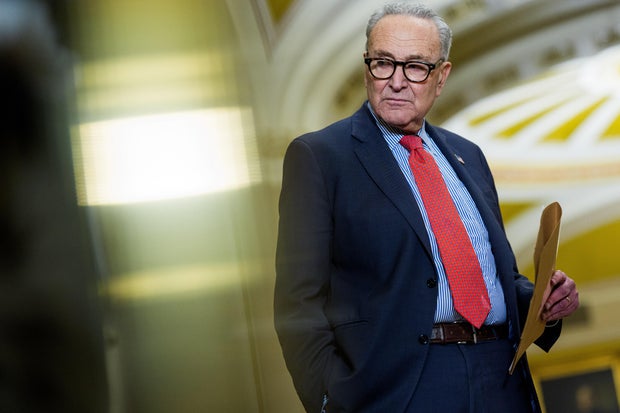 Senate Minority Leader Chuck Schumer during a news conference at the U.S. Capitol in Washington, D.C., on Dec. 9, 2025.
Aaron Schwartz / Bloomberg via Getty Images
Senate Minority Leader Chuck Schumer during a news conference at the U.S. Capitol in Washington, D.C., on Dec. 9, 2025.
Aaron Schwartz / Bloomberg via Getty Images
The long-anticipated vote on the ACA tax credits comes in the aftermath of the shutdown, when Republicans agreed to allow a vote on a Democratic bill in exchange for reopening the government. The subsidies, which helped around 22 million low and middle-income Americans pay for health care costs in 2025, are set to expire at the end of the year. Annual premiums for those who purchase coverage through ACA exchanges are expected to more than double without an extension, according to KFF, stretching the already-strained budgets of millions.
Given the option to put forward a bill of their choosing, Democrats chose to bring up a clean three-year extension of the subsidies, a bill known as the Lower Health Care Costs Act. The move all but guaranteed that the effort would fail, since Republicans generally oppose an extension without significant reforms to address fraud and impose income caps. But Democrats are more than willing to force their GOP colleagues to vote against extending the subsidies, viewing the coming price hikes as a salient political issue heading into next year's midterm elections.
Senate Minority Leader Chuck Schumer called Thursday's vote on the tax credits extension a "moment of truth for Republicans," noting that the credits are set to expire in a matter of weeks.
"Congress should have solved this problem months ago," Schumer said at a news conference Wednesday. "Hakeem Jeffries and I asked the Republican leadership and Donald Trump over and over and over again to sit down and come up with a solution to the crisis. They refused."
What the Republican health care bill would do
Republicans have argued that the current structure of the tax credits, which involves sending the funds directly to insurance companies, encourages fraud, since brokers and agents are incentivized to enroll customers who may not qualify. GOP lawmakers have pointed to a recent report from the Government Accountability Office, in which investigators submitted applications for coverage through exchanges using fictitious personal details, most of which were still approved.
Republicans have sought to overhaul what they see as a broken health care system for years, but have failed to coalesce behind a strategy to implement significant changes.
After weeks of discussion, Senate Republicans announced this week that they would put forward a bill of their own for a side-by-side vote, hoping to alleviate the political pressure that would come with voting against the Democratic proposal.
The Republican bill, named the Health Care Freedom for Patients Act and led by Sens. Bill Cassidy and Mike Crapo, takes another approach to address health care costs. Rather than extending the enhanced tax credits, it would redirect funds to health savings accounts for those who use bronze plans on state exchanges. Proponents argue that doing so would allow people to save on premiums by switching to the lower-tier plans, while they would also be able to use the HSA funds toward their deductibles.
Senate Majority Leader John Thune announced Tuesday that Republicans would put up the Crapo-Cassidy bill, which he said "reflects the views of the Republicans here in the United States Senate."
Democrats have largely rejected the Republican plan since it doesn't address the tax credits, leaving millions with higher premiums in the short term.
Thune: Democratic bill is a "partisan messaging exercise"
On the Senate floor on Wednesday, Senate Majority Leader John Thune called the Democratic approach a "partisan messaging exercise," saying they "seem hard-over on doing this."
"I don't have any expectation probably that we're going to get Democrat votes for our proposal, but we are offering something that actually does reduce health care costs and premiums, puts power back in the hands of individuals, and that really is what this ought to be about," Thune said.
As both sides appeared aware of the likelihood that the bills would fall short in Thursday's votes, Thune didn't rule out an extension of the tax credits going forward.
"There is an interest in solving it," Thune told reporters Wednesday. "Obviously we don't have a lot of time to do this, but I think there are ways in which you could, where there's a will, and if there are two sides willing to come together."