3 months ago
35
3 months ago
35
The new Sydney Fish Market will open on January 19. The Herald has charted the sometimes rocky path to this milestone.
See all 9 stories.In September 2024, when it was clear that the new Sydney Fish Market was likely to miss its scheduled completion that year, the project managers installed in the market a digital clock that counted down the minutes to the opening of the site across Blackwattle Bay.
It was a stand-in response to frequent enquiries about the opening date, and an expression of confidence in the building that others were claiming was too grand, too expensive, was not fit-for-purpose and running behind schedule.
The date was set for June 20, 2025.
Two months later, the clock was reset to September 26, 2025. Then it was reset again. In December, a social media campaign to promote the last Christmas at the old site was judiciously set aside. Last October, a press conference called to celebrate the imminent opening of the new building omitted mention of a date.
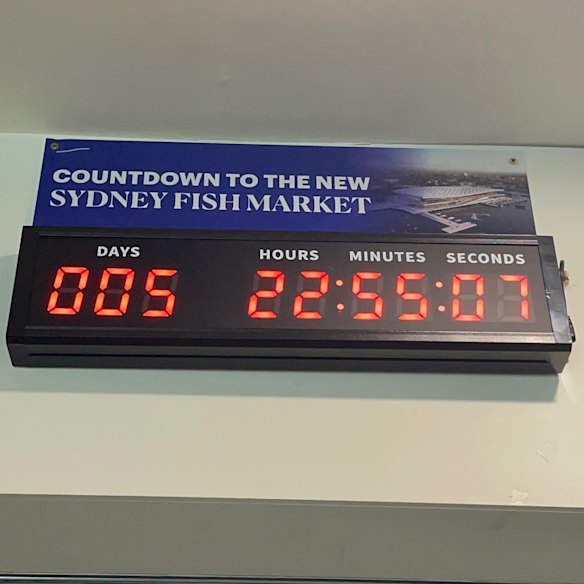
The clock counting down to the opening of the new Sydney Fish Market had to be reset several times.
The number of hours left on the clock is now in double digits, and when the $836 million wave-shaped building finally opens for business on Monday, it will stand as a monument as much to perseverance as to fish.
Like the Red Queen in Lewis Carroll’s Through the Looking Glass, who can never be reached by walking forwards, for the past 25 years the prospect of a new fish market has seemingly receded for each step taken towards it.
Hijacked by spivs, exploited by corrupt politicians, derailed by recalcitrant merchants, engulfed by internecine warfare, the path towards construction was bedevilled by competing interests, some of which continued to play out even as the new building rose from the sea.
In 2001, the corrupt fisheries minister Eddie Obeid plotted to take control of the market in cahoots with fraudulent property dealer Nati Stoliar and redevelop it based on the Singapore model where super yachts could moor, a deal exposed in Kate McClymont and Linton Besser’s book He Who Must Be Obeid.
Eight years later, stripper cruise operator Joe Elias got a piece of the action when crooked ports minister Joe Tripodi announced that his $2 party boat company had been awarded the tender to redevelop a marina on the land now occupied by the new fish market, fending off major property dealer Lendlease. The marina never happened, and the government was forced to negotiate with him when it decided to build the fish market there. (A probity hearing found no evidence of improper behaviour by Elias or Tripodi.)
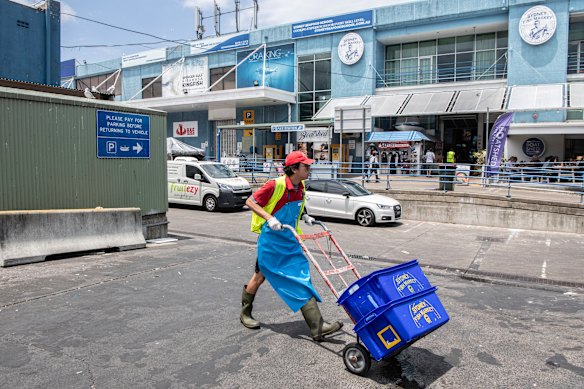
Visions for a replacement to the old market came and went.Credit: Steven Siewert
A vision by real estate agent Robert Deans to develop Blackwattle Bay spilled into warfare in 2015 after he and his associate, businessman Dominic Galati, bought into a seafood company that gave them a voice on the Sydney Fish Market board.
The fish market’s tenants supported their proposal, but the fishermen who formed the other 50 per cent of shareholders supported a rival proposal by Brookfield Multiplex. John Faulkner recounted in his fish market history Fishy Business that the dispute between fishermen turned dirty with allegations of rigged ballots, proffered bribes and intimidation tactics, including bags of human faeces left on the doorstep of the Catchers’ Trust company secretary’s mother.
The Sydney Fish Market evicted the seafood company from the site to deprive it of voting rights and Deans and Galati spectacularly fell out and spent the next eight years in litigation. (Galati resurfaced in 2024 threatening to sue the government for the rights to develop the site.)
Meanwhile, the old site that housed the fish markets, with its leaking roof, stinking floors and hazardous parking lot, was well past its use-by date.
For years a redevelopment was held up while the government equivocated on funding it, then because the tenants and fishers who own the business were not prepared to accept the government’s terms for doing so.
In 2016, then-premier Mike Baird announced a $250 million redevelopment of the market, and a design competition was held a year later. No building that conformed to the brief was capable of being delivered for anything like that budget, however, and the winning design was no exception.
Designed by Danish-based 3XN Architects, the building selected to house the new Sydney Fish Market was colossal in size and complexity, and the budget was quickly updated to $750 million – a “huge blowout in costs for what is essentially a glorified shopping centre over Blackwattle Bay”, Greens MP Jamie Parker complained.
But the business case was built on the key role it will play in linking 15 kilometres of harbour foreshore all the way to the Sydney Opera House, its tourism potential and the land that will be unlocked when the existing building is demolished.
Perched over the water at the head of Blackwattle Bay, its basement is fully submerged, while an undulating roof the size of four football fields floats above, comprised of 350 panels to give it the appearance of scales. It uses 1700 glass louvre panels on the facade.
Each of these elements is intricately engineered, and every time one of them needed to be adjusted during the build, there were knock-on effects that multiplied down the line. Subcontractors reported an unusually large number of variations, each of which added to their costs, suggesting that the $750 million budget billed to taxpayers for the actual construction is likely to be considerably less than the real cost.
Some subcontractors did not survive the cost blowouts, most notably the roof engineer Sharvain, which collapsed weeks after the final tiles were laid, owing more than $50 million, and pulled down at least two of its subcontractors with it. “People are pretty much struggling to keep their homes,” one of them said.
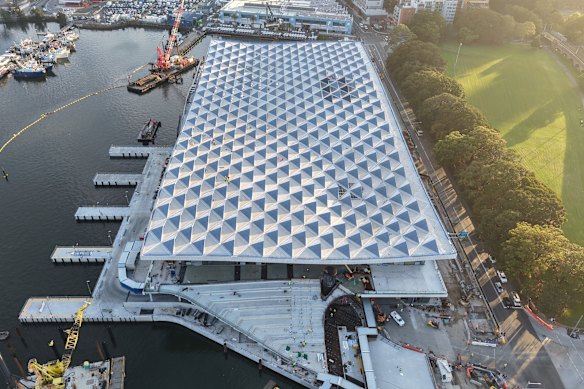
The complexity of the Fish Market roof added to costs.Credit: Multiplex
Head contractor Multiplex has lodged a $250 million legal claim against the NSW government.
None of this was helped by COVID-19, during which time the cost of labour and materials skyrocketed. But concurrent to the pandemic, an even more significant issue emerged before the main pilings were laid.
Building over water is an inherently difficult exercise that is often solved by the construction of a temporary watertight structure, known as a cofferdam, to provide a dry zone for workers.
Two construction companies that tendered for the project proposed completely draining the cofferdam in the traditional way, but Multiplex won the tender with an innovative and cheaper proposal to work off floating formwork inside the cofferdam.
This method would not require the cofferdam to be fully drained, and avoid destabilising the acid sulphate soils at the bottom of the harbour by exposing them to oxygen. But it was a huge engineering challenge to keep the basement from floating away due to the uplift – a concept likened to trying to keep a bucket half submerged in a bathtub.
A plan to fasten the floating formwork basement to the bedrock on steel piles failed, and Multiplex was forced to adopt its competitors’ proposed strategy of fully draining the cofferdam and importing about 80,000 tonnes of sand to cap the toxic sediments.
This method was not without its own challenges. The sand had to be stored on Glebe Island and brought to the construction site on barges, with little manoeuvrability in the tight confines of Blackwattle Bay. The barge used as a staging post to pump sand had less than 300 millimetres of leeway as it was brought under Glebe Island Bridge.
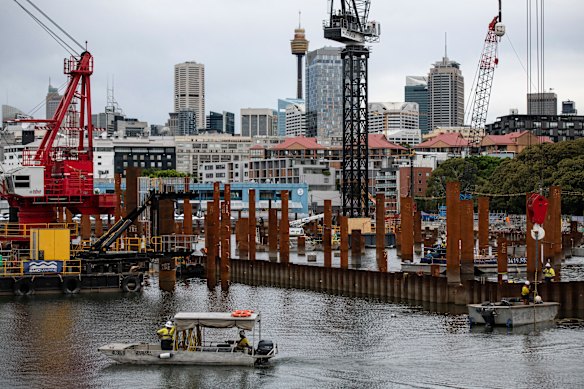
Multiple vessels plied the confined waterway of Blackwattle Bay during construction.Credit: Wolter Peeters
“There were multiple subcontractors of subcontractors,” barge owner Greg Kroef says. “There were piling barges trying to put on the last of the piles, and we were pumping sand, and there were multiple floating vessels trying to work in a very confined area.”
“The first activity is the key activity because so many trades can’t start until the piles are in. It’s like trying to get out of a corner with no room and there’s a whole lot of work that needs to happen.”
In July 2022, one of his barges accidentally released more than 250 tonnes of sand into the harbour, prompting remediation works.
In addition to the installation issue, a dispute emerged between the cofferdam manufacturer and Multiplex over the integrity of the structure. The engineering company that built the structure was confident it was sound, but Multiplex claimed it was defective and took over the work in the spring of 2022. Each company sued the other for damages.
The two companies are also in dispute over a smaller cofferdam structure between the water and the road, which leaked into the car park during construction. The structure was originally designed from steel, but amended to concrete on the side closest to Bridge Road, resulting in reduced carpark space, and drawing the ire of the Sydney Fish Market tenants.
When Infrastructure NSW informed parliament in November 2022 that the building was on track to be completed by 2024, the flow-on effects had yet to play out.
Loading
Infrastructure NSW chief executive Tom Gellibrand puts the year’s delay to the original timeline down to five factors, including COVID restrictions, a historic period of wet weather, the collapse of a crane boom in September 2023, and Multiplex’s decision to shut down all its construction sites for several weeks after a work-related death on another project. But the single biggest delay can be attributed to problems with the cofferdam, he says.
“Multiplex had some concerns about the engineering integrity of this structure and did a whole lot more work and decided to strengthen the cofferdam, and that was about a six-month delay for Multiplex,” Gellibrand said. “But that was important work because if you’re working inside a cofferdam you need to make sure it doesn’t collapse.”
Running alongside the major construction issues, the seafood retailers at the old fish market had their own doubts about whether the new site was fit for purpose, raising concerns including the movement of goods between levels, whether the glass walls will expose their product to heat, and whether the power supply would be adequate.
The agreement the Sydney Fish Market signed with the NSW government in 2019 entitled the company to grandfathered rent and like-for-like premises in exchange for rescinding its first right of refusal to develop the old site. But it failed to index the fit-out costs, which rose more rapidly than anyone anticipated.
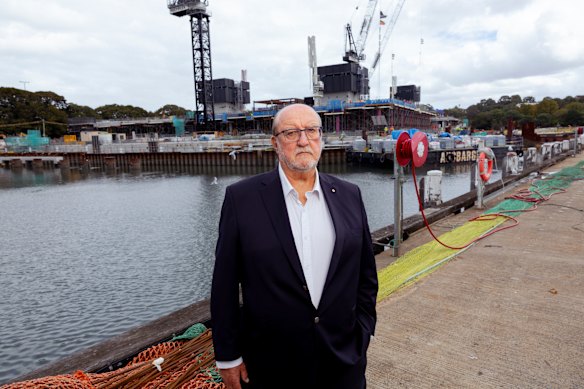
Former Sydney Fish Market chair Graham Turk did not live to see the market completed.Credit: Dominic Lorrimer
In March 2024, Graham Turk, a former chief executive and chairman of the Sydney Fish Market who had negotiated the agreement after decades of lobbying for the markets to be redeveloped, lost his patience.
“Some of them – not all of them – are very greedy people, and they just wanted more and more and more and more,” Turk said at the time. “The greed of the tenants combined with the inefficiencies and incompetence of Infrastructure NSW is a great mixture for a disaster.”
The Sydney Fish Market tenants retaliated by uninviting him to the biennial industry seafood awards the following month, where he had been nominated for a lifetime achiever’s award.
Turk did not live to see the opening of the new markets. He died in August 2025, just days after the last of the subtenants who had been refusing to move to the new site finally signed their new leases and submitted their fitout plans.
Gellibrand acknowledges that convincing the tenants took longer than expected. But he says it did not affect the building’s completion date because the construction was already delayed.
“Their leverage was limited because we were doing what they asked us to do,” Gellibrand says.
Loading
At the last auction on the old site on Friday morning, the buyers quarrelled with the managers in the usual way, though they put their issues aside at 7am for speeches from the chief executive and operations manager. Bacon and egg rolls and toasties were served.
Master Fish Merchants’ Association president Kerry Strangas, who owns Poseidon’s Harvest Seafood in Sylvania’s Southgate Shopping Centre, soaked it up without knowing how to feel. He has been sceptical about whether the new site will live up to the hype. Now that it is happening, he is hopeful that it will work out.
“Even now, it hasn’t sunk in that I won’t be going back to the site any more,” Strangas says. “I’ll be going somewhere totally different.”
The last lot to go under the hammer was a haul of luderick, or blackfish, from Lake Illawarra at 8.23am. Then one by one, the auction clocks went blank.
Be the first to know when major news happens. Sign up for breaking news alerts on email or turn on notifications in the app.