
The battle of the Dan Sullivans is on.
The Alaska Supreme Court ruled Monday that a man with the same name as Republican Sen. Dan Sullivan can challenge the sitting lawmaker in the state's GOP Senate primary in August. The high court upheld a ruling from a lower court judge that cleared the way for Daniel J. Sullivan to appear on the primary ballot, reversing a decision by state officials earlier this month that he was ineligible because he was allegedly trying to confuse voters.
The state Supreme Court directed Alaska's Division of Elections to decide how Daniel J. Sullivan should be listed on the ballot "within the confines of existing Alaska ballot design law."
The conflict is taking place in one of the country's most closely watched Senate elections. The sitting Sen. Sullivan is running for a third term, but former Democratic Rep. Mary Peltola is vying to challenge him, setting up what could be an unusually competitive race in a deep-red state that hasn't elected a Democrat to the Senate in almost 20 years.
The senator has called his same-name competitor a "sham candidate" and accused him of trying to trick voters and help Democrats flip the seat. Daniel J. Sullivan — a retired teacher and former U.S. Forest Service employee from Petersburg, Alaska — has denied those allegations and insisted he is both qualified and genuinely interested in running for Senate.
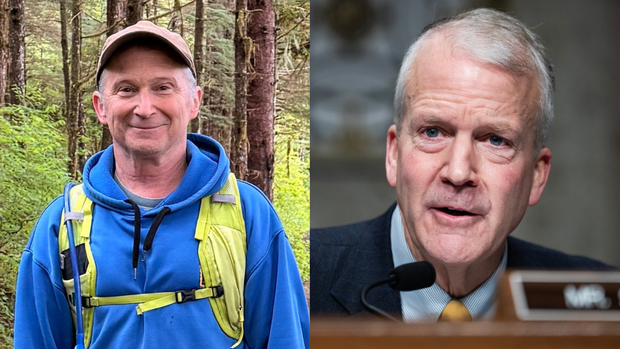 Daniel J. Sullivan and sitting Sen. Dan Sullivan, both of whom are running in Alaska's GOP Senate primary.
Karen Dillman via AP / Tom Williams/CQ Roll Call via AP Images
Daniel J. Sullivan and sitting Sen. Dan Sullivan, both of whom are running in Alaska's GOP Senate primary.
Karen Dillman via AP / Tom Williams/CQ Roll Call via AP Images
About two weeks ago, the Alaska Division of Elections determined that the challenger Sullivan could not appear on the ballot, arguing his paperwork "was not filed in order to declare an actual good-faith candidacy, but was instead filed with a purpose to confuse or mislead."
In a letter to the candidate, Director Carol Beecher pointed to the fact that Daniel J. Sullivan had initially requested to appear on the ballot as "Dan Sullivan," the same name format as the senator. She also wrote that he hadn't previously been affiliated with the state Republican Party, had a website design that "appears to be deliberate[ly]" similar to the senator's campaign site and had worked with a political consultant with links to Democratic candidates.
Daniel J. Sullivan asked a state court to reverse the decision. On Friday, Judge Thomas Matthews ruled in his favor, finding the non-senator Sullivan met the requirements to run for U.S. Senate and the state didn't have the authority to exclude him based on "good faith."
"The court does not minimize the Division's concern that voters should not be misled," the judge wrote. But he added that "Alaska election law gives the Division tools to address that concern," including regulating how candidates appear on the ballot.
With ballots set to be printed this week, the issue was appealed to the Alaska Supreme Court on an expedited basis, with both sides filing court papers over the weekend.
The state Division of Elections asked the high court to overturn Matthews' ruling, arguing it would "leave Alaska constitutionally required to permit bad-faith ballot access." The agency said it reached its conclusion about Daniel J. Sullivan after it received a complaint from the National Republican Senatorial Committee "credibly alleging" he was seeking to "cause voter confusion" and made a "bewildering" request to appear on the ballot with the senator's middle initial.
If Daniel J. Sullivan is permitted to remain on the ballot, the state asked the Alaska Supreme Court to allow it to print his full name and list his party affiliation as "nonpartisan" to "ensure voters are not forced to guess between two nearly identical names."
The Alaska Republican Party and several GOP-led states filed amicus briefs siding with Alaska.
Daniel J. Sullivan's lawyers, meanwhile, argued the state "lacked any basis in Alaska law to exclude Mr. Sullivan from the ballot" and didn't have the power to look into his "private motivations." They wrote that state law doesn't give officials the power to keep qualified candidates off the ballot due to potential confusion.
"[All] that Mr. Sullivan asks here is to be listed on the ballot, and the Division is obviously empowered to do so in a non-confusing manner," his lawyers wrote.
Following oral arguments, the high court sided with Daniel J. Sullivan in a two-page order late Monday, and said it would issue a fuller opinion at a later date.
Jeffrey Robinson, an attorney for Daniel J. Sullivan, told CBS News his legal team is "grateful" for the Alaska Supreme Court's decision to "affirm Judge Matthews' well-reasoned, thorough order vacating the Division's unlawful decision to exclude Mr. Sullivan as a candidate."
"We expect that the Division will act in full compliance with existing Alaska ballot design law in its preparation of the ballots," Robinson said in an email.
The senator's campaign spokesperson, Nate Adams, said: "We're disappointed in the court's decision because as the sham candidate Dan J. Sullivan's lawyers made clear in their legal arguments, the only reason he is running is to deceive voters and manipulate Alaska's election system."
"However, we are encouraged by the fact that the Director of the Division of Elections will be able to use her expertise to differentiate between the Petersburg fraud and the incumbent — Senator Dan Sullivan — to the benefit of Alaska voters," Adams said.
In:
Republicans with same name compete for same seat
Candidate confusion in Alaska Senate race as Republicans with same name compete for same seat
(04:32)

















































