3 months ago
28
3 months ago
28
A Gippsland wind farm plagued by hurdles will be bought entirely by the State Electricity Commission, which will spend up to $700 million to own the project and get it under way.
The SEC’s purchase of the Delburn Wind Farm, first approved in 2022 and bogged down by delays because of the project’s location in a pine plantation, will allow construction to begin in early 2026, with completion expected in 2028.
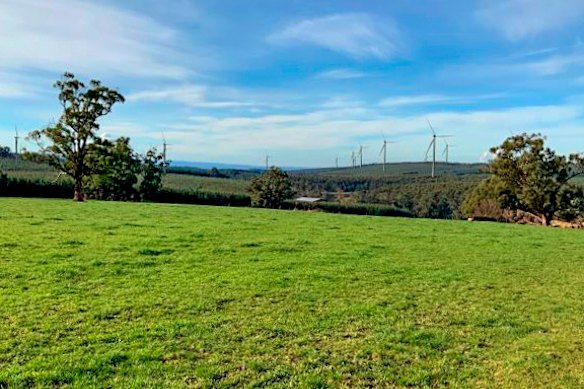
An artist’s impression of the Delburn Wind Farm.
When completed, it will have 33 turbines generating 205 megawatts of electricity capable of powering more than 130,000 homes.
Under the deal, to be announced by Energy Minister Lily D’Ambrosio on Tuesday, the SEC will spend $650 million to $700 million to buy the wind farm, to be built in the Strzelecki Ranges, from private investors.
The government says it is the first wind farm project to fully secure financing in Victoria over the past 12 months.
D’Ambrosio said the SEC was driving investment in renewable energy generation while also serving as the retailer to all state government departments and functions.
Loading
“The SEC is powering Victorian government operations with 100 per cent renewable electricity – with all profits being invested back into projects that will deliver more renewable energy and lower power bills for Victorians,” she said.
Approvals for the wind farm at Delburn were first lodged with the Victorian planning minister. The plan triggered a local backlash and warnings the development was a bushfire risk, partly because of its location in a plantation.
It was approved by the planning minister in 2022, but this decision went on to be challenged by community groups in court until the case was dismissed in 2023. To ease community concerns, developers proposed using artificial intelligence to manage bushfire risks, among other measures.
Yet the project remained under a cloud after further amendments to its planning permits were sought, and construction timelines were regularly pushed back throughout 2024 and 2025. The wind farm will be the first SEC-owned project in Gippsland, which has for decades been crucial to the nation’s energy system through its large coal-fired power plants.
“This project will tap into the Latrobe Valley’s proud history as Victoria’s energy heartland and ensures the region continues to play a leading role in our renewable energy future,” Eastern Victoria MP Tom McIntosh said.
It is estimated the project will create 300 local jobs while $22 million will go into programs for its neighbours and into community benefit funds.
The announcement of a third SEC project comes two weeks after the completion of its first investment, a large-scale battery project in Melbourne’s west known as the Melbourne Renewable Energy Hub. When the commission was first revived, the Victorian government committed to spending $1 billion on renewable or storage projects and reinvesting the profits from these investments into other projects.
It has now surpassed this figure and committed least $1.27 billion, investing $245 million in the battery hub, at least $650 million in the wind farm and $370 million for a solar and battery park at Horsham under construction.
The decision to invest in a challenged onshore wind project in a year when no similar projects have fully secured financing aligns with the vision for the SEC first outlined by chief executive Chris Miller in 2024.
Loading
At the time, he said the commission would invest in projects where the private market is still unsure as the state tries to close a five-gigawatt gap between where Victoria needs to be, according to the Australian Energy Market Operator, and the current trajectory of renewable and storage projects set to be delivered by 2035.
“SEC has now committed more than a gigawatt of renewable energy capacity – a quarter of our 2035 target of 4.5 gigawatts,” Miller said on Monday.
Another key plank of the state’s energy policy, offshore wind, is under significant strain after various private sector developers pulled out of bids to build farms off the coast of Gippsland.
The Victorian Auditor-General’s Office said this month that the state would not meet its target of generating 2 gigawatts of offshore wind by 2032.
Experts have criticised the SEC’s most frequently stated goal, to bring household energy prices down, as difficult to achieve directly.
The government has argued it is achieving this through increasing renewable generation and by encouraging household electrification.
Start the day with a summary of the day’s most important and interesting stories, analysis and insights. Sign up for our Morning Edition newsletter.
Most Viewed in Politics
Loading