3 months ago
16
3 months ago
16
Opinion
November 29, 2025 — 5.00am
November 29, 2025 — 5.00am
There was nothing unusual in billionaire Gina Rinehart’s rant against anything with an environmental hue last weekend when her trusted lieutenants from Hancock Prospecting fronted her National Mining Day event.
As always, renewables are seen as anathema to her carbon-intensive iron ore and coal interests. Rinehart even slammed her own mining partner Rio Tinto for spending billions to curb its carbon emissions. Their investors’ dividends “are being sacrificed on the green altar”, according to Rinehart.
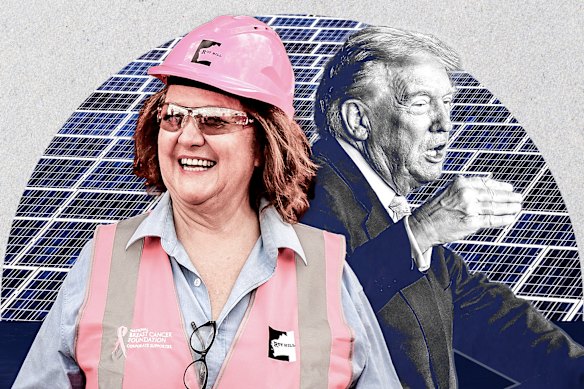
Gina Rinehart’s abhorrence of the renewable sector does not extend to the minerals underpinning it, which have soared thanks to Donald Trump.Credit: Monique Westermann
“The religion of carbon-neutral propaganda unfortunately burdens humanity by much more expensive energy costs, especially propagated by the wrongly called renewable energy,” Hancock’s Tad Watroba said at the mining day event.
“If the energy transition is, as some say, an operation on the open heart of our economy, then so far, this operation has failed miserably,” said Hancock iron ore head Gerhard Veldsman.
Loading
Right on cue this week, the Rinehart-backed Lynas Rare Earths told investors it had lost a month’s production of rare earth processing thanks to ongoing power disruptions in Kalgoorlie, Western Australia, which have hobbled its new processing plant.
The Lynas ASX announcement highlighted a line from 2021, when it originally signed the energy deal, saying it was meant to ensure “access to cleaner power in lieu of costly, emissions-intensive diesel generators”.
Rinehart’s Hancock Prospecting highlighted media reports on the production downgrade suggesting that renewables were to blame.
Except that, as Lynas chief executive Amanda Lacaze made clear to investors at the annual meeting in Sydney this week: It was not.
“We don’t see it being associated with the source of the energy. It is primarily a network condition,” Lacaze told investors on Wednesday.
The actual problem is the fact that the gold mining town continues to be served by a single high voltage 220Kv power line. It is literally a single point of failure for the region despite the billions of dollars WA has made from the iron ore boom.
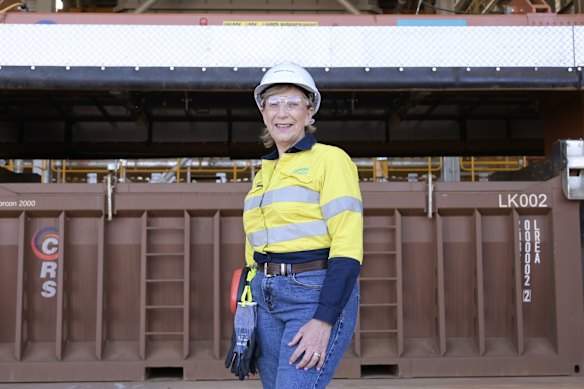
Lynas Rare Earths chief executive officer Amanda Lacaze at the company’s processing plant in Kalgoorlie, Western Australia.Credit: Bloomberg
Lacaze’s point with the diesel reference in the Lynas ASX statement was that Lynas was hoping to rely on something more environmentally friendly than the diesel generators that power most remote mining sites including, until recently, its Mt Weld lithium mine.
“One of the benefits for Kalgoorlie was access to grid power. And as it turns out, that has not been as successful as we thought that it was going to be,” she told this masthead.
Lynas is now scrambling to ensure any ongoing problems will not lead to a drop in production for the financial year and its short-term solution is likely to be diesel. But you only need to look at Mt Weld to see where Lynas and other miners see their long-term energy future.
Mt Weld features a 7MW solar farm, a 24MW wind farm, and a 12MW battery storage system, which means, as Lacaze told investors this week, it can run for weeks at a time entirely on renewable energy.
Solar, wind turbines, batteries. It is everything Rinehart loathes in spades, as anyone who heard the Mining Day speech can attest.
So why is Rinehart one of the biggest investors in Lynas, which survives on providing these crucial elements to wind turbines and EVs, as well as electronics and defence applications?
And it is not an outlier either among her multi-billion dollar investment portfolio, which extends to cattle, tech and an enviable list of properties.
Rinehart’s Hancock Prospecting has recently emerged as the largest shareholder in US-based rare earths group MP Materials. Closer to home, it also has a substantial stake in Arafura Rare Earths.
But nothing highlights the contrast between Rinehart’s rhetoric and business interests better than ASX-listed Vulcan Energy.
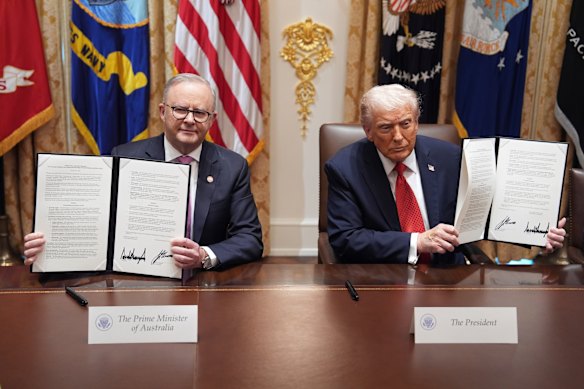
US President Donald Trump and Prime Minister Anthony Albanese hold up signed agreements on critical minerals and rare earths last month. Credit: AP
Rinehart’s Hancock Mining holds a substantial shareholding in Europe-based Vulcan Energy, which is betting its future on producing zero-carbon lithium.
Vulcan received a €100 million ($177 million) grant from the German government last year to help with its commitment to “decarbonising Germany’s energy landscape”, as its chief executive Cris Moreno said.
But her rare earth forays have been in a class of their own, thanks to one particular friend of Rinehart’s.
All of her rare earth investments soared after US President Donald Trump’s trade warfare with China made it necessary to build a critical minerals supply chain that can’t be choked off by China.
The term “rare earths” refers to 17 minerals and elements crucial to the manufacture of many high-tech products such as mobile phones, electric cars, wind turbines and, most crucially, military equipment such as fighter jets and nuclear submarines.
The broader critical minerals sector includes metals like lithium, which serves electric cars, batteries and solar cells.
China’s restrictions on rare earth exports pretty quickly demonstrated how vital the country’s supplies were to crucial US industries and its defence generally.
Loading
This is why Arafura and MP Materials have directly benefited from taxpayer funding under deals announced by the White House and the Australian government last month. Lynas is receiving funding from US defence due to its status as the only operator of a rare earths supply chain outside of China.
Rinehart’s buying spree of rare earths and lithium stocks in recent years meant no one was better positioned to benefit from this boom than her.
According to Forbes, the value of her high-tech metal investments soared to more than $US2.5 billion after of Trump’s deals last month.
It is now a growing slice of Rinehart’s $US33 billion fortune, sourced almost entirely from her inheritance of the company’s iron ore tenements.
What no one from Hancock Prospecting is willing to explain is why is Rinehart investing so heavily in these sectors.
Australia’s richest person, and its most avid climate denier is not someone you would expect to indulge a contrarian voice within her trusted circle.
But with so much of her wealth dependent on the fortunes of China, some say a rapidly changing geopolitical environment might mean some insurance is called for.
“From iron ore to lithium, rare earths, copper and potash, Rinehart has methodically built a portfolio that reads like a Western-aligned counterweight to China’s critical minerals dominance,” the Australian Strategic Policy Institute’s John Coyne says.
“Rinehart is playing a different game, and she’s playing it well. Her portfolio reflects not just commercial acumen, but strategic foresight.”
But we shouldn’t expect her to stop tilting at the wind turbines her money is funding.
The Market Recap newsletter is a wrap of the day’s trading. Get it each weekday afternoon.
Most Viewed in Business
Loading