
 2 months ago
79
2 months ago
79
Strolling through a sprawling Vinnies in suburban Canberra, seasoned op-shopper and demographer Dr Liz Allen spied a tiny, colourful lapel pin. The design, part heartbeat, part oscillation, was familiar. She bought it.
Pins like this are given to graduates who have completed their master of cybernetics degree at the Australian National University. Only 89 graduates have graduated out of the 121 people who enrolled since its inception in 2019 – a 30 per cent dropout rate, according to internal data provided by a whistleblower.
The School of Cybernetics is an anomaly in the higher education landscape. The course fees are advertised at $39,925, although it’s unclear how many students, past or present, have paid the full amount. It is rumoured that almost every student has been granted a generous scholarship, although an ANU spokesperson declined to provide numbers.

Highly confidential documents seen by this masthead indicate that very few of the 28.2 equivalent full-time students in 2023 paid the sticker price. That year, total revenue from fees, philanthropy and research income was just $258,000 for the entire school – or $9000 a student.
Expenses attributed to the School of Cybernetics, however, were $7 million. The documents equate that to $237,000 a student, leaving the university with $228,000 per student to be found from elsewhere to cover the cost of teaching its tiny, privileged cohort.
The ANU spokeswoman declined to answer how many cybernetics students had been awarded scholarships, the value of those scholarships or where the money to fund them came from, other than that scholarships were generally funded by “industry and general revenue”.
But the document calculates the margin of revenue to expenses as a whopping minus 2494 per cent.

To understand just how significant that is, it is worth comparing it with the School of Computing, which sits in the same College of Systems and Society as cybernetics. In 2023 it brought in $60 million in revenue and had expenses of $35 million, leaving a $24 million margin, the documents say. So each of the 1700 computing students generated revenue of $36,000 and incurred expenses of $21,000, leaving the university with a $15,000-per-student profit margin.
While some of the calculations on the slides contain discrepancies, sources within the university say this is mostly due to rounding errors.
“Even if the numbers were rounded and calculated perfectly, the estimate wouldn’t be any more accurate; it would just look neater,” a person with knowledge of the data tables said. “This is the tool that was shared with senior staff to tell them how much their school costs or makes [financially]. The university seems to think it’s good enough to be approved for decision-making.”

Cybernetics is the creation of Professor Genevieve Bell, an Australian-born cultural anthropologist who was lured to Canberra in 2017 from a 20-year career with the multinational US-based computer chipmaker Intel, with the bold promise she would “create a new branch of engineering”.
The story Bell told during an interview with the journal Research-Technology Management in 2022 was that then-ANU vice chancellor Professor Brian Schmidt had called her with a plan to reinvigorate engineering and computer science at the university.
“Brian decided that he wanted to go beyond the traditional, science-based curriculum,” Bell said. “He wanted to train engineers who were also aware of and focused on the human side of the work that they did. That’s why he called me. And he said, ‘It is time to come home.’
“I was living in Silicon Valley and I was not interested in coming home. But as the conversations continued I began to think differently. I realised that what motivates me most in the world is being given a problem so big it seems insurmountable.”

As Bell tells it, that insurmountable challenge is about “combining engineering with design thinking and ethics”.
It’s an audacious idea and it comes with a high price. The vast financial black hole in the School of Cybernetics is even starker in the context of Bell’s 2024 appointment as vice chancellor.
In the early weeks of her tenure, Bell embarked on the largest cost-cutting program in Australian higher education history. For Renew ANU, Bell claimed $250 million needed to be cut from the ANU’s cost base in a single year to bring it back to a break-even position by the end of 2026.
“It is not going to be possible to grow our way out of persistent operating deficits by enrolling more students,” Professor Bell said. “We need to adapt to a changing policy landscape and broader economic forces by reshaping the way we do things.”
By early 2025, forced redundancies, course cuts and service rationalisations swept across the campus, ravaging the university’s culture, staff and student morale. More than 1000 jobs disappeared during 2025, according to Department of Education data. And it was revealed in Senate estimates in early June that reputational damage has been estimated at $100 million.
Amid the chaos, Bell was forced to resign as vice chancellor in September 2025, less than two years into her five-year contract.
Among the courses that were in Bell’s sights for rationalisation was the School of Music, which was slated for staff cuts and a major redesign for being expensive and unprofitable. The reason provided was that its conservatoire model of education was too costly, attracting the ire of the music community, from Richard Tognetti to Jimmy Barnes.
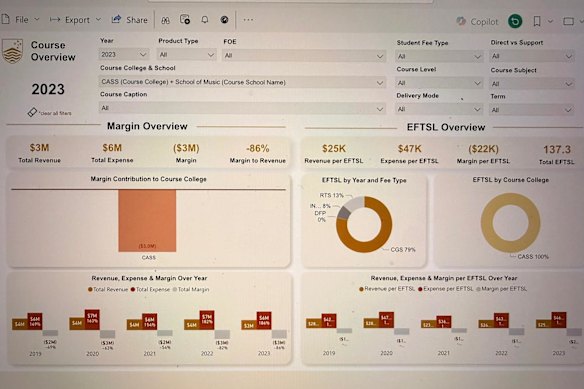
The secret financial documents confirm the School of Music did run at a loss. It generated $3 million in revenue but incurred $6 million in costs. In other words, the university had to subsidise each of its 138 students to the tune of $22,000, a figure dramatically lower than the $228,000 subsidy for each cybernetics student.
A former senior academic at ANU, who asked not to be named, said the validity of various courses, such as cybernetics or music, did not rest solely on their ability to make money.
“Increasingly, the challenge for universities, remembering that they are not-for-profit organisations, is that they offer sufficient courses that generate profit to balance those that are academically and strategically important but do not cover costs,” she said.
In responding to a question on notice from Senator David Pocock about how many new staff were hired and promotions made during the period of cost-cutting under Renew ANU, the university answered that cybernetics had “contributed the largest budget cut of the academic entities in the College of Systems and Society, including approximately 30 per cent reduction in headcount”.
However, internal data from the whistleblower shows that the number of full-time equivalent academic staff increased from 18 to 22 between 2023 and September 2025, while all the cuts were made in non-academic staff, whose equivalent full-time numbers fell from 20 to just eight.
Academic staff numbers in the School of Computing fell from 90 to 68, while professional staff remained at 23.
“If cybernetics took a bigger cut than other schools in the college, it absolutely should have. It is one of the most egregious examples of bloat across the university,” said an insider who asked not to be identified for fear of retribution.
The school only offers a single postgraduate course of 12 or 18 months. There are 15 students enrolled in its masters program this semester, according to the whistleblower, and another eight active but not currently enrolled. The program is capped at 20 new students a year.
On its “people” page, the cybernetics school lists 79 faculty, fellows and residents (some honorary, mostly not), PhD students, affiliates and operations staff. Many of the academic staff listed on the website have meritorious and substantial research careers but others appear to have risen to senior positions without the normally requisite publishing, teaching or professional experience. There are seven virtual “cybernetic imagination residents”.

The ANU spokeswoman declined to answer questions about staff numbers, which positions were paid and which weren’t, citing privacy concerns, but said they included “a mix of paid and unpaid appointments”.
This masthead approached Professor Bell for comment and heard back from her lawyer. It is understood Professor Bell disputes any suggestion she favoured the School of Cybernetics while she managed Renew ANU.
The word “cybernetics” was coined in the 1940s by US scientist and philosopher Norbert Weiner, who described it as the science of communication as it relates to living things and machines. Drawing on Weiner and other intellectuals, such as the anthropologist Margaret Mead, Bell has described cybernetics as both “theory and practice”.
“It’s both the theory of and the approach to building complex systems that have humans, technology and the ecology in a constant dynamic relationship,” she has said.
Cybernetics, as it is practised at ANU, is unlike other iterations of the field, which lean into highly technical expressions of engineering, maths and physics. Instead, Bell’s creation is heavy on art and literature, as well as on Indigenous culture and knowledge.
While located in the School of Systems and Society (previously engineering and computing), only a tiny handful of the academic staff listed on the School of Cybernetics website have qualifications in engineering, computer systems or maths.
Six do not have PhDs – which contravenes an edict from the higher education regulator that to teach a university course an academic must hold a degree at least one step higher on the Australian Qualifications Framework than the course they are teaching. To teach a masters course a teacher must have a PhD.
The most striking example of this is Professor Andrew Meares. Meares worked as a press photographer for Fairfax Media for 27 years, and then briefly as the official photographer to then-opposition leader Bill Shorten.
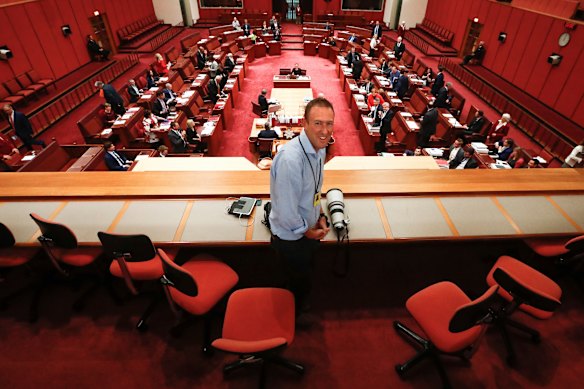
Since his appointment in mid-2019 as a senior fellow, Meares has zoomed up the career ladder, holding eight positions in the School of Cybernetics, culminating in full professorship in 2024. This is despite not finishing his university degree, making a certificate IV in photography from TAFE NSW in the early 1990s his highest qualification.
While Bell resigned as vice chancellor, she retained her title as a distinguished professor. However, in January, Bell was suspended after she was presented with a show-cause notice alleging “serious misconduct” in relation to the promotion of Meares. Meares is not accused of wrongdoing.
As a professor, Meares is paid a salary of at least $220,550, while Bell continues to be paid $583,500 – although she is on leave with full pay until January 2027.
Meares was approached for comment but forwarded the request to the ANU media office.
Another highly unusual dimension to the School of Cybernetics is its assessment profile. A whistleblower alerted the academic board last year after discovering that 91 per cent of all grades awarded since the school’s inception in 2019 were high distinctions. The analysis found not a single student failed or merely passed any subject.
The same whistleblower recently claimed to this masthead that he has found evidence of marks being changed months after they were posted.
A former senior academic said financial losses should not be the only factor considered when assessing a program’s viability.
“Cybernetics is a very high-loss-making venture but you need to understand where that fits in and how decisions are made. Budgeting at ANU is done at the college, not the school, level. Decisions can be made to cross-subsidise. In this case the very successful School of Computing is generating a very significant profit margin, largely from undergraduate and international students, but there are very few postgraduate and PhD students.
“If cybernetics was set up to be attractive to a multidisciplinary population, and to grow the research or master’s level cohorts, there is potentially a strategic case to build capacity in different types of students.”
Music, for the most part, was saved but dozens of students left, amid last year’s uncertainty, to resume their studies in Melbourne and Sydney.
Back to ANU academic Liz Allen and the pin. After 18 months of fighting the Renew ANU proposals, Allen handed it over to her battle-weary union mate Lachlan Clohesy. It cost her a dollar.
Start the day with a summary of the day’s most important and interesting stories, analysis and insights. Sign up for our Morning Edition newsletter.

















































