3 months ago
17
3 months ago
17
The protest was not opposed by the Sydney City local area command, which had sought legal advice on the proposed banner after the NSN gave notice of its plans under the name White Australia. It meant the rally proceeded as an authorised public assembly.
When is a protest ‘authorised’?
A protest is an “authorised public assembly” if organisers serve a notice on NSW Police at least seven days before the protest and:
- The police commissioner does not oppose the protest; or
- It is not prohibited by a court.
In this case, notice was given of the protest on October 27. NSW Police said it sought legal advice “and it was determined that there [were] ... no legal grounds to object to this public assembly”.
When a protest is authorised, participants have a relatively narrow immunity from criminal liability for certain acts related to the protest, such as blocking traffic. This is not a licence to engage in criminal activity.
According to the legal advice given to police, the wording used on the banner did not constitute an offence, and there were no legal grounds upon which to oppose the demonstration.
NSW Police applied for an urgent prohibition order last month to ban a planned pro-Palestine march that was expected to result in tens of thousands of people descending on the Opera House forecourt.
The order was made by the NSW Court of Appeal on public safety grounds after police expressed fears of a crowd crush.
McNamara said the laws would cover more than crowd crushes.
“It would have been appropriate for the police to consider seeking a prohibition order [in this case],” he said. “It would be for the Supreme Court to decide how they would adjudicate on that.
Loading
“Contrary to how the concept of public safety has been perceived and characterised over the course of the last two years, in particular, it’s not simply about physical safety ... [and the] dangers that go with large crowds.
“That’s a dimension of public safety, but the legislation actually doesn’t offer a narrow conception of what interests need to be weighed up ... to decide whether a protest should be authorised or prohibited.”
McNamara said the judge making the decision would need to balance competing rights.
“Given the nature of the subject matter of this particular protest, it would have been appropriate to consider the rights of the Jewish community … and other minority communities not to be subjected to public expressions of racist hatred and racism,” he said.
Lanyon told the ABC’s 7.30 program on Monday that the Summary Offences Act, which sets out the prohibition order process, “is very broad in terms of what it permits” and “it does look very favourably on people’s rights to protest and free speech”.
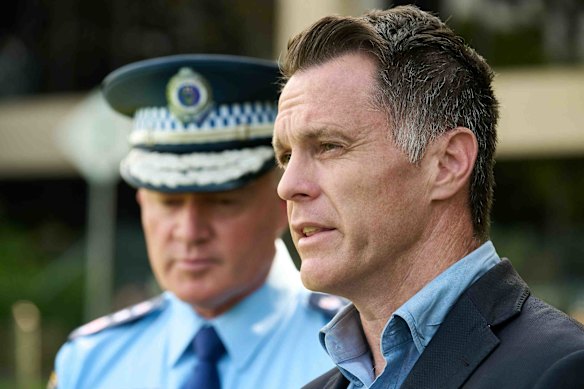
NSW Premier Chris Minns and Police Commissioner Mal Lanyon speak after the rally on Saturday.Credit: Flavio Brancaleone
“[Under] the legislation, as it stands at the moment, generally the grounds that we would oppose it is on public safety or a significant disruption to the public,” he said.
Lanyon said a “communication error” meant he was not briefed on the rally. Had he known, he would have “asked to see whether there were sufficient grounds to take it to the Supreme Court”. However, he also said he was “supportive of the decision that was made in this instance”.
The Minns government was not briefed on the rally in light of the communication error.
‘History of violence’
Lanyon told the ABC there was “nothing there to indicate there was a risk to public safety” based on “the behaviour of that group when we have dealt with them previously”.
Loading
Deakin University Associate Professor Josh Roose, a political sociologist whose work focuses on violent extremism and terrorism, said the NSN was a “national group with national co-ordination”.
“They have a history of violence, most recently at [Indigenous protest] Camp Sovereignty in Melbourne,” he said.
He noted NSW Police had previously relied on different public safety-related powers on Australia Day 2024 to stop the same group entering the Sydney CBD for a rally. But Roose was not opposed to potential new laws in this area, and said there could be lower thresholds for police intervention without “requiring violence or clear incitement”.
Hate speech
Premier Chris Minns suggested laws criminalising hate speech needed to go further, such as banning the phrase “blood and honour” – a slogan associated with the Hitler Youth.
“Firstly, it’s illegal to have Nazi symbols in NSW, but not the Nazi speeches or Nazi slogans,” Minns said.
University of Sydney Professor Emeritus Simon Rice said the protest organisers “walked a very fine line” and arguably there was a defence available to them under racial vilification laws for the banner.
He also did not believe the banner fell foul of section 93ZA of the NSW Crimes Act, which makes it an offence to display a Nazi symbol in public.
Loading
Rice was not convinced the laws needed to change, and said chanting a Nazi slogan might be caught by existing laws.
Rice said there was potentially “enough there [in this case] for the police to step in and stop this if they chose to” by seeking a prohibition order.
“It’s just that so far the circumstances have been [limited to] … a physical concept of public safety,” he said.
“I think this invites them to think about whether or not there’s a broader concept of public safety: protecting people from vilification. That may happen next time.
“I think it would be really interesting to know what the court said about that.”
Comment was sought from NSW Police.