3 months ago
18
3 months ago
18
By Lily Shanagher
December 22, 2025 — 2.49pm
The explosion of a SpaceX rocket earlier this year put multiple passenger planes in danger, with one pilot declaring “Mayday” before being forced to fly through the debris.
The experimental rocket ship belonging to Elon Musk’s company disintegrated minutes after lift-off in January, scattering fiery debris across the Caribbean region and causing widespread disruptions to air traffic.
Pilots of three planes, carrying a total of 450 people, were forced to decide whether to fly through a field of rocket debris or risk running low on fuel over water, according to Federal Aviation Administration documents.
The files, which The Wall Street Journal reviewed, revealed that the January 16 explosion posed a greater danger to planes in the air than was publicly known.
The explosion rained a meteor-like shower of debris across parts of the Caribbean for about 50 minutes and could have put lives at risk, the FAA said.
Fiery trails shooting through the sky were visible from the cockpits and cabins of commercial aircraft and private jets. If a piece of debris had struck an aircraft in flight, it could have caused severe damage to the plane and possible passenger fatalities.
All flights eventually landed safely.
The uncrewed Starship test flight was Musk’s seventh attempt at launching a rocket ship into space in his quest to make life on Mars a reality. Responding to the explosion, the billionaire posted on social media: “Success is uncertain, but entertainment is guaranteed!”
During the incident, an air-traffic controller told one of the planes, a JetBlue flight en route to Puerto Rico: “You want to go to San Juan, it’s going to be at your own risk.”
The other two, a private jet and Iberia Airlines flight, also declared fuel emergencies and travelled through the temporary no-fly zone, the WSJ reported.
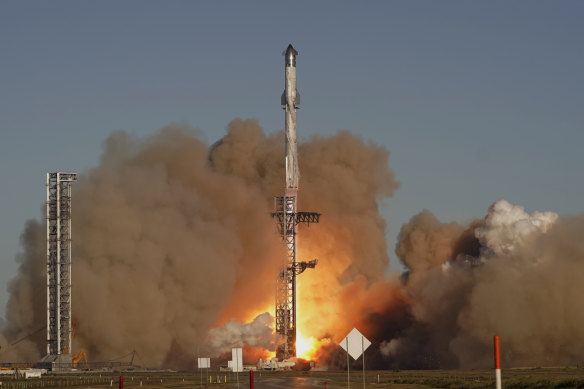
SpaceX’s mega rocket Starship launches for a test flight from Starbase in Boca Chica, Texas.Credit: AP
A controller in Puerto Rico told pilots they would have to declare an emergency to land at the capital. One pilot responded: “In that case, we declare emergency: Mayday. Mayday, Mayday.”
Air traffic controllers working on the issue had to try to divert planes from the debris areas, increasing their workload and causing a “potential extreme safety risk”, according to one FAA report from an air-traffic facility in New York.
At least two planes flew too close to each other, requiring a controller to intervene to avoid a collision, the documents said.
Loading
As well as the extreme safety risk, the FAA recorded that SpaceX failed to call an emergency hotline immediately after the explosion. Controllers in Miami first heard of the explosion from pilots seeing the debris, not from Musk’s company.
Space X, the world’s busiest rocket launcher, has already launched 11 Starship missions and is planning future flights over Florida, Mexico and North Atlantic aircraft routes. Starship, which stands at 121 metres tall, is the most powerful rocket ever developed, the company said.
The explosion alarmed airline industry and US government officials because of its impact on air travel and the growing number of space operations.
The safety risk of debris is set to keep increasing. The FAA predicts an annual average of 200 to 400 rocket launches or re-entries in the years ahead, compared with 24 operations on average each year between 1989 and 2024.
Following the January incident, the agency set up a panel of experts to conduct a safety review to examine how to deal with debris risks from spaceflight failures.
FAA officials suspended the review in August, claiming that most of the safety recommendations were already being implemented. The unusual move surprised the panel members.
Since the January explosion, SpaceX has conducted four more Starship launches, two of which were successful, while two failed.
Loading
During the test in March, the engines failed shortly after lift-off, leading the rocket to spin out of control and explode midair. In May, the rocket spun out of control and broke apart near its intended splashdown location in the Indian Ocean.
The company plans to launch a new, more powerful version next year. Musk has already predicted there would be problems. He said on a podcast in September that he warned the rocket “might have some initial teething pains because it’s such a radical redesign”.
The London Telegraph has approached SpaceX for comment.
Telegraph, London
Most Viewed in World
Loading