3 months ago
20
3 months ago
20
Left alone with his thoughts – relatively alone, given the hovering TV cameras and a worldwide audience awaiting his immediate verbal download of the one that got away – Oscar Piastri kept his distance and his counsel.
There was nothing to say, but ample time to think.
As the Australian Formula 1 driver waited for the post-race podium ceremony after finishing second in the Abu Dhabi Grand Prix, the 24-year-old’s mind would have wandered as his mouth stayed shut.
How could he have led the world championship after 15 of the 24 rounds and still fallen short? How could the best season for an Australian driver since Alan Jones won his sole world title 45 years previously have ended with him in third place in the standings? And what effect did being asked to cede a position to teammate Lando Norris at the Italian Grand Prix in September change what happened next? That moment, when McLaren botched the British driver’s pit stop, gained Norris three championship points. He eventually secured the title by two.
How will that effect what happens internally at McLaren in the future?
For all Piastri’s misfortune and self-inflicted wounds this season – and there were many after he squandered a 34-point championship lead after 15 rounds to fall 13 points short – Monza will be the one that sticks in his craw when he has time to decompress from a campaign that fast-tracked the Melburnian from rising star to title contender.
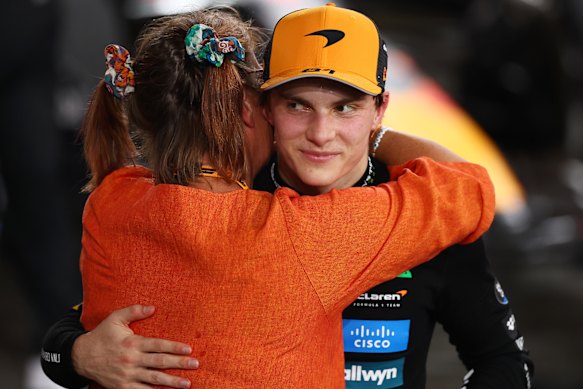
Oscar Piastri embraces Lando Norris’ mum Cisca Wauman.Credit: Getty Images
Yes, he lost points to errors at Albert Park and in Azerbaijan, contentious penalties in Silverstone and Sao Paulo, and a McLaren strategic howler in Qatar where he looked set for his first win in months in the penultimate round of the season.
But Monza – when he was ordered to move aside for Norris for a team mistake that had nothing to do with him – felt like an overreach when it was demanded, and invited questions over whether McLaren’s “Papaya Rules” to pursue fairness between its two drivers had a preferred outcome in mind.
Whether correlation led to causation, we’ll never know. But after Monza, Piastri’s worst weekend of the year came next time out in Baku, and he went without a single podium for the following five rounds as Norris surged, the Briton taking the lead after the Mexican Grand Prix with five rounds remaining.
After showing such metronomic form and unflappable composure atypical for a driver in just his third F1 season, Piastri’s late-campaign wobbles, Norris bouncing back from a Dutch Grand Prix engine failure and Max Verstappen arresting a 104-point championship deficit to turn Abu Dhabi into a three-way title showdown for the first time in 15 years simultaneously showed how far Piastri has come, but how far he has left to go.
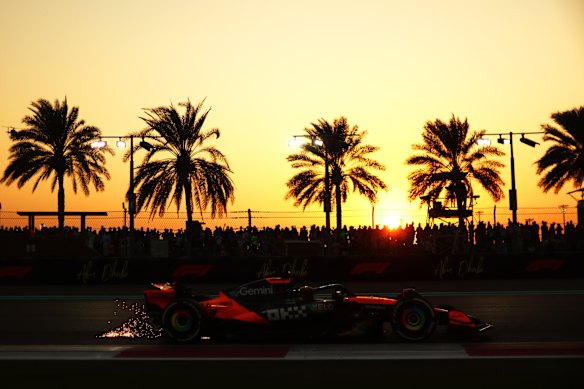
Piastri in action during the Abu Dhabi Grand Prix.Credit: Getty Images
From third on the grid in Abu Dhabi, behind Verstappen and Norris – Piastri knew what was required. “From where I’m sat, I need things to happen in the race to win the championship,” he said after qualifying on Saturday. But because Abu Dhabi’s soporific circuit layout rarely promotes jeopardy – Verstappen’s win on Sunday was the 11th successive race at Yas Marina where the pole-sitter took victory, a state of high-speed stasis that makes the processional Monaco Grand Prix look interesting – Piastri could do little.
A robust first-lap pass of his teammate around the outside of turn nine – a place where overtaking is rare, especially in the opening stages of a race where the cars are weighted down with 58 laps of fuel and not at their most nimble – was clinical, but proved to be Piastri’s high point.
Starting on hard-compound tyres while Verstappen and Norris used the preferred medium Pirellis, Piastri’s plan was to run a longer first stint of the race than his championship rivals, gain track position when they pitted, and hope for those aforementioned “things” to happen to vault him into the box seat for the title.
Piastri led for 17 laps when Verstappen pitted on lap 24 and retained second place after he pitted by the end of lap 40, but with Verstappen well ahead and Norris under no threat from Ferrari’s Charles Leclerc behind as he comfortably ran in the third place that was enough to secure the title, the final race of an enthralling season petered out to a limp conclusion.
“We tried a bit of a gamble on strategy, tried absolutely everything to try to win the race and give ourselves the best chance to win the championship, but ultimately we didn’t have the pace today,” Piastri said.
“It’s been a fun challenge,” he added, referencing his season-long battle with Norris that began when the McLaren teammates locked out the front row of the grid in Melbourne in March and ran all the way to the chequered flag in Abu Dhabi, Piastri four seconds ahead of his teammate after the final lap of the year.
“It’s been an enjoyable season for both of us, probably … and I’m saying that as the person who’s not champion. I’ve learned plenty of things along the way.
“When things have been good this year, I’ve felt unstoppable at points. To even be able to get to that point is a pretty cool feeling to have.
“There’s been plenty of times where that’s not been the case, and I think I’ve learned a lot of lessons on how to deal with tough moments, adversity from different directions.”
Piastri’s 13-point deficit to the champion is the closest any Australian has got to emulating Jones’ 1980 title for Williams since Mark Webber – now Piastri’s manager – fell 14 points short of Red Bull teammate Sebastian Vettel in Abu Dhabi in 2010.
No Australian has won more races in a single season than Piastri’s seven this year, equal to Norris and one shy of Verstappen, who closed out a failed quest to become the first driver to win five successive titles since Michael Schumacher (2000-04) with three straight victories.
In just three seasons and 70 races, Piastri has won as many grands prix (nine) as Webber did in his 215-race career, and two more than McLaren predecessor Daniel Ricciardo managed in his 13-year F1 tenure.
Loading
Given McLaren’s dominance of the season – it was only Verstappen’s brilliance that made the British team sweat – there’s plenty of optimism for the 2026 calendar that begins in Melbourne next March, even with a significant regulatory shift for F1 between seasons that may shake up the pecking order for the coming campaign.
For now, though, Piastri will process 2025, wonder if he could have handled the tough times better, and keep his fingers crossed that McLaren’s policy of letting its drivers fight fairly persists now one of them has the world champion’s No.1 on the nosecone of his car next year.
“I’ve been in championship battles before in the junior categories but in F1, it’s got a little bit extra to it,” Piastri smiled, somewhat ruefully.
“I’ve learned plenty about that this year, and I think that will only help me going forward.”
News, results and expert analysis from the weekend of sport are sent every Monday. Sign up for our Sport newsletter.
Most Viewed in Sport
Loading