3 months ago
26
3 months ago
26
Editorial
December 26, 2025 — 5.00am
December 26, 2025 — 5.00am
While we are yet to discover what the Bondi Beach gunmen did in the Philippines, their sojourn is a reminder of how the threat of extremism can survive underground in our region despite massive endeavours by governments to eradicate it.
Father and son Sajid and Naveed Akram spent most of November on the southern Philippine island of Mindanao at Davao City, and our South-East Asia correspondent Zach Hope reports their phones may have been detected in a distant rural region with a history of violent Islamic extremism and a reputation for sheltering and training international terrorists.

Thousands gathered on Sunday at Bondi Beach for the National Day of Reflection for victims and survivors.Credit: AP
Philippine police confirmed the Akrams used a mobile phone “twice” outside of Davao City during their 28-day stay and visited a gun shop, an Islamic centre, an ATM and a beachside resort.
Philippine authorities confirmed one line of inquiry, first reported by News Corp, that investigators were looking at the movements of two other Sydney men whose trip to Davao City overlapped with part of the Akrams’ stay. However, no red flags had been discovered. The Akrams and the other Sydney pair might have been, and remained, strangers.
Loading
Australia had been concerned about the threat posed by militants in Mindanao for nearly a decade. In 2017, members of the ADF were sent to strengthen Manila’s long-term ability to combat terrorist threats and prevent the spread of Islamic State to our region.
Then-defence minister Marise Payne said the increased cooperation would enhance intelligence, surveillance and reconnaissance in the southern Philippines, and strengthen information-sharing arrangements. “Globally, we have seen the effect of extremist ideology and terrorist threats on millions of civilians and it is alarming to see this disruption come to our region,” she said. “The spread of Daesh-inspired terrorism is a direct threat to Australia and its interests, and we are committed to working with our partners and allies to ensuring Daesh cannot establish a geographic foothold in the region.”
Mindanao has a fractious history of independence and breakaway movements, including a push to establish an Islamic state. It also reportedly served as a training ground for Jemaah Islamiyah militants who carried out the 2002 Bali bombing that killed 202 people, including 88 Australians, and continues to devastate their survivors.
After a protracted five-month battle in 2017, the Philippine government placed Mindanao under martial law. Subsequently, a peace deal eventually set up an autonomous Muslim government region, but sporadic armed skirmishes have continued.

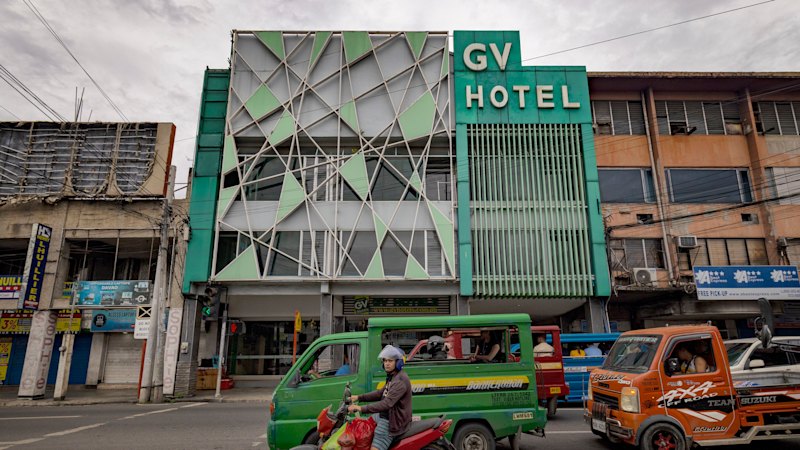
The GV Hotel in Davao city, Philippines, where Sajid and Naveed Akram stayed in November.Credit: Getty Images
Without wishing to prejudge the various inquiries by Australian security authorities into the killings in our own eastern suburbs, it is now entirely probable that the Akrams travelled to the Philippines seeking assistance for their murderous enterprise from like-minded fanatics.
While governments and authorities dissect the alleged Bondi Beach murders to address the challenges involved in heading off or meeting future threats, the Philippines’ experience carries stark lessons for an Australia struggling to come to grips with the tragedy.
Rogue maniacs and terrorist groups can be weakened, crushed and even die. However, their ideologies live on and bubble under the surface, awaiting the next moment.
Most Viewed in World
Loading