3 months ago
29
3 months ago
29
The response that some parents have had to the social media ban for under-16s shows how many now see disciplining their children as the job of the government or the school – anyone but them (“Has Australia’s social media ban been a success?” January 16). In the months leading up to the ban, every news outlet ran stories of how tech-savvy children planned to use their expertise to get around the bans and retain (or regain) access to the banned sites. Surprise, surprise that has actually happened by the use of fake IDs, new email addresses and tricks to fool the facial age estimation scans. The reaction, however, of one parent who discovered that her daughter was able to quickly regain access to Snapchat by a similar ruse was to be surprised and then throw up her hands. “I’m miffed,” she said, “I was expecting the government to clean it up for the kids.” Apparently, the thought of taking her daughter’s devices off her was unthinkable. I wonder if this mother would have had the same reaction if her child was found drinking whisky in her bedroom. Would she close the door and allow her daughter to get drunk? Would it be the government’s fault that they didn’t make the licensing laws watertight? Parents who turn a blind eye to any form of lawbreaking send a message to their children that all laws can be flouted if there is a clever way around them. Mike Reddy, Vincentia
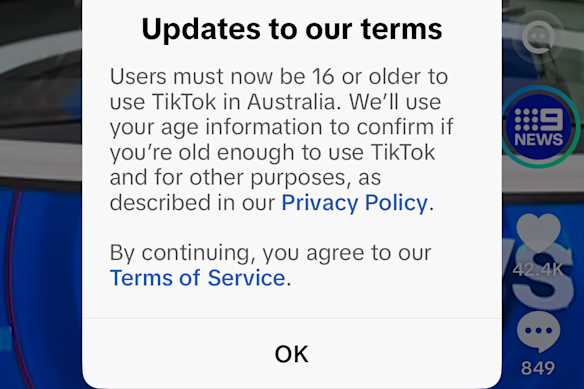
Notifications for all users started popping up on social media apps including TikTok on December 9, hours before the social media ban officially came into effect.
So now we are relying on the government to act as a surrogate parent? At least it gives teachers a break. There is usually a call for schools to do more to heal society’s problems. John Ure, Mount Hutton
I asked my 11-year-old granddaughter about the social media ban. She explained it hadn’t affected her at all because she wasn’t on social media – only on Facebook and Instagram. Obviously, the new rules are still a work in progress. Jennifer Whaite, Oatley
Curtain falls
I agree with Professor Catharine Lumby in praising the actors who chose to postpone their production of The Merchant of Venice (“Actors halt Shakespeare over Shylock”, January 16). Their decision reflects judgment, not censorship, at a time when many Jewish Australians are still reeling. Antisemitism did not begin with Shakespeare. It was shaped over centuries by law and custom. In medieval England and Europe, Jews were excluded from most professions and trades. They could not join guilds, own land or hold public office. Moneylending, barred to Christians under church doctrine, became one of the few livelihoods open to them. From that exclusion grew resentment and enduring stereotypes. Shylock cannot be understood without this context. He is mocked, abused and spat upon throughout the play. His anger, however confronting, grows out of humiliation and exclusion. Shakespeare reflects the prejudices of his age, but he also exposes the cruelty that produces them. It is also worth remembering that there were few, if any, openly practising Jews in England in Shakespeare’s lifetime, following their expulsion in 1290. The character of Shylock was shaped more by inherited myth than lived experience. As students are taught when studying The Merchant of Venice, understanding the world that produced Shylock is essential to understanding the play itself. John Kempler, Rose Bay
I see why a theatre company might have doubts about staging The Merchant of Venice so soon after the Bondi atrocity. But now is surely the time to confront antisemitism, not wait until it subsides again into the sewers of unspoken prejudice. Shylock’s speech in Act 3, Scene 1: “If you prick us, do we not bleed? If you tickle us, do we not laugh? If you hurt us, shall we not be revenged?” is one of the most powerful challenges to race hatred ever written. Let it be heard. David Salter, Hunter’s Hill
The problem with the proposed religious text exemption from hate speech laws can be summed up by another quote from The Merchant of Venice: “The devil can cite scripture for his purpose.” Edward Loong, Milsons Point
Level heads needed
Thank you, Waleed Aly, for adding wise words to a debate that until now can only be described as infuriating and amateurish (“Albanese’s hate speech critics agree on one thing”, January 14). The most important federal legislation to be passed this century needs level heads, deep thought and extensive consideration and communication of its consequences for every Australian. Childish bickering by the opposition is infuriating. Suggestions for change should be made with clear heads and put forward in a positive framework that would enhance the current bill, rather than acerbic criticism that equates to divisive politicking. Susan Ley is behaving like an indignant school teacher who has lost control of the classroom. It’s time to raise the bar people, and that means the government and the Greens as well. For all of our sakes. Donna Wiemann, Balmain
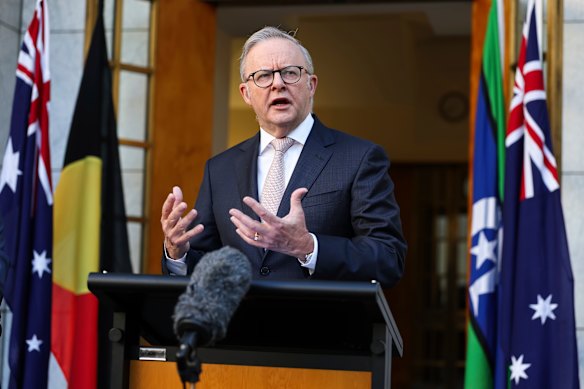
Prime Minister Anthony Albanese is appealing for unity to pass hate speech laws.Credit: Alex Ellinghausen
Criticism of the government for the exclusion from hate speech laws for quoting scriptural text should consider that the constitution includes a provision for religious freedom. Any valid law must abide by the constitution unless it is changed through referendum. So any restriction on religious speech or other activities would require a referendum, similar to the attempted Voice to Parliament. John Reidy, McMahons Point
It’s hard to understand why there is such haste in trying to pass legislation to restrict what we may say and write even further than is currently the case. There are already laws against incitement to violence and defamation. Some would say such laws are already too restrictive or leave too much for the courts to interpret. The prime minister is so politically minded that it’s hard to know what he really thinks about these things. Legislation can’t stop hate and the haste with which the proposed new laws may be imposed on us is more likely to cause frustration and anger than might be the case if the process were given more time. David Morrison, Springwood
The anti-Labor forces in politics, business, the media and lobby groups give us a first-class lesson in the politicisation of a tragedy. Demand the immediate recall of parliament. Demand a royal commission. Keep up the demand until a royal commission is called, then complain about the choice of commissioner and the terms of reference. Keep complaining for months while the commission is under way. When parliament is recalled, complain that the process is rushed. Reject any legislation making up excuses as required, to ensure that only the favoured constituency gains any benefit. Make sure that your members of parliament and would-be candidates get plenty of media coverage. Do everything possible to keep the tragedy in the public eye and prevent any corrective actions. Alan Kesby, Casula
Religious texts? Who wrote the hard copy? Like all reporters after the fact, using only memory or recourse to that of others, the work, at best, is filtered through the writer’s perspective or prejudice. None of the major scripts that I can find have been physically written by those who are claimed to have “said” them. All the actual “writers” have relayed what they were told or heard from others. Let’s be careful what we believe as fact, as it may be no more than gossip. Let’s not go to war over that. Richard Lynch, Belbora
Same fish, different pond
On Friday morning, I made my last visit to the old Sydney Fish Market before it moves to its glamorous new home (“Double the visitors, same number of car spots: Traffic fears for new fish market”, January 16). The functional, ugly but lively complex is finally closing at the end of this week. I’ve been visiting for nearly 60 years, first with my dad in the late 60s. It’s been part of my life for a long time, as it has for many other Sydneysiders – early morning visits for prawns and fish, taking overseas visitors, eating fish and chips by the water, selecting mixed oysters from all over Australia for dinner parties, learning how to prepare fish at the cooking school, going on a behind- the-scenes tour and crazily shopping at 3am on Christmas Eve for lobster and crab. Wonderful memories and mixed emotions, but I look forward to a happy relationship with the new market. Philip Smith, Waterloo
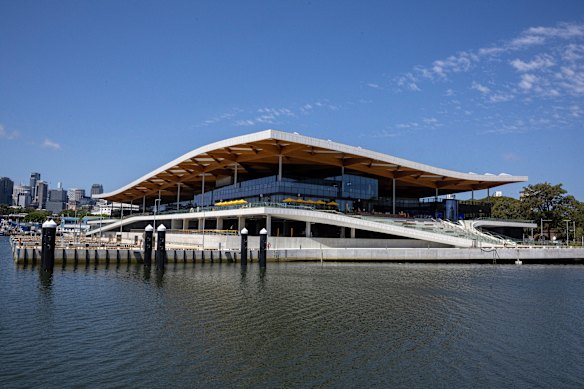
The new Sydney Fish Market will open on Monday.Credit: Sitthixay Ditthavong
The naysayers predicting every possible issue with Monday’s opening of the new Sydney Fish Market probably also vacated Sydney during the 2000 Olympics. It won’t be perfect, folks, and the markets will probably have teething pains, but I suspect the sun will still rise on Tuesday morning. Stephen Driscoll, Castle Hill
In planning ahead for the transport needs of the new fish markets not only are many more services needed on the inner west light rail, including during the peak, but also another long-term solution. The new metro station at Pyrmont could be linked by an all-weather walkway, similar to that at Barangaroo. Matthew Doherty, Camperdown
Tourist towns
Zoya Patel is spot-on about the feelings of people who live in holiday destinations (‘Live in a holiday hotspot? Try not snarling at the tourists’, January 16). My town of 17,000 swells every Christmas, Easter and school holiday to at least double its size. Locals count down the weeks until these influxes, then we count down to their exodus. We do, however, totally understand that our little haven of bushland and seaside delights depends on the money the tourists bring and so we put up with the temporary inconveniences. What we really don’t like are the complaints about the lack of city comforts and rudeness to our shop staff, especially the young ones. Stop those and there just might be more smiling and less snarling. Lynda Gilfeather, Surf Beach
Emergency CPR
The heart of this continent’s ecosystems is sustained by an intricate network of arterial waterways, from the mighty Murray-Darling to the “humbler” yet significant ephemeral wetlands and watercourses (“Murray River now classified as critically endangered”, January 16). As with our hearts, appropriate sustenance is essential to avoid damage. That the lifeblood of the country is in danger of a catchment version of cardiac arrest is alarming. In this case, we need immediate CPR ... Catchment Protection Required. River and wetland systems cannot be kept on artificial life support. Steve Dillon, Thirroul

Before and After of Murray Darling BasinCredit: Fairfax Media
The big mistake in the Murray-Darling basin was the adoption of the belief that separating land rights from irrigation rights would lead to an economically efficient allocation of water. It was just that, a belief, and the environment has suffered terribly because of it. The great problem now is how to unwind four decades of mismanagement with industry lobbyists braying at the door. Greg Baker, Fitzroy Falls
Climate prophesy
There was an interesting article and graph in the Herald showing the rise in global atmospheric temperatures since 1980 (“The past three years were the world’s hottest on record”, January 15). In 1986, I was lecturing to university postgrads on environmental medicine and I attended a climate change conference where evidence was presented for fossil fuel-related global warming and long-term postulated impacts on health for Australians, particularly a rise in mosquito-borne diseases, heat illnesses and an increase in weather disasters. Forty years later and all of this has come to pass – an increase in global temperature of 1.5 degrees, an increase in malaria and dengue in northern parts of Australia, more recently Japanese encephalitis, and increased frequency of cyclones, floods, heatwaves and bushfires – exactly as was predicted at that conference. So where were our leaders? Why are we still supporting fossil fuels? We need to get on with it or our children and grandchildren will suffer the worst consequences of our inaction. John Frith, Paddington
Laws that protect
Your correspondent Lynne Strong provides a well-reasoned argument for the principle of leadership morality rather than regulation based in law (Letters, January 16). But idealism and reality are two different things. As an example, US President Donald Trump has just declared that his actions are governed by his personal morality. That frightening utterance tips the balance towards safer legal constraints, which are better than having a religious crank or a cult leader acting as an exemplar. While we have no one as dangerously mendacious as Trump, Australian politics is not short of eccentrics. The law might be an ass, but it’s infinitely better than being taken for a ride by a reinless horse. Trevor Somerville, Illawong
I can’t help imagining some future final year history student discussing “The role of Donald Trump in World War III”. That is, of course, if we don’t “All go together when we go, All suffuse with an incandescent glow”, as the satirical American singer Tom Lehrer predicted. Viv Mackenzie, Port Hacking
I have a dream: Elon Musk renews his friendship with Donald Trump. He then offers Trump a truly, really beautiful and wonderful one-way ticket on one of his SpaceX rockets. The universe is welcome to him. Planet Earth might then regain some semblance of normality. Tony Denzel, Bonny Hills

Credit: Alan Moir
Shrinking world
Correspondent Bev Matthews must be living in a dream world (Letters, January 16). Far from parents having large families, Australia’s birth rate is well below replacement level, and we could not maintain our economy without a steady influx of immigrants to make up the deficit. In fact, the whole global population is stabilising and will reach its maximum later this century. It raises an interesting question of how we shall cope at the end of the century, when developing countries no longer have a population surplus that we can exploit. Bruce Hyland, Woy Woy
Bev Matthews need not worry too much about the effect of large families on the environment. The few extended families these days are outweighed by the many small ones, with one or no children at all. China’s population is currently shrinking, as are many nations’. The world’s population is projected to top out at just over 10 billion in 60 years’ time, then to go into decline. The larger worry is our failure to rein in greenhouse gas emissions, both per capita and overall. Rising temperatures and reduced arable land might mean that the decline happens sooner and more dramatically. Andrew Taubman, Queens Park
EV chargers
Looking to the future as we age, my wife and I have been looking at buying a unit in a regional city but we have been hampered by a common stumbling block – home charging of our electric car is almost impossible. Too many bodies corporate actively discourage EV charging, and not enough buildings have purpose-built charging points. It’s disappointing. Phil Armour, Yass
No parking
I was interested in Matthew Bartinel’s ideas for town planning (Letters, January 16). Restricting car spaces is a great idea, but only if people stop buying so many vehicles. In our area, with multiple duplexes having replaced single dwellings, the streets are crammed with cars, boats, caravans, and trailers – because there’s nowhere else to put them. Josephine Piper, Miranda

Fewer parking places in unit blocks have led to more caravans and trailers on the street.Credit: Louise Kennerley
Give and get
Thanks to correspondent Kim Crawford for her regular reading to residents at a local nursing home (Letters, January 16). Volunteering her time, and no doubt bringing other skills and attributes along with her, gives much to the residents. Kim would also know that “what you give, you get”. Volunteering is a great way to experience unexpected rewards for what often seems like little personal effort. Salle-Ann Ehms, Glebe
Live to sleep
If you manage to sleep longer, won’t you have less time for living (“How to live longer by sleeping better”, January 16)? Mustafa Erem, Terrigal
Cyber sewage
The news that recycled water from Sydney Water’s proposed upgrade to the city’s sewerage network would be used to cool data centres is intriguing – water from sewage used to cool machines that turn out sewage (“The $3 billion fix promised for Sydney’s mysterious poo balls”, January 16). John Elder, Brisbane (Qld)
- To submit a letter to the Sydney Morning Herald, email [email protected]. Click here for tips on how to submit letters.
- The Opinion newsletter is a weekly wrap of views that will challenge, champion and inform. Sign up here.