3 months ago
29
3 months ago
29
By Jonathan Abrams
January 3, 2026 — 5.20am
AI-generated artists topping iTunes and Billboard charts. Podcast hosts speaking fluently for hours in languages they do not know. Dead celebrities brought back to life and filling up social media feeds.
For years, artificial intelligence was a disruption on the horizon. In 2025 it arrived in tangible ways, big and small. Here are a few examples of how AI intersected with pop culture last year.
An Oscar season controversy
In January, the makers of the 2024 film The Brutalist revealed that they had partnered with a software company to enhance the Hungarian accents of the lead actors, Adrien Brody and Felicity Jones.
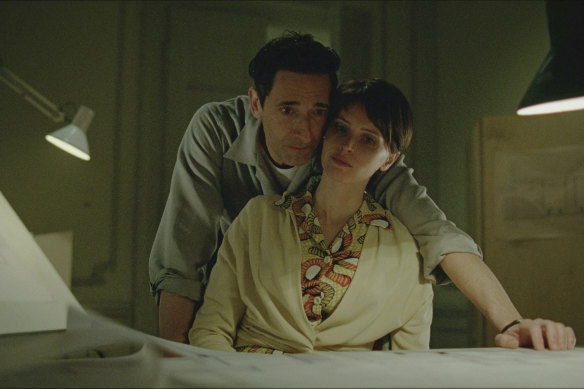
Adrien Brody and Felicity Jones in The Brutalist.
The epic drama about a Hungarian-Jewish architect who survived the Holocaust and remakes his life as an immigrant in America became an awards season favourite. The revelation about the film’s use of AI came to light in the lead-up to the Oscars and became a major talking point; it was nominated for best picture but fell to Anora, while Brody took home the award for best actor.
Loading
In April, the Academy of Motion Picture Arts and Sciences clarified its position on the use of AI and digital tools, which “neither help nor harm the chances of achieving a nomination”.
The uproar surprised Holly Willis, who teaches at the University of Southern California’s School of Cinematic Arts, and who compared the enhancements to normal post-production touch-ups.
“It misses the fact that cinema is completely made up of all kinds of augmentation, from lighting to colourisation, to the ways in which sound is recorded and shifted and altered in the post-production process,” Willis said.
AI-generated musicians find success
Over the summer, a new band called Velvet Sundown gained momentum, drawing over 1 million plays on Spotify in just a few weeks. It was an impressive number for an unknown act. In July, it was revealed that the band wasn’t a band after all, but a “synthetic music project guided by human creative direction, and composed, voiced, and visualised with the support of artificial intelligence.”
The disclosure sparked issues over legitimacy and whether streaming services should be obligated to inform listeners if the music they listen to is artificially manufactured.
Spotify released a statement in September that it was working to reduce the amount of “AI slop” on its service amid other efforts to tighten its AI policy.
The output from AI acts proliferated, though.
In November, Walk My Walk, a song from an AI-generated project named Breaking Rust topped Billboard’s Country Digital Song Sales Chart, and an AI-generated musician called Solomon Ray led the iTunes top 100 Christian and gospel albums chart. Also in October, traditional hitmaker Timbaland introduced his latest protégé — an AI pop singer named TaTa Taktumi. “I call it artist development, reengineered,” the producer told The New York Times.
A new Wizard of Oz spectacle
Should classics remain untouched and endure as artefacts of the time during which they were created? Or should new technology be embraced as a way to make these classics relevant to new generations? Those questions are at the centre of The Wizard of Oz run that started at Sphere in Las Vegas in August.
Sphere Entertainment Co. spent an estimated $US80 million ($A119 million) to modernise the 1939 musical, teaming up with Google to make the movie large enough to fit a screen that circles and rises over the viewer, along with other changes. Judy Garland’s Dorothy, for example, is now seen with legs in a scene that was previously a close-up. Voices that had been only heard off-screen were now spoken by visible people.
“I think we have to understand this as a movie adaptation,” said Dominic Lees, an associate professor of filmmaking at the University of Reading in Britain. “You can make a really good argument that AI here is adapting a pre-existing film into something that mostly looks just like the original film, but is greatly expanded.”
Podcast hosts clone their voices
Building up a loyal podcast audience was traditionally a by-product of familiarity between the host and listeners.
The same technology behind popular chatbots can now cut some of the busywork down for podcasters. “Host replicas are already being used to augment, or even replace, in-studio performances, and to translate episodes into other languages,” the Times reporter Reggie Ugwu found.
The risk is that hosts can ostracise the fan bases they worked hard to cultivate. “It entirely undermines the art form,” Nate DiMeo, the host of Memory Palace, told Ugwu. “The thing you’re listening for is a window into someone else’s consciousness. That is the whole ballgame.”
“Some leading podcasters have tried it out and then decided to drop it, and the big podcast publishers are really shying away from it, and that goes back to broad issues over trust: Will the audience trust this kind of act?” Lees said.
Deceased celebrities fill social feeds
The debate over artificially generated videos featuring dead celebrities is only beginning.
In September, OpenAI released Sora 2 AI Video Generator. The AI research company prohibits the creation of videos featuring living people, but social networks became inundated with deepfakes of dead celebrities ranging from Tupac Shakur to Bob Ross.
Zelda Williams, the daughter of actor Robin Williams, pleaded with online users to stop sending her AI-generated videos of her father in October.
“You’re not making art, you’re making disgusting, overprocessed hot dogs out of the lives of human beings, out of the history of art and music, and then shoving them down someone else’s throat hoping they’ll give you a little thumbs-up and like it,” she wrote. “Gross.”
Meet Tilly Norwood
The September introduction of Tilly Norwood, a realistic-appearing AI-generated actress, sparked concern in Hollywood over job replacement.
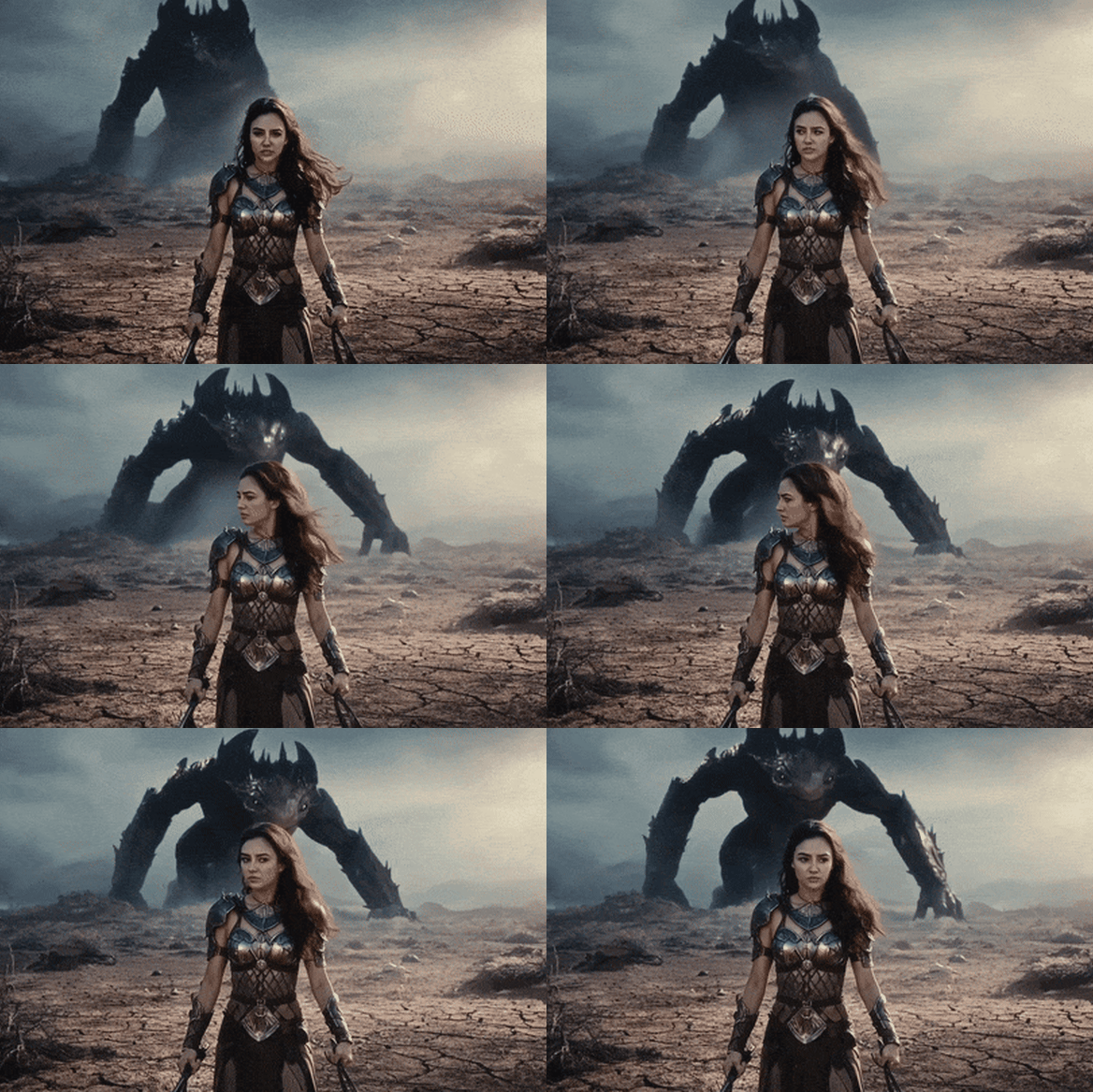
Tilly Norwood in action in her show reel ... except she is an AI performer.
The digital character was promoted by its creator, Eline Van der Velden, as screen-ready and in discussions to sign with a talent agency. In response to criticism, Van der Velden said Norwood was created not as a replacement for human actors but as another vehicle for storytelling.
Loading
“To be clear, ‘Tilly Norwood’ is not an actor, it’s a character generated by a computer program that was trained on the work of countless professional performers – without permission or compensation,” the Screen Actors Guild-American Federation of Television and Radio Artists said in a statement.
“We’ve had virtual influencers for many years, and this is a part of the internet culture that’s been around,” Willis said. “When you have someone who looks as human as Tilly Norwood does, it really made the acting community think about what our future might hold.”
Top filmmakers have their say
Some noted directors came out against the use of artificial intelligence in films near the end of the year.
“AI, particularly generative AI – I am not interested, nor will I ever be interested,” Guillermo del Toro, the Oscar winner who directed Netflix’s adaptation of Frankenstein, told NPR. “I’m 61, and I hope to be able to remain uninterested in using it at all until I croak.”
James Cameron, known for his pioneering use of visual effects, told ComicBook that generative AI is not used in his latest film, Avatar: Fire and Ash.
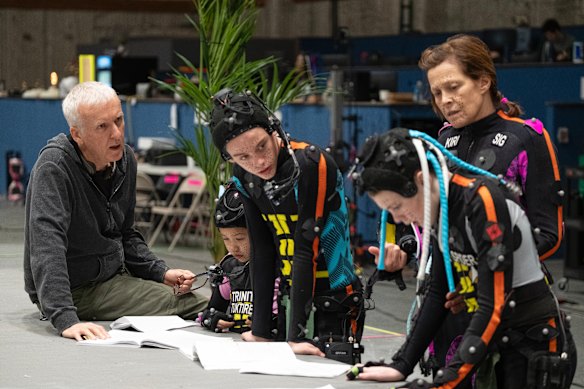
Sigourney Weaver (far right) on the set of Avatar: Fire and Ash with director James Cameron and fellow actors Trinity Bliss, Britain Dalton and Jack Champion. Despite the special effects, there was no AI.Credit: Mark Fellman
“I’m not negative about generative AI,” Cameron said. “I just wanted to point out we don’t use it on the Avatar films. We honour and celebrate actors. We don’t replace actors. That’s going to find its level. I think Hollywood will be self-policing on that. We’ll find our way through that.”
Disney reaches a landmark agreement
In December, Disney announced it would purchase a $US1 billion ($A1.49 billion) stake in OpenAI and allow its famed characters onto Sora, the company’s short-form video platform, becoming the first major Hollywood studio to align itself with an AI company.
The agreement arrived after Disney, along with Universal, sued Midjourney, an AI image generator, in June, arguing that it trained its software and allowed users to “blatantly incorporate and copy Disney’s and Universal’s famous characters”.
This deal will now allow users to make videos featuring those very characters, including from Disney films such as Toy Story and Frozen, along with animated versions of characters from Marvel properties and Star Wars films.
Most Viewed in Culture
Loading