
 4 months ago
61
4 months ago
61
For Gina Rinehart, power was never something observed from afar. It was something to be built, curated and sustained.
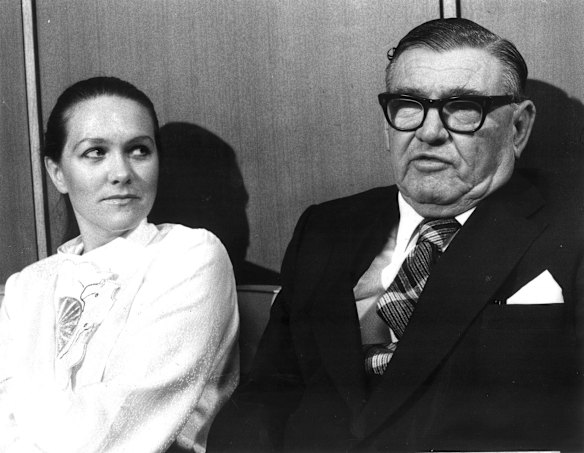
As a young woman growing up in the Pilbara she moved easily through a world where political leaders, industrialists and global figures were not distant names but dinner guests and travelling companions — a world shaped by her father, Lang Hancock, where influence was cultivated as frequently as iron ore deposits.
The guest lists alone told the story. Queensland premier Joh Bjelke-Petersen would drop in as an ideological kindred spirit. Labor giant Gough Whitlam would be shown prospective mining sites. But it was the presence of another prime minister, John Gorton, at Rinehart’s 21st birthday that crystallised just how close the Hancock orbit sat to the centre of Australian power.
It was a statement of reach – the kind of access that would later define her own political relationships, including with Queensland senator Pauline Hanson and her One Nation party.
Lang Hancock’s “Hancock Benefit Tours” flew politicians, investors and powerbrokers across the Pilbara, offering not just a sweeping view of mineral wealth but a carefully constructed argument about how Australia should be run. His daughter was part of that choreography – checking seatbelts, pouring tea, serving meals and, crucially, listening.
Those early lessons now echo in the alliances the mining billionaire has forged — from conservative figures in the Coalition, including leading Nationals, Peter Dutton as Liberal leader and, perhaps now most potently, with Hanson, whose insurgent politics mirrors a populist wave sweeping much of the west.
This week, that relationship took a dramatic and highly visible turn, but it also revived a long-running controversy that has followed the pair for months. Hanson revealed she had acquired a new campaign aircraft – a Cirrus SR22 – gifted via a company linked to Rinehart, alongside a surge of financial support from figures in her orbit.
“BREAKING NEWS - I’ve got a new plane, Sarah,” Hanson declared on social media. “Yes it was donated. Yes I’m super happy. Yes it’s fast. Yes it’s amazing. Yes it’s going to annoy the Guardian. Yes it means I can visit more regional towns across the country more often. Yes it’s a Cirrus G7. Yes it’s sexy. Yes I have a pilot.”
The tone was triumphant, but the backdrop is more complex.
For much of the past year, the blossoming relationship between Hanson and Rinehart has attracted fervent speculation and questions over transparency — particularly around private flights and hospitality that were not initially disclosed. Much of that scrutiny has been driven by the reporting of Guardian Australia journalist Sarah Martin, whose work has repeatedly forced retrospective declarations and amendments to parliamentary registers.
A trip to Florida last October became the clearest example. Hanson travelled aboard Rinehart’s private Gulfstream G700 and stayed at her Palm Beach mansion near US President Donald Trump’s Mar-a-Lago. The flights and hospitality were only formally declared after the details were exposed, with initial paperwork rejected before being resubmitted correctly.
Hanson and her staff have often been evasive. When asked about Rinehart’s possible financial support for the party in December, her influential chief of staff James Ashby claimed: “I haven’t seen any money from her.”
But it was not an isolated incident. Hanson’s register of interests shows multiple flights and trips facilitated by Hancock Prospecting over months, a pattern that has drawn scrutiny from political opponents and electoral authorities alike.
During the South Australian election in March, One Nation’s lead candidate Cory Bernardi said he would pay for flights operated by S. Kidman & Co, a company majority owned by Rinehart, that was used to transport him and Hanson on the hustings. Last week, he announced he’d repaid “in excess of $40,000”, adding it was “worth every cent”.
The flights drew fierce criticism from Labor at the time, who urged electoral authorities to investigate if any donation law breaches had occurred.
But Hanson can’t understand what all the fuss is about.
“These flights are no cost to the taxpayer,” she said. “It didn’t cost the taxpayer a cent for me to fly on a plane – are you worried about whose plane it was on?”
As One Nation draws alongside the Coalition in the polls, eats away at Labor voters in the working-class outer suburbs and threatens a federal seat once held by a Liberal and National Party leader, the financial network underpinning the surging party is also becoming clearer.
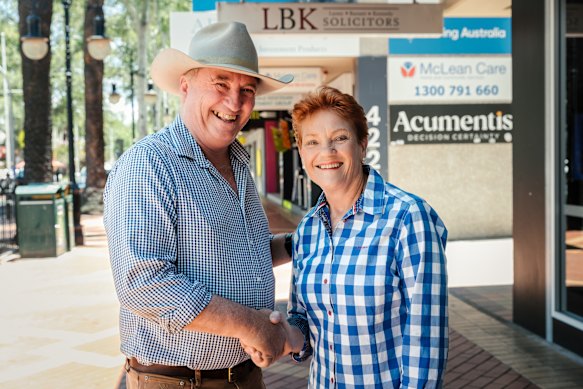
Hanson and her star recruit Barnaby Joyce have appeared in regional electorates wearing blue-and-white check shirts and hats branded S Kidman and Co – and wearing Rossi boots, another of Rinehart’s brands – as if they were posing for a store catalogue. Candidates are driving gifted One Nation-branded utes also donated via Rinehart.
When Rinehart couldn’t attend a Rowing Australia event at Lake Barrington, Tasmania, earlier this year, she sent along Hanson’s daughter Lee – a state senate hopeful – to present the trophy. The mining magnate has even voiced her own character in Hanson’s popular satirical online cartoon, Please Explain.
On Wednesday, the One Nation leader announced two senior Hancock empire figures, Ian Plimer and Adam Giles, had each recently contributed $500,000. Hanson also singled out “two wonderful, patriotic Australians”, Angus and Sarah Aitken, for what she described as an “enormous $1 million investment”.
That donation stream is also part of a broader shift. Reporting by The Australian in January revealed that a trio of former Liberal-aligned fund managers — Douglas Tynan of GCQ Funds Management, Ben Cleary of Tribeca Investment Partners and Aitken of Aitken Mount Capital Partners — had each pledged $100,000 to One Nation after Rinehart agreed to take them to dinner with Trump at Mar-a-Lago. Trump met with the group in March.
The arrangement, struck at a lunch aboard the private residential ship The World, reflects growing frustration among traditional Liberal donors and a willingness to redirect financial support toward a party seen not so much as more ideologically aligned as to send a message.
“The Liberals are too worried about trying to win back inner-city teal votes with middle-of-the-road policies rather than appealing to hardworking Australians in suburbia who are being totally stuffed over by the current government on everything from housing to energy costs,” Aitken said at the time.
“Hence this is why One Nation is taking a lot of former lifelong Liberal voters as the party of common sense. I have no interest in donating more money to the federal Liberal Party.”
A blossoming friendship
While Hanson and Rinehart are obvious bedfellows in hindsight, it was not until January last year, when the pair were spotted alongside former Liberal Party vice-president Teena McQueen dining while on holiday in Thailand, that their partnership became clear.
Since then, fundraising methods have at times been as unconventional as the politics they support. According to reporting by the Australian Financial Review, Rinehart has hosted airborne fundraising dinners aboard her private jet, with donors paying $15,000 a seat to join Hanson, and on one occasion Barnaby Joyce, for a circuit above Sydney.
The imagery is striking: a populist movement railing against elites, financed at altitude by some of the country’s wealthiest individuals.
Many within the Nationals believe Rinehart’s shift away from the Coalition to One Nation was a driving factor in the defection of Joyce, who was twice deputy prime minister. A longtime friend of Rinehart, Joyce has been equally unapologetic about the relationship.
The Tamworth-based MP told this masthead earlier this year that Rinehart had a strong political view “that’s not aligned with any party”.
He rejects the suggestion that Rinehart exerts undue influence over policy, insisting the relationship runs in the opposite direction.
“We don’t change who we are, people decide to align with us,” he said, adding that “there are times where I fervently disagree with Gina Rinehart”.
He was emphatic on the question of direction: “I’ve never been told by Gina … you must do this, you mustn’t do anything … it’s always been a conversation”.
More broadly, he argued that business leaders understand the legal and political risks of overreach.
“People who have gone a long way in life in business are generally not so naive as to start telling politicians what to do, they’ll have discussions, they’ll have views, but they don’t have instructions”.
It is difficult to get people on the record to talk about the extent of Rinehart’s political influence and interference. Those who know her well fear falling out of favour. But many make the point that her political support isn’t all it’s made out to be.
“A figure like her in America would be donating hundreds of millions, if not a billion, in any given campaign cycle,” one influential conservative figure who calls Rinehart “a good friend” says.
“Yes, she’s thrown a bit of money [$900,000] towards [campaigning group] Advance, and $20,000 here and there to individual Coalition candidates over the years, but really she usually just offers logistical support.”
They point to Climate 200’s $6.5 million for independent candidates at the last election, as well as Labor’s single biggest donor – Labor Holdings, an investment arm of the party – which donated $4 million, and the Mining and Energy Union’s $3.3 million.
Atlassian co-founders Mike Cannon-Brookes and Scott Farquhar (to teal independents), Visy billionaire Anthony Pratt (to both the major parties) and professional gambler Duncan Turpie (the Greens) have also regularly given donations bigger than the cost of a plane.
The single biggest donation to the Coalition came from philanthropist Pam Wall, who gave $5.2 million to the Liberal Party of South Australia in 2024-25, in memory of her late husband, Ian Wall.
John McRobert, a long-time confidant of Rinehart who also helped draft Hanson’s tax policies at the 1998 election, is not surprised the pair have joined forces.
“They are both great Australians,” he says. “And any donations are paltry compared to the hidden money funding organisations such as GetUp and Greenpeace, and running government propaganda machines.”
He said they both clearly agreed that net-zero emission policies must be “faced and disgraced for the nonsense it is and the economic damage it has done to Western society”.
McRobert, who is also close with One Nation senator Malcolm Roberts, said Hanson deserved an “honorary doctorate from the university of hard knocks”.
“She clearly has learned much from her years at the coal face.”
But to Labor, Rinehart’s One Nation support has helped reinforce a simple narrative.
Treasurer Jim Chalmers this week put it bluntly: “I think Pauline Hanson is a wholly owned subsidiary of Gina Rinehart, and we know this because whenever Pauline Hanson’s asked to vote in the interests of Australian workers, she instead votes in the interests of Gina Rinehart.”
Centre for Public Integrity chair Anthony Whealy, who has described the government’s donation reform agenda as “flawed”, said donations of the scale received by Hanson emphasise the “corrosive influence of money in politics”.
“While these donations are not illegal at this time, they represent a serious assault on democratic values,” Whealy said.
Whether that characterisation holds politically is almost beside the point. What is clear is that Rinehart’s influence is no longer confined to the Coalition – though her relationship with Peter Dutton remains a key part of the story.
The relationship deepened through personal access and policy alignment. Dutton’s appearance at Rinehart’s 70th birthday, brief but symbolic, while he was opposition leader in 2024 underscored her place within the Coalition’s inner orbit. It also attracted fierce criticism.
There was common ground on nuclear energy, economic deregulation and cultural issues. The ACTU criticised the billionaire mining magnate as “behaving like an oligarch” for trying to buy influence over the Coalition’s industrial relations policy.
But there were also limits. Rinehart’s fierce opposition to a gas reservation and her uncompromising stance against net zero placed her at odds with a Coalition trying to navigate electoral realities.
As those tensions grew, particularly after last year’s electoral defeat, Rinehart’s willingness to back alternatives became more pronounced. Hanson is the clearest beneficiary.
Those in their inner circle say the relationship between the two women is built on shared policy instincts, personal rapport and a global outlook. Hanson’s appearances at the Conservative Political Action Conference, alongside figures such as Trump and Nigel Farage, places her within the same populist ecosystem that Rinehart has embraced.
Many point to Hanson’s recent strident defence of Victoria Cross winner Ben Roberts-Smith following charges of five war crimes of murder as a key indicator of Rinehart’s influence. They’ve coincided with an online campaign attacking future Liberal leadership hopeful Andrew Hastie, a potential witness in the criminal trial.
For Rinehart, the appeal of One Nation is clarity and freedom – a party in desperate need of cash to compete, unburdened by the compromises of governing or the need to appeal to metropolitan voters.
But the risks are just as clear. Her deepening association with Hanson sharpens political attack lines and reinforces a narrative of conservative politics shaped by billionaire influence.
“I think it’s very dangerous for Pauline to be so publicly gloating about money from the richest person in the country,” one conservative political operative says. “Voters can turn on you pretty quickly on this stuff.”
The gift of a plane is more than transport. It’s a signal that Rinehart’s influence is no longer orbiting Australian politics, but hoping to steer it.
Cut through the noise of federal politics with news, views and expert analysis. Subscribers can sign up to our weekly Inside Politics newsletter.

















































