3 months ago
32
3 months ago
32
The chatter around HBO’s hit hockey romance series Heated Rivalry has mostly been about the scenes without clothes. And deservedly so; let’s give shapely butts and thoughtful intimacy co-ordinators the recognition they deserve. At every opportunity, preferably.
Still, in the hands of a lazier costumer, the off-the-ice clothes on a show so packed with nude scenes and hockey uniforms could have felt like an afterthought. But for Toronto costume designer Hanna Puley, Heated Rivalry – the story of two men’s professional hockey rivals sharing a secret romance over a decade – was an intriguing assignment. It offered an opportunity to explore a collection of athletes and sports-adjacent characters who, despite the bro-y homogeneity of the world they inhabit, each carry their own distinct interpretations of manhood.
Loading
Puley, whose credits also include this year’s Amazon Prime series Overcompensating, spoke to Ashley Fetters Maloy about her Sex and the City approach to costuming the four main characters and the surprisingly specific fashion sense of guys who don’t care about clothes.
Did you spend a lot of time in hockey settings to research for this show?
I am not really a sports fan. So honestly, no. But I don’t think you need to to be able to see archetypes. And generally, I work in archetypes.
In North America, at least in big cities, there’s a tendency for people to find their tribe and then figure out how to fit in. There are uniforms. Within each subculture, within each group, everybody dresses the same. The intention was to make these guys seem desirable and representative of a culture they very much exist in. But I did look at what athletes wear off the rink or off the court. Hockey is like, the higher up in the sport and the richer they get, they just wear a more elevated version of what they wore before.
Is that something that you wanted to show in their clothes, the progression from being young, broke rookies to successful pro athletes?
One hundred per cent. The earliest we see [the two rivals, Canadian-born Shane Hollander and Ilya Rozanov of Russia] is when they’re 16, when they first meet. They’re wearing stuff that we probably found at a thrift store that felt worn. As Ilya gets more comfortable in himself, some of that confidence of being the top athlete comes out in being able to wear things that are ostentatious and expensive. Shane just stays super under the radar and prides himself on his performance. He ends up in, you know, $500 sweatsuits.
Shane looks like a lot of his teammates in that way.
There are very blatant markers of a group identity. Their clothes are all as accessible as possible, as mainstream as possible, like they just don’t think about it. Which is itself a bit of a uniform: the hoodies, and if they’re wearing nicer pants, it’s probably still a bit of a track-pant version of that.
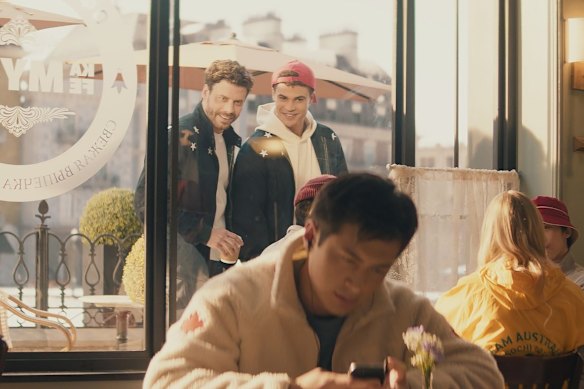
Hudson Williams stars as Shane Hollander, a closeted hockey player trying to stay under the radar in an extremely heteronormative environment.Credit: HBO Max
You also worked on Overcompensating, about a high school football star who goes to college and gets recruited into a bro-tastic fraternity while coming to terms with the fact that he’s gay. These shows share that storyline, closeted gay or queer men really working hard to “pass” in these extremely heteronormative environments – wanting to blend in visually when they feel, in this other invisible way, conspicuously different.
A lot of it is needing to belong. That sense of community can be hard to find, and if you can find it by wearing the uniform everyone else around you is wearing, it’s a shortcut to feeling connection.
In Heated Rivalry, Shane doesn’t want people looking too closely at him or asking questions about him. I love how when he runs into Ilya at the nightclub in episode four, he’s literally wearing a white T-shirt - though it looks like a pretty nice white T-shirt.
We looked at what they did on The Bear and were like: “Yeah. Merz B. Schwanen, that’s the right move.” [laughs] So many straight guys I know, they’ll go out thinking they look like the best version of themselves, and they’re wearing, like, a white T-shirt or a black T-shirt. It’s this whole idea of not trying too hard. Not wanting to put yourself out there. Once you put in effort, you draw attention. There’s an avoidance of that in heteronormative male culture.
At the same time, a white T-shirt in a dark space will draw the eye. In that scene, they’re both wearing white as they look for each other in the club. And they’re glowing.
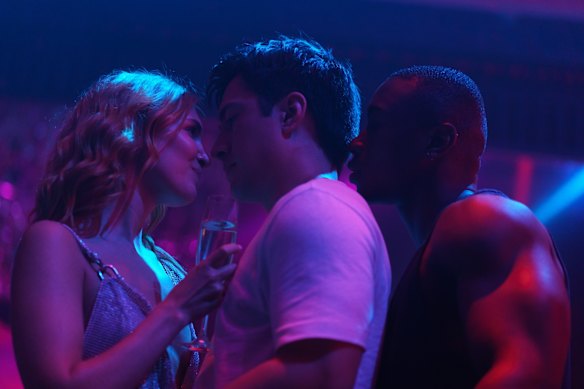
Sophie Nélisse as Rose Landry, Hudson Williams as Shane Hollander and Devanté Senior as Miles.Credit: Sabrina Lantos
Ilya’s shirt in that club scene is this shinier, silkier button-down dress shirt, with a leopard-skin print on it. That’s a smart bit of character work, too.
It’s such a crazy shirt. And so Eastern European in this beautiful, delicious way. But I like the metaphor of the skinned cat – he’s perceived as a predator, but the cat on that shirt is dead. It’s just the skin.
Ilya’s one of the only characters who wears a lot of fun, funky clothes. Where did you source his wardrobe?
We got some great pieces at a consignment store in Toronto called Archive Threads. In the tuna melt scene, Ilya is wearing these drop-crotch Rick Owens pants we found there.
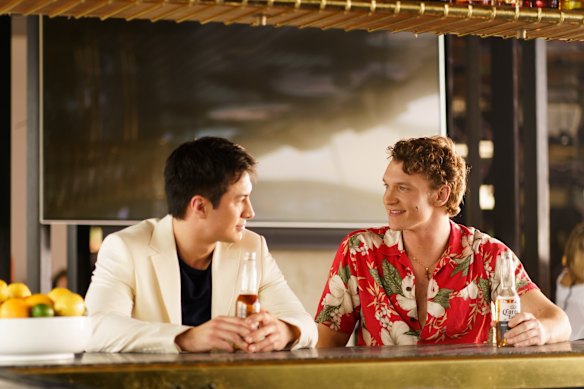
Ilya Rozanov (Connor Storrie) is one of the few characters who wears anything loud or colourful.Credit: Sabrina Lantos
The tuna melt scene is interesting visually – Ilya and Shane are dressed almost identically, in black sweats.
Shane’s wearing Ilya’s clothes in that scene. He doesn’t come expecting to sleep over. And Ilya’s trying to kind of absorb Shane into his world a little bit in that moment and make him feel safe in this space metaphorically. Giving someone your clothes is one of the most intimate things you can do, to have someone wear the pieces that are next to your body all the time.
There’s a lot of shared clothing, actually. Like Scott and Kip [the closeted pro hockey player and his openly gay love interest] – the scene where Kip finds the tuxedo that Scott left in the closet, he’s wearing the red hoodie Scott wore coming into the apartment after practice. We played around with that a lot with the shared clothes. I think it’s a real representation of intimacy and care.
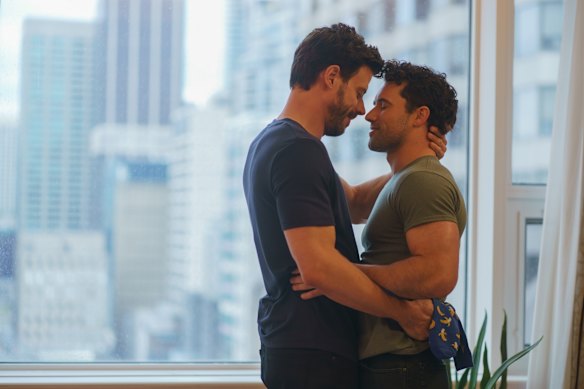
François Arnaud as Scott Hunter and Robbie G.K. as Kip Grady.Credit: Sabrina Lantos
Scott Hunter is one of the most self-consciously closeted characters on the show. Was that something you wanted to emphasise through his clothes?
When I read the scripts, I was approaching it with a bit of a Sex and the City mentality: Shane, Ilya, Scott and Kip are like these four versions of male identity and male queer identity. Shane, boy next door. Any guy in your high school class. Just like – a guy.
Loading
A lot of men would look at Shane’s wardrobe and say what he wears are “normal” clothes, like default men’s clothes.
I think because it represents this institution of masculinity that’s been created. I am clothed, so I’m ready to go. That’s it. No further thought.
Ilya’s the bad boy: He wears a lot of black, but he’s playful. He’s doing whatever he wants and messing around with expectation. Kip is proudly gay, an art history student, a bit more working class, so for him I went with either vintage or thrifted. Everything had been worn. I just wanted him to feel really lived in.
And Scott’s older; he’s established. He knows himself, and he knows how to mask, and he’s probably the most comfortable wearing the mask of any of them because he’s been doing it so long.
There’s something kind of comically athlete-bro about the “incognito” outfit he wears out shopping with Kip. I think it’s the baggy hoodie.
And the sunglasses! There’s no risk-taking. Everything is just… fine. He has money, he can buy himself nice clothes, but it’s just like, “This is what normal guys wear.” It’s so funny, people have been posting pictures of Auston Matthews, the centre for the Toronto Maple Leafs, wearing that exact same outfit. All these things have been seen before. I don’t think I’m breaking any ground here – I’m just observing.
Heated Rivalry is streaming on HBO Max.
This interview, originally published in The Washington Post, has been edited and condensed for clarity.
Find out the next TV, streaming series and movies to add to your must-sees. Get The Watchlist delivered every Thursday.