3 months ago
21
3 months ago
21
Public backlash against synthetic turf and rubber crumb is growing as evidence mounts about the damage to human health and the environment from the plastic heating to extreme temperatures and leaching forever chemicals and microplastics into waterways.
The plastic surfaces have become increasingly popular with councils and schools for parks, playgrounds and sporting pitches across Australian cities because it is cheaper, easier to maintain and can allow a higher usage for community sport.
However, the material can heat up to 75 degrees on hot days, according to the NSW government, causing off-gassing and the risk of burns, and raising questions about its suitability given the need for climate adaptation as Australian and global temperature records continue to tumble.
Emma Bacon, executive director of Sweltering Cities, a group that advocates about the impact of climate change on cities, said astroturf was not just dangerously hot for people or pets using the surface, but also made the surrounding suburb hotter.
“The fake plastic grass profoundly contributes to the urban heat island effect by being much hotter than concrete and hotter than grass, which is increasing … the local air temperatures,” Bacon said.
On a 43-degree day in Melbourne last Friday, Ben Cox from Parents for Climate used a temperature gun to measure surfaces in Victoria Park in Kew. Despite cloud cover, the astroturf was 54 degrees in the sun and 44 degrees in the shade, compared with natural grass at only 42 degrees in the sun and 38 degrees in dappled shade. The rubber crumb in the area with exercise equipment was 64 degrees.
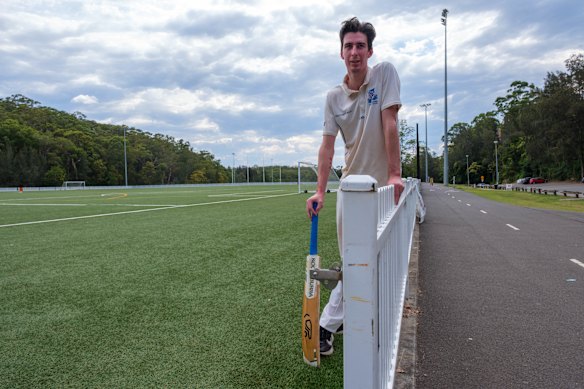
Cricketer Michael Middleton coming off the synthetic pitch at Blackman Park in Lane Cove after playing on a hot afternoon earlier this summer.Credit: Oscar Colman
“Councils have done a really great job in so many areas of providing wonderful playgrounds for our kids, but as the climate changes, we’re going to have to invest more and more money in keeping playgrounds safe so they can be used year round,” Cox said.
A report by the NSW Department of Planning, Housing and Infrastructure last year noted that during very hot summer days in Western Sydney, synthetic surfaces reached average surface temperatures of 70-75 degrees, compared with 37 degrees for irrigated natural grass.
Sydneysider Michael Middleton plays cricket, and for the past three years his club has played on a synthetic field at Lane Cove’s Blackman Park. While the 24-year-old appreciates the even surface of fake grass versus badly maintained natural turf, it comes with a big downside, even during normal summer heat.
“Whenever we are going to play on an astroturf field, and we see it’s going to be 30-plus degrees, there’s a bit of a groan from the whole team about ‘oh no, this is going to be a really tough day’,” Middleton said. “You can really feel the heat bounce off a lot more.”
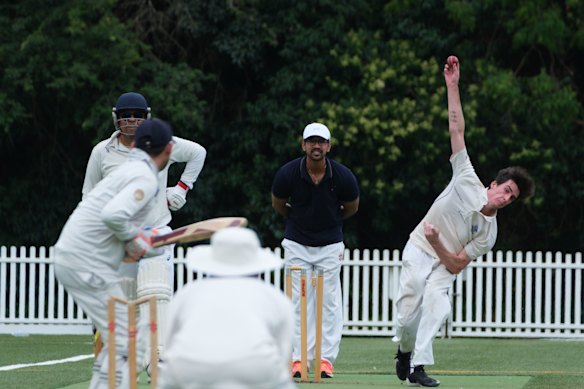
Synthetic turf is used by many councils and schools because it is cost-effective, low maintenance and can withstand higher use than natural grass, but it is uncomfortably hot for summer sports and an emerging source of microplastic pollution.Credit: Oscar Colman
Middleton and his teammates have experienced burns around the elbows, hips or knees when they dive for a ball.
“There’s been quite a few times we’ve had multiple teammates just at the end of the game with a bit of blood or a bit of burning, which is a bit rare from a game of cricket,” he said.
The NSW planning department guidelines note that councils often install synthetic turf because it lasts longer and will withstand higher usage. However, Jeff Angel from the Total Environment Centre said it would be better to develop natural grass fields with better drainage.
Garnet Brownbill, co-founder of the Natural Turf Alliance, said one argument in favour of synthetic turf was that it did not get as muddy, saving winter sport, but this ignored the fact that more days were lost to heat in summer.
Microplastics and PFAS
Brownbill said the rubber crumb material – used as a springy surface in playgrounds and netball courts and a layer under plastic grass – was originally sold as a way to recycle old car tyres.
“All it’s really doing is spreading the problem further afield,” Brownbill said. “It’s bizarre that you wouldn’t let kids go and play on a stack of car tyres, yet they mechanically shred them, and it’s [meant to be] fine for kids to play on.”
A report from Total Environment Centre and the Australian Microplastic Assessment Project found synthetic grass fragments in waterways are a growing problem. At Rose Bay in Sydney Harbour, synthetic grass fragments increased about tenfold between 2022 and 2025, reaching more than 20 blades per square metre.
Manly Cove, previously identified as the worst microplastic hotspot in Sydney Harbour, has three times as many synthetic grass segments as it did in 2019. Grass fragments were recorded in 40 per cent of samples in 2019, rising to 95 per cent in 2024-25.
Gunnamatta Bay in Port Hacking, Collins Flat Beach and Manly Lagoon in Middle Harbour, and Tower Beach in Botany Bay recorded up to 2500 blades per square metre.
The plastic blades of grass are also coated in per- and polyfluoroalkyl substances (PFAS), a family of synthetic chemicals that do not break down in the environment and can cause problems for the health of humans and wildlife.
Anthony Amis from Friends of the Earth Melbourne noted that “children who play on it might fall over on it, or crawl on it, and get it on their skin and then their hands go in their mouth”.
“The odour from the field is oppressive on a hot day.”
Garnet Brownbill, Natural Turf AllianceThe federal parliamentary inquiry into PFAS in November noted research from the University of Technology, Sydney that indicated a single synthetic field could release 800 to 3200 kilograms of PFAS-contaminated particulate into the environment. The inquiry recommended that Australian governments should ban PFAS in artificial ground coverings.
There are more than 200 synthetic sports fields in NSW alone, the parliamentary inquiry found. An earlier report by the NSW chief scientist noted it had increased from about 24 in 2014.
Synthetic pitches are also increasingly popular among many Melbourne councils. Merri-bek City Council Mayor Nat Abboud said there was growing demand for public open space, and council sometimes used synthetic surfaces to deliver the best outcome for users and the broader community.
“Council aims to manage sports grounds in a way that maximises use and provides the highest-quality and most sustainable grounds to support community demand within budget allocations,” Abboud said.

Climate activist Ben Cox shows how hot these surfaces get on a hot day at Victoria Park playground in Kew. Credit: Paul Jeffers
Community amenity
Brownbill got involved in campaigning against synthetic turf when his council installed a synthetic football field at his local park, Gardiner Park in Banksia in Sydney, during the COVID-19 pandemic.
The result, Brownbill said, was that community members no longer rode bikes or walked their dog in the park. The Nepalese cricketers who used the field every afternoon for both informal and formal cricket matches left. The dozen or so bocce players in their 60s and 70s who played at all hours were pushed out. Eight families sold their forever homes and moved out.
Loading
And yet, there was a 300 per cent increase in usage.
“Now it’s no longer a community park. It is a soccer facility that’s used seven days a week, with boot camps and training starting at six o’clock in the morning and often finishing at nine o’clock at night,” Brownbill said.
“One of the big things has been the smell. The odour from the field is oppressive on a hot day. The smell is permeating through the windows and air-conditioners and it will linger until 10 o’clock at night.”
A spokesperson for Bayside Council said all-weather playing fields provided the opportunity for participation in sport during periods of weather when natural surfaces can become unusable, required less downtime for maintenance, and could accommodate more hours per week of playing time.
The all-weather field only occupied about 18 per cent of Gardiner Park’s total area, council said. “Gardiner Park has been used for organised sport for over 80 years,” the spokesperson said. “The park also caters to the needs of a broader community and includes a playground, walking paths, and passive recreation space.”
Get to the heart of what’s happening with climate change and the environment. Sign up for our fortnightly Environment newsletter.
Most Viewed in Environment
Loading