3 months ago
28
3 months ago
28
The helicopter takes off at 10am, banking over a patchwork of paddocks and coastal lagoons. Battering through headwinds, it crosses into Bass Strait and rumbles out over the ocean.
The passengers in hi-vis and denim look out at the grey-blue expanse or sit with their eyes closed, swaying with the rhythm of the airframe. No one talks for half an hour – it would be too loud to hear them over the rotor noise anyway – until the tiny silhouettes of their destinations break the horizon.
For most of this ExxonMobil crew, today marks the start of another two-week rotation on Marlin, a hulking steel island 42 kilometres off the Victorian coast, where oil and natural gas are extracted from reservoirs deep beneath the seafloor.
But the first drop-off point, for a smaller cohort of workers, is at a different kind of platform: one that’s soon to be flushed out, ripped from the water forever, and hauled to shore to be dismantled.
The wheels touch down on its helideck and the door opens to a blast of salt-heavy air. A stairwell with metal treads leads down to a heated room below. “Welcome to Cobia,” says a worker inside.
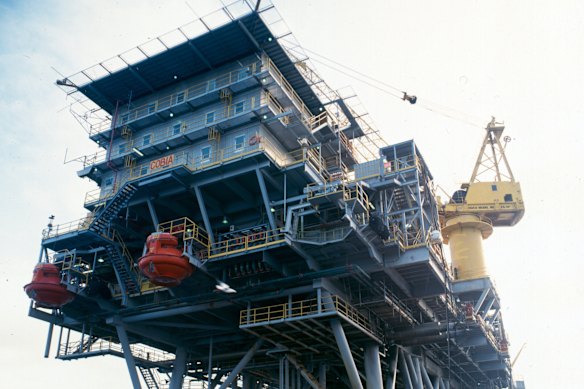
Cobia, which produced oil for decades in the Gippsland Basin, is one more than a dozen soon to be decommissioned.
Cobia is one of the 19 huge steel outposts, many as tall as skyscrapers, that are scattered across the Bass Strait’s Gippsland Basin between Victoria and Tasmania. Owned by American oil giant ExxonMobil in a joint venture with Woodside Energy, these platforms – each named after a species of fish – have been hidden engines of the economy since the 1960s, pumping out fossil fuels to turn into the petrol, diesel and gas that have powered our vehicles, homes, electric grids and factories. It’s estimated they have supplied roughly half of the crude oil ever produced in Australia and met 40 per cent of all gas demand in the nation’s eastern states.
But after more than half a century, just six of these facilities remain active. Cobia and a dozen others have reached the end of their productive lives as their wells have petered out, while higher costs have discouraged further drilling, leaving their owners to deal with the complex, multibillion-dollar problem of what to do with the massive amount of old infrastructure still sitting in the ocean.
It has also ignited a complicated debate that Australian governments and regulators are starting to grapple with for the first time on such an enormous scale: should these companies be made to take everything they built here away and leave the seabed as they found it? Or should they be permitted, in some instances, to leave parts of their structures behind if they can convincingly show it will be better for the marine environment and ecosystems that have developed around their massive underwater pylons?
Loading
With 13 non-producing platforms, four subsea facilities, and hundreds of kilometres of pipelines and umbilicals all requiring removal by ExxonMobil here over the next few years, the clean-up job, known as decommissioning, will be the biggest ever conducted in Australia and the largest undertaking of its kind that the company has attempted anywhere in its far-flung global operations.
Conservationists like Fern Cadman from The Wilderness Society are paying close attention. The environmental precedents this campaign threatens to set, she says, could be significant. Over the coming 25 years, the Centre for Decommissioning Australia, an industry-backed research body, estimates 5.7 million tonnes of material must be removed from offshore oil and gas facilities in Western Australia, Victoria and the Northern Territory; the equivalent of 110 Sydney Harbour Bridges. The total decommissioning bill for offshore producers could exceed $US40.5 billion ($60 billion).
“What ExxonMobil and Woodside do, or don’t do, has implications for the future of oil and gas clean-up right around Australia,” Cadman says. Of most concern is their bid for permission to cut off their obsolete platforms to a depth of 55 metres below the waterline, leaving the lower portions in place for marine life, she says. “We are concerned about the radioactive material, heavy metals, plastics and other contaminants found in much oil and gas infrastructure that could end up in the marine environment and the food chain if it’s not taken out of the ocean,” she says.
The maritime union also wants to see national rules mandating full removal, as well as the development of purpose-built facilities to handle the contaminated structures and restrictions stopping operators from shipping material overseas for dismantling and recycling instead of keeping the work for local employees. “Let's get the job done right, and done here,” Maritime Union of Australia assistant secretary Thomas Mayo says.
So far in Bass Strait, more than $3 billion has been spent on sealing about 200 disused oil and gas wells. This process is known as “plugging and abandoning”, explains Richard Perry, ExxonMobil Australia’s manager of decommissioning, and it requires the use of specialised equipment to install cement plugs to secure each of the wells from the underground reservoir.
But the next step, says Perry, will be a sight to behold. He and his team are now getting started on the colossal task of readying the platforms for 2027, when the Pioneering Spirit, a purpose-built ship the length of six jumbo jets, will arrive in the southern hemisphere for the first time ever to pull them out of the water. “It’s the biggest vessel in the world,” says Perry. Using its eight sets of horizontal beams to grip its target like a spider, the giant ship will sail up to the platforms one at a time and in a single motion lift off their “topsides” – the entire upper sections containing the helipad, living quarters and operational areas – then turn around and lift off the lattice-like steel support structures, known as jackets.
Loading
Preparations on the platforms include major demolition works, the identification and flushing out of any residential hydrocarbons, and the installation of huge customised lift points for the Pioneering Spirit to grasp. “These will be the first fixed platforms in Commonwealth waters to be removed in Australia,” Perry says.
Weighing a combined 60,000 tonnes, the retired platforms will then be put onto barges and sent onshore to the Barry Beach Marine Terminal for demolition and recycling. There, the structures will have their own concrete blocks to sit on, explains Perry, as well as an impermeable membrane to capture any leaks. “In the event any residual hydrocarbon drips are present during the dismantling of the process equipment, we will make sure they are captured and go through a water-treatment facility, so nothing can get into the waterways,” he says.
Dismantling is expected to take about three years, with more than 95 per cent of the material in the structures to be recycled. Onshore recycling is set to create up to 80 jobs in Gippsland during preparation and execution.
When oil and gas operations cease in Commonwealth waters, titleholders are required to completely remove everything they have brought in, the law says – unless they can demonstrate that leaving some infrastructure “in-situ” will lead to an equal or better environmental result and gain specific approval to do so. Since the first phase of Bass Strait decommissioning work began in 2021, ExxonMobil has arranged studies to seek to quantify the ecological value associated with its subsea structures, some of which have been there for 50 years and are completely covered in marine life that serves as food for dozens of fish species and larger fauna such as seals.
“It creates an ecosystem,” says Perry. “When we consult with groups such as the game fisheries, they will ask why we aren’t leaving the entire platform that attracts species such as marlin, sharks and tuna.”
One 2023 paper found keeping at least the lower sections would be critical for established species in the region and provide "ongoing ecological service through provision of habitat and foraging opportunities".
Environmental advocacy group Friends of the Earth says the argument that abandoned infrastructure can serve as “artificial reefs” is not supported by scientific consensus, and suggests the industry is simply trying to minimise hefty decommissioning bills. It points to other research highlighting that oil and gas structures contain traces of hazardous materials accumulated over decades of operations, including naturally occurring radioactive material, mercury, lead and arsenic. Long-term investigations of potentially toxic impacts are impractical, campaigners say, and in situations of scientific uncertainty, the regulator should give priority to environmental precaution.
ExxonMobil says it acknowledges that some community groups prefer complete removal, but maintains that its proposal to leave deeper sections of the steel jackets could be a better outcome than “going back to a clean seabed”, and will seek approval from the National Offshore Petroleum Safety and Environmental Management Authority (NOPSEMA).
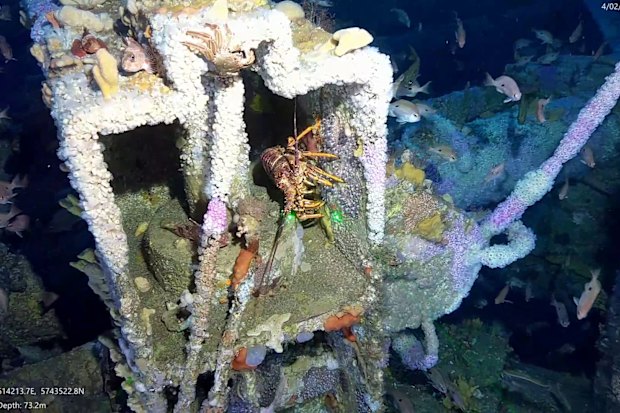
A lobster at the Cobia platform. ExxonMobil says most of its offshore structures are completely covered with marine life.Credit: ExxonMobil
“If that is not approved, then we will return and remove the remaining structures down to the seabed in a future campaign of work,” Perry says. NOPSEMA has asked the company for further information about the long-term fate of steel in seawater, he adds. “These are industry-first questions we do need to address,” he says.
NOPSEMA says it has previously approved some applications to leave small amounts of infrastructure in place, but any proposal is assessed on a case-by-case basis, and must be backed by “robust evidence”.
For many years, authorities had been “asleep at the wheel” on decommissioning, with a permissive regulatory regime allowing oil and gas developers to either delay or avoid their liabilities by divesting late-life production assets or continually putting off clean-up works for years or even decades, says Cadman. A wake-up call came in 2020 north-west of Darwin, where the Northern Endeavour, a decrepit oil production vessel, had been sold by Woodside to a small company that soon went broke and left taxpayers to pick up a $1 billion-plus decommissioning bill.
Cadman says Australia’s legal requirement for full removal is strong, and NOPSEMA has begun sending a tougher signal than other jurisdictions, such as the United States, about the extent of clean-up required. “We want to see these companies make good on the requirement to clean up after themselves,” she says.
Loading
For now, though, as decommissioning ramps to full swing in the lead-up to 2027, the Gippsland Basin operations are bustling with more activity than they have seen for years. Historically, the joint venture has employed between 300-500 staff working on its offshore oil and gas platforms. Since decommissioning began, there are now more than 800 people employed offshore.
One of them on board the Cobia platform is Paul Prestney. Originally part of the first rig crew that drilled Cobia’s wells way back in 1982, Prestney says he has come full circle after recently taking up his new role overseeing its decommissioning. In the 1990s, he says, Cobia was pumping out 3000 kilolitres – or 18,000 barrels – of oil a day. “Last year, we turned the oil off, took it right down to a couple of hundred kilolitres towards the end,” he says.
Is it sad seeing it coming to an end? “Yes, I think so,” says Prestney, but he puts it in this perspective: the decades of oil and gas production and processing here have been incredibly beneficial for the Gippsland community, so much so that any economic hardships “seem to have passed this area by”. “I’m really blessed for what it has provided me and my family,” he says. “But we have a life – this has a life.”
The Business Briefing newsletter delivers major stories, exclusive coverage and expert opinion. Sign up to get it every weekday morning.