2 months ago
19
2 months ago
19
Opinion
December 9, 2025 — 3.54pm
December 9, 2025 — 3.54pm
It has been almost a decade since Gianni Infantino swept into power as FIFA president. Like a frog in a pot being brought to the boil, the fundamental changes made to the sport during his reign have been so gradual you may not have noticed the totality of the impact, unless you somehow climb out of the pot and take the time to reflect.
We’ll start with the obvious: the World Cup’s expansion to 48 teams, which makes it practically impossible for any one nation to host alone. Unless, of course, you are Saudi Arabia, in which case you can.
The new-look FIFA Club World Cup is now a thing, too, every four years, despite howls of protest about the game’s increasingly jammed schedule.
Teams can now use five substitutes, up from three, a response to the fixture congestion created by the COVID-19 pandemic. It’ll never go back.
Then there was the introduction of VAR in 2016, something Infantino’s predecessor, Sepp Blatter, was against. Its remit was supposed to be for “clear and obvious errors” only, but now there is talk that it could be used at the World Cup to adjudicate whether corner kicks have been correctly awarded. It won’t stop there.
And now, for Infantino’s next trick: the introduction of mandatory mid-match advertising breaks - sorry, “hydration breaks” - which will effectively turn what is famously known as a game of two halves into one of four quarters.
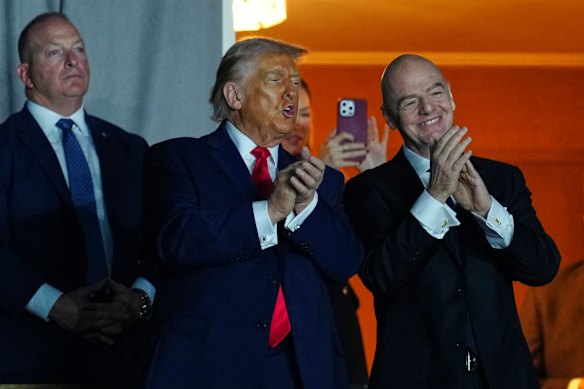
Donald Trump and Gianni Infantino at the World Cup draw.Credit: AP
There are already measures in place to combat the risk of extreme heat and humidity: breaks of up to three minutes are taken when the ‘Wet Bulb Globe Temperature’ surpasses 32 degrees Celsius, and/or when it is determined that heat stress is a serious risk. We know these rules well in Australia, where the A-League is played over summer; indeed, drinks breaks were regularly taken at the Club World Cup earlier this year, which was played in the United States during the same punishing June-July window as the World Cup. (Yes, they were sponsored.)
The other tool available to FIFA is to move kick-off to a more suitable time for conditions, in the evening or at night. That’s what we do here in Australia, and that’s what FIFA didn’t do with the Club World Cup, and it won’t do for the World Cup, because that would be problematic for European time zones. It is what it is. We get it.
But now FIFA has gone further than anyone asked for, declaring all matches at the World Cup will pause for a three-minute break in the middle of each half - regardless of conditions, even if they don’t call for it, and including those played in indoor venues. The Socceroos will play their three Group D fixtures in Vancouver, Seattle, and San Francisco, where temperatures rarely nudge past the mid-20s, even at the peak of summer. Perfect weather for football.
Drink up anyway, courtesy of Powerade.
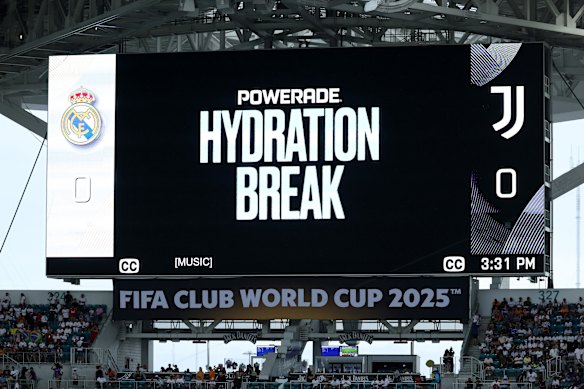
Get used to this.Credit: Getty Images
Note where this decision was announced: at FIFA’s World Broadcaster Meeting.
“Yes, this creates quarters … and in-game commercial breaks. Love it,” the former US international Alexi Lalas posted on X, saying out loud the thing FIFA didn’t in their press release.
It’s just a happy coincidence that three-minute breaks are perfect for broadcasters and advertisers. It’s not FIFA’s fault that, across 104 matches, it happens to equate to more than 10 hours of bonus advertising space.
Today, I feel … hydrated.
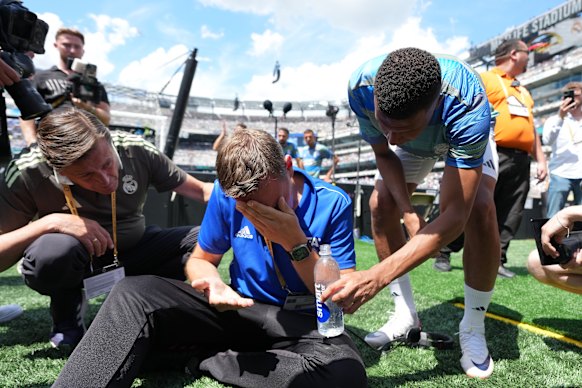
Kylian Mbappe offers water to a bystander during the warm-up of the Club World Cup semi-finalCredit: Getty Images
You have to hand it to Infantino. He’s played it perfectly, with more than enough in-built plausible deniability. The genius here is the range of defences available to FIFA for any criticism.
Are you complaining about drinks breaks? Well, they’re only responding to the very real concerns raised at the Club World Cup. You’re not against improved player welfare, are you? You want to watch better football, don’t you?
What about the one-size-fits-all thing? Well, it’s for integrity, dummy: this guarantees “equal conditions for all teams, in all matches” - which is patently false, since they can’t control the weather. Yet. But still. You’re not against integrity, are you?
Infantino has said this World Cup will be like “104 Super Bowls”. Using his words as a guide, the average cost for a 30-second spot at this year’s Super Bowl was US$7 million, so let’s do the maths ... that’s US$8.74 billion.
We’re being silly. It won’t be that much. Let’s be super conservative and say it’ll be worth $300 million to FIFA. That’s still a nice piece of action, you might say - but FIFA distributes money to every national association, including developing countries, and in theory, this enhances their ability to improve the game in those kinds of places. You’re not against improving football in developing countries, are you?
At the 1994 World Cup held in the United States, there were no formal protocols for drinks breaks, much to everyone’s frustration. When summer conditions were again rightly flagged as an issue ahead of the 2002 edition in Japan and South Korea, calls for drinks breaks were dismissed as a ploy to sneak ad breaks into matches. A FIFA spokesperson even said the laws of the game were “sacrosanct”, and changes to them couldn’t be made for one competition.
“It is a bit puzzling where this has come from,” FIFA official Keith Cooper told the BBC at the time. “It is not that hot. Temperatures are in the low to mid-20s.”
Loading
So, what has changed? Well: the world. And no, we’re not talking about global warming. We’re talking about ‘enshittification’: the process in which products and services degrade over time to boost profits. It started online, and now it’s everywhere.
Nobody is denying the heat is a problem. But FIFA’s solution is a deliberate over-correction, designed to maximise revenue by stealth under the guise of welfare, at the expense of the fluidity of games that will require no interruptions.
And really, is there anything more American than that?
Most Viewed in Sport
Loading