
 2 months ago
68
2 months ago
68
Andrew “Twiggy” Forrest has a warning for billionaires who don’t use their wealth for good.
“You’re going to die pretty flipping lonely,” the mining mogul said in a podcast interview last month. “And you deserve to.”
Forrest wants to tackle some of the world’s hardest problems, from gender inequality and ocean pollution to modern slavery and bushfire threats. And he has built one of Australia’s biggest charities to do just that.
The Minderoo Foundation has $7 billion in assets. Globally, it sees itself in the same mould as the Bloomberg and Gates foundations. Highly qualified staff, poached from consulting firms, rival mining giants, the military and the CSIRO, receive resources most not-for-profits could only dream of.
“We never, ever give up,” the charity says in a list of core values shared by Forrest’s businesses.
But Minderoo has quietly given up on some of its most audacious projects, announced by Forrest with fanfare at Parliament House or the United Nations headquarters in New York.
A natural disaster initiative working toward ambitious 2025 deadlines vanished from the charity’s website and the latest annual report. A proposed $US300 million fund to combat plastic pollution closed after spending only a fraction of that amount. The mission to end the Indigenous employment gap within a single generation faded away.
Minderoo says the projects were never abandoned; instead, the charity pivoted and evolved.
But former staff, bound by non-disclosure agreements, describe lost focus and unexplained shifts in direction, as its hyperactive founder takes on new missions. “He needs the next shiny thing,” says one.
Forrest, who turned Fortescue into one of the world’s largest iron ore miners, describes Minderoo as both “hard-core results-focused” and willing to take risks. “If every project was guaranteed to work, Minderoo would not be doing its job,” he said in a statement.
He also took a swipe at Minderoo’s “former leadership”, saying they “worried too much about how they could feel good, or worse, how they could look good”.
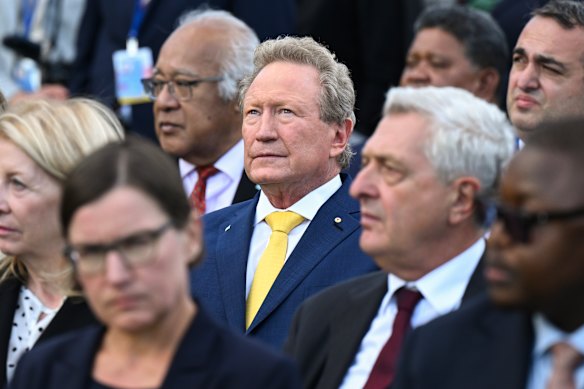
Minderoo says it spent more than $300 million on projects last financial year, including children’s cancer research, arts grants and ocean conservation efforts. To date, it has also spent $58 million on humanitarian relief in Gaza.
In response to detailed questions about its operations, Minderoo’s chairman, barrister Allan Myers, KC, wrote letters to this masthead and its publisher, arguing that Forrest and his former wife, Nicola, could have kept their fortune “entirely for personal use” but had instead created Australia’s largest philanthropic foundation.
Myers’ letters also raised the prospect of a defamation lawsuit, objecting to questions “drawing on private matters, unverified claims and speculative assertions”.
A big splash
Charity work, along with his devotion to green energy, has transformed Forrest from a mere mining magnate into a global statesman. Forrest is a yearly fixture at Davos conferences and tours war-torn Ukraine. He has appeared on the cover of Time magazine and met the Pope.
He also knows Bill Gates. The relationship dates back more than a decade. It was the Microsoft founder who approached Forrest with the idea of signing the Giving Pledge: a commitment to give away most of his fortune in his own lifetime.
Andrew and Nicola Forrest were already interested in philanthropy. They founded Minderoo as a children’s welfare charity in 2001. But they supercharged it after signing the Giving Pledge in 2013, “to shine a light on inequality and share the vast majority of our wealth”.
Donations worth hundreds of millions of dollars flowed from the Forrests into Minderoo’s accounts. Then, three years ago, they made a $5 billion donation of shares they owned in Fortescue. The couple announced their separation soon after and stepped down as co-chairs of Minderoo the following year. They remain actively involved as board directors.
![Andrew Forrest [centre] at Davos in 2023.](https://static.ffx.io/images/%24zoom_0.182%2C%24multiply_0.5892%2C%24ratio_1.777778%2C%24width_1059%2C%24x_0%2C%24y_0/t_crop_custom/q_86%2Cf_auto/bf71795956e6cf57b13460cb3b4c26d22acc8fa7)
The seeds of Forrest’s pivot from Pilbara miner to global change-agent can be traced to 2014, his first time at Davos. Two days before his speech to the world’s elite at the Swiss Alpine resort, Forrest had clinched a deal. The Pakistani state of Punjab would receive technology developed by WA’s Curtin University to transform unusable, dirty lignite coal into diesel in exchange for eradicating modern slavery in the region.
Former British prime minister Tony Blair hailed the development as a great example of Australian philanthropy. But the technology never arrived, and millions in Punjab continue to live in modern slavery.
Forrest laid the blame on the Pakistani government. “The government could not deliver on its obligation,” he said.
Minderoo’s Walk Free initiative has worked for more than a decade to highlight modern slavery, funding the Global Slavery Index and lobbying governments to pass tighter laws.
But some say Minderoo’s influence in the field can have unintended consequences.
“When Twiggy makes this big splash of all of this money that he’s donating, every other philanthropist and donor in Australia thinks, ‘Oh, that sector’s really well funded because they’re funding it’,” says Fuzz Kitto, who runs antislavery organisation Be Slavery Free with his wife Carolyn.
“But what they’re funding is their family projects, and in fact, the sector is incredibly underfunded.”
The Kittos worked with Minderoo on the Fair Catch campaign to stamp out modern slavery in the seafood industry. It disintegrated after Minderoo pulled out.
“There was no notice, no winding down, no handing over, no funding,” says Kitto. “Somebody was just like, ‘We’re not doing this any more’.”
Kitto does not doubt Forrest’s good intentions, but believes publicity may be as big a driver as outcomes.
“There’s no stopping what you can achieve if you don’t need to get the credit for it yourself,” he says. “With Twiggy, it’s kind of the opposite.”
Forrest said the suggestion he had focused on credit over delivery was “rubbish” and that Minderoo highlighted the value of its partners, which number in the hundreds.
A Minderoo spokesman said that although Fair Catch “became less prominent as a standalone initiative, the underlying objectives did not disappear,” and it continues to improve traceability across seafood supply chains.
Kitto believes Minderoo could work better with others. “But it’s really hard to ever be in the same room with Twiggy because there’s not enough room for his head and anybody else.”
Fires and floods
One of Minderoo’s most public commitments was a $70 million Fire and Flood Resilience Initiative, launched at the National Press Club after the devastating fires of 2019.
The plans were so ambitious, they were likened to Apollo moon missions.
Minderoo aimed to help build technology that would detect and extinguish bushfires anywhere in the country within an hour. It would also cut the hazard risk in Australia’s 50 most vulnerable communities by 50 per cent by the year 2025.
“We must say, ‘Enough is enough’, and put an end to communities going up in flames,” Andrew and Nicola Forrest said at the time. “We will never give up until the job is done.”
Today, there is next to no mention of bushfires and floods on the Minderoo website. The latest annual report referred only to funding for Disaster Relief Australia, a separate organisation, which has since collapsed.
Planned collaborations with the NSW Office of the Chief Scientist to assess bushfire technology did not proceed. A fire-retardant trial never happened. A proposed army of 125,000 volunteers working to reduce natural hazards, named the Australian Resilience Corps, was backed by millions of dollars in investment and some of Australia’s biggest companies, but folded after less than two years.
A former Fire and Flood team member applauded Forrest for his ambition and willingness to try something new. However, what didn’t help was a focus on “ribbon-cutting activities”: outcomes that could be photographed for annual reports. “We could’ve really changed things as long as there was investment in it,” the former employee says.
A Minderoo spokesman said the charity’s work was driven by need, not photographs, although “imagery helps people understand the challenge Minderoo is working to solve”.
Asked whether the Fire and Flood goals were achieved, the spokesman said: “Minderoo delivered substantial work against the ambitious goals and deployed more than the original $70 million commitment”.
It provided 250 temporary accommodation pods, funded an international competition to develop bushfire detection technology and supported hazard reduction and resilience planning by other organisations. Rather than continue to run its own resilience corps, Minderoo shifted to funding “specialist partners”.
“Minderoo made a call that it was better off supporting and funding those who were already doing things rather than reinventing them,” says Lee Goddard, a former Fire and Flood manager.
After serving as a rear admiral in the navy, Goddard says he was excited to work for an organisation willing to “fail quickly” and adapt. He was surprised to hear that Minderoo’s bushfire and flood work had dropped off the website, “because I think there were significant achievements”.
When Forrest announced the plan to end out-of-control bushfires, he was already trying to fix the plastic waste choking the world’s oceans. In 2019, he appeared at the UN headquarters in New York to launch a bold Minderoo recycling scheme called Sea the Future.
“That’ll cost about a million dollars a week, and we’re going to underwrite that for five years,” he said in a TED talk. “Total contribution is circa $US300 million.”
The audience broke into applause.
But according to one former staff member, Minderoo spent nowhere near that amount before it shut down Sea the Future in 2023.
Minderoo says the closure was partly driven by its growing awareness that recycled plastic was more harmful to human health via leached chemicals, based on findings by its own medical research projects. The charity declined to answer how much Sea the Future spent. Instead, it pointed to $168 million committed to its Plastics and Human Health initiatives since 2021.
The former employee admits the economics of the large-scale recycling projects may never have worked without a global plastics treaty, an idea Minderoo continues to lobby for.
At the same time, “the toll on good people who had been employed or were in the process of being employed was extremely high”.
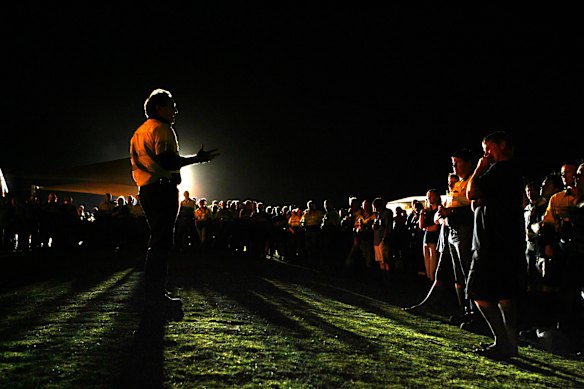
Never Ever Give Up
At the family station in WA’s Pilbara region, Forrest grew up with Aboriginal stockmen. As a child, he often visited the quarters of his father’s head stockman, Scotty Black, lying down in Black’s bed, waiting for him to clock off and play.
In 2008, he launched a plan to create 50,000 Indigenous jobs. Two years later, at an event attended by Russell Crowe, Cate Blanchett and then prime minister Kevin Rudd, he announced Generation One, an initiative designed to end the employment disparity in a single generation.
Minderoo at first focused on generating Indigenous job “pledges” by corporations. Then it moved on to seed funding for Indigenous entrepreneurs and created the Indigenous Employment Index, a research project it still funds but no longer oversees.
Today, the employment gap remains a chasm at 21 per cent. But Generation One has been dissolved.
“Obviously, his commitment is not there,” one former employee says of Forrest. The employee, who had a “pretty good experience” with Minderoo in the beginning, says Generation One met its early targets on job pledges.
“But they changed CEO that many times, and brought in inexperienced people to deal with local Aboriginal people,” the former employee says. “It completely lost its focus.”
When asked how many jobs Generation One created, Forrest said 61,000 were pledged by employers. He blamed the government for not providing training to support workers. The number of jobs actually filled under Generation One was closer to 30,000, according to Minderoo.
“While the brand may have been retired, the work continues today,” a spokesman said, pointing to $54 million Minderoo had committed to Indigenous-led organisations, programs and initiatives since 2021.
Throughout his Indigenous jobs campaign, Fortescue was fighting a court battle with the Yindjibarndi people over compensation for mining on their lands. After more than a decade of litigation, the Federal Court sided with the Yindjibarndi last month, ordering Fortescue to pay $150 million for cultural loss.
That business-minded ruthlessness has driven Minderoo to an extraordinary scale. It has also put some of its loyal lieutenants offside.
“Only results matter,” says Forrest. “Never, Ever Give Up applies to the mission, not to keeping every program funded forever regardless of evidence, urgency or need.”
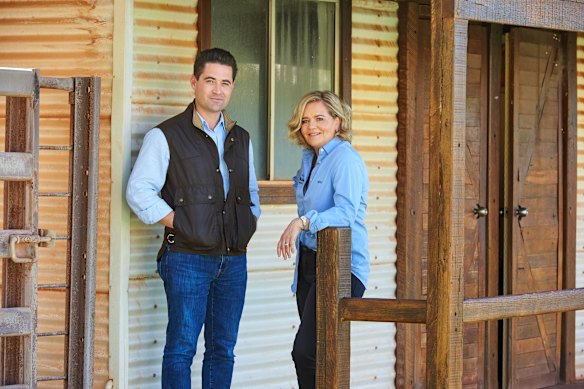
Executing that vision is Forrest’s right-hand man, John Hartman, who runs both Minderoo and the Forrests’ $30 billion investment firm Tattarang.
A former share trader, Hartman was convicted in 2010 of insider trading crimes committed with his former best friend, Oliver Curtis. Shortly after leaving prison in 2012, he was offered a second chance by Forrest, working for his cattle business.
“He’s one tough mofo,” a former Minderoo manager says of Hartman. The former employee describes feeling “utterly inspired” after speaking with Forrest. But “Andrew, like most billionaires, surrounds himself with a trusted inner circle who both protect him and protect him from himself. John Hartman does both of those things very well.”
Forrest praises Hartman for his humility and leadership. In the words of former Minderoo manager Emma McDonald, “he’s a really calm, stable, rational person”.
When Minderoo announced a strategy reset in 2023, Hartman said the charity would focus less on short-term goals and in-house projects. At the time, Minderoo acknowledged it had bitten off too much.
But Hartman does not answer directly when asked which projects were discontinued. He mentions only the shift from recycling plastic to developing safer plastic alternatives.
“The intent was not to reduce ambition, but to concentrate effort and philanthropic resources where Minderoo could add the greatest value and contribute most effectively to lasting change,” Hartman said in a statement.
Minderoo’s decisions have made it harder for outsiders to track its progress. Once-lengthy annual reports have slimmed down. Accounts that used to show each project’s spending now declare only totals for donations and grants. “Related-party purchases” worth $12 million last financial year were deemed immaterial and not explained.
Minderoo says its accounts are fully compliant. But Jason Ward from the Centre for International Corporate Tax Accountability and Research says an organisation of Minderoo’s size should be made to release more details.
Ward points to the tax exemptions granted to charities and their donors by the government, arguing “public support deserves public accountability”.
Personal passions and private interests
In early January, Forrest used a LinkedIn post to rail against New Year’s resolutions, declaring he was “doubling down on action”.
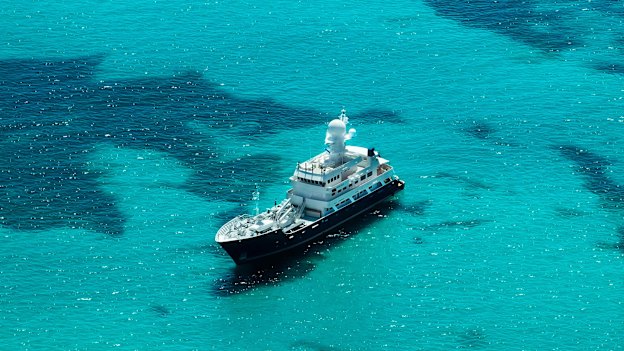
The picture beneath his post showed him wearing a Minderoo work shirt on board his $70 million 58-metre super-yacht. Forrest’s Pangaea Ocean Explorer also doubles as a research vessel, with high-end laboratories housed alongside luxury suites.
The yacht was called upon three years ago when the federal government announced it would spend $3.4 million on a partnership with Minderoo to map biodiversity in Australia’s marine parks.
“Minderoo’s Pangaea Ocean Explorer vessel will serve as the primary research platform,” a government press release said.
But the Pangaea is owned by a private Forrest company. Financial reports reveal Minderoo spent about half its $8.4 million project budget on charter fees.
Minderoo’s spokesman said the charity ended up spending $16 million on the ecology project. He said the Pangaea was only used following an independent review of alternative vessels and pricing. Minderoo did not provide a copy of the review.
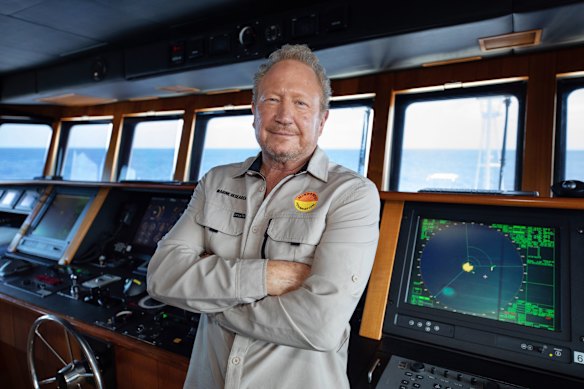
Ocean protection is both a Minderoo cause and a personal passion for Forrest, who was awarded a PhD in marine ecology from the University of Western Australia in 2019. Minderoo made donations of almost $100 million to UWA, before and after the degree.
The foundation went on to employ three technicians who had worked with Forrest on his doctorate. A Minderoo-funded body provides scholarships to students now working under his PhD supervisor, Jessica Meeuwig, who contributed to chapters of his thesis. For a time, a Forrest company invested in an energy business run by Meeuwig’s partner, the Australian Financial Review reported.
“The University of Western Australia’s philanthropic relationship with Dr Andrew Forrest is unrelated to the award of his PhD,” a university spokeswoman said. “Dr Forrest was subjected to the same examination process as any UWA PhD candidate.”
Two examiners considered his oral exam and written thesis to be in the top 5 per cent internationally.
Those external examiners – Professor Callum Roberts from the UK and Professor Douglas McCauley from the US – are now members of Forrest’s Lethal Humidity Global Council. The positions are unpaid. Roberts also serves on Minderoo’s Natural Ecosystems Advisory Board, which pays members $3750 per meeting.
McCauley said Forrest is an ocean science nerd whose career is “not normal by any measure”.
Forrest’s spokeswoman said if every PhD graduate were expected to cut all institutional ties with their supervisors, examiners, technicians or fellow graduates, universities would grind to a halt.
Said Roberts: “Successful business is all about relationships”.
The two camps
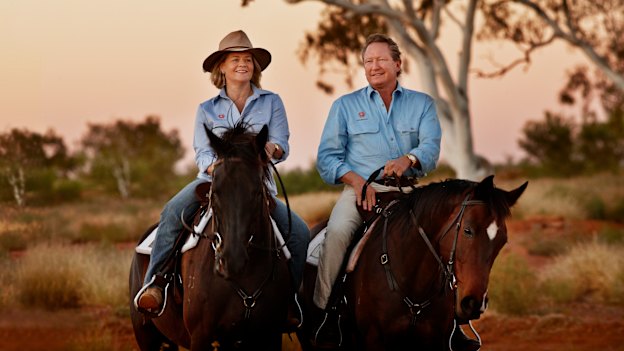
Those close to Forrest say he acts with conviction and, unlike others, he is willing to put his hand in his pocket.
“I watch so many other people in his position with his level of connections, influence, and wealth who don’t,” says Dr Stephen Burnell, managing director of Forrest’s for-profit biotech investment business Tenmile and a strategic advisor to Minderoo.
“He does it almost irrespective of knowing that it’s going to set him up for whatever the criticism is. I think that’s incredibly brave.”
A criticism from some former staff is that while Minderoo preaches equity and fairness on a global scale, it falls short in its own workplace, with staff left ostracised and pushed out of roles as priorities shifted.
Forrest rejects anonymous feedback as “sniping from the shadows”, despite his charity’s widespread use of non-disclosure agreements that limit public criticism. He and Nicola declined to comment on their 2023 separation, which some former staff felt had split Minderoo into camps that mistrusted one another.
In a statement, Nicola Forrest said: “I am proud of the team and the work that’s been done for more than 20 years, including the successful Thrive by Five campaign, supporting the arts, and the Early Years Partnership with the WA government.”
She said the Minderoo board and executive team oversee grants “with a view to ensuring foundation funds are used for maximum impact”.
The Forrests declined to answer questions on tax matters: both the size of the deductions from their Minderoo donations and the level of tax they pay overall.
Corporate records provide glimpses of their tax situation. Another Forrest company, NEGU Pty Ltd (named for the slogan Never, Ever Give Up), reduces its income tax bills through a multibillion-dollar trove of franking credits.
The company received $2 billion in trust distributions in 2021. It paid 0.1 per cent of that amount in income tax.
Other prominent Australian billionaires have not pledged to part with their wealth in their lifetimes. Forrest said, “some donate aeroplanes to politicians”, referring to Hancock Prospecting’s Gina Rinehart and her gift to Pauline Hanson’s One Nation. (Rinehart also donates to medical research and bushfire funds.)
But few have generated as prominent a global profile through their donations as Forrest.
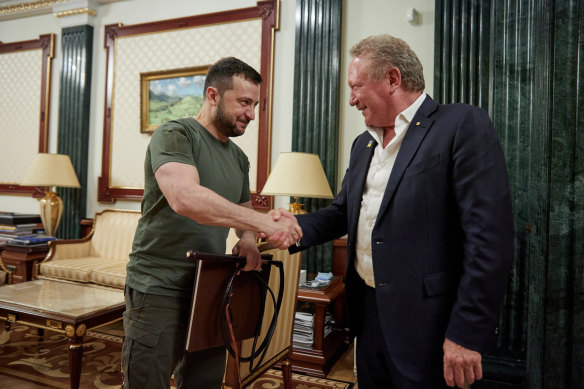
Vasyl Myroshnychenko, Ukraine’s ambassador to Australia, describes Forrest as an “embodiment of the Australian spirit of being bold and entrepreneurial”.
In 2022, Forrest made global headlines by pledging to invest $740 million in the country’s reconstruction, but that money will only be spent once the war ends and Ukraine eliminates corruption. To date, Minderoo has donated $40 million.
“When people meet him, they may get a different impression because his brain functions so quickly,” Myroshnychenko said. “His level of energy is so strong.”
The Ukrainian pin on the lapel of Forrest’s suit jacket broke from overuse last year. The billionaire asked the ambassador to find one from a small market store in Kyiv’s main square.
Forrest wanted to continue wearing the pin while meeting world leaders.
Get a weekly wrap of views that will challenge, champion and inform your own. Sign up for our Opinion newsletter.

















































