1 week ago
2
1 week ago
2
Opinion
September 29, 2025 — 7.30pm
September 29, 2025 — 7.30pm
In 2000, my late partner Shane received the diagnosis we had all been dreading. He had Huntington’s, a fatal neurodegenerative disease caused by a single genetic mutation. There is no cure. If one of your parents has it, there’s a 50 per cent chance that you will inherit the altered gene and eventually develop Huntington’s as well.
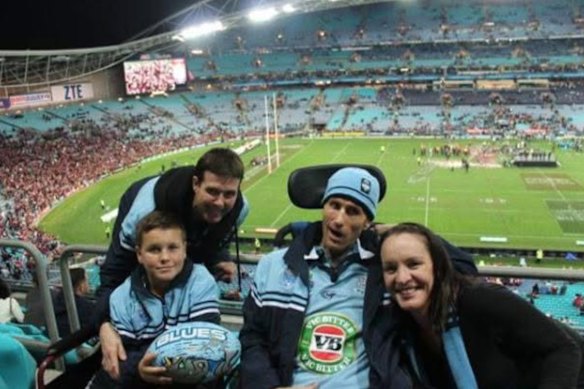
Harley with his stepfather, Steve, his father, Shane, and mother, Katherine, at the State of Origin in 2013.
When we found out, our son, Harley, was just over a year old. I remember looking at him and thinking how much he was like his dad – two peas in a pod in their mannerisms and looks. It was eerie, almost uncanny.
The only thing I really grasped in that moment was this: if Harley was ever to face this disease, then the way I represented it to him would shape the way he handled it. That thought cut deep to my core. Of course, I hoped we hadn’t won the genetic lottery with Huntington’s, that Harley might be spared; I never truly believed then that it would be his reality. But the brutal truth of the 50-50 risk was always there. Over time, the more I read, the more I educated myself, the more I lived it, the clearer it became that things for Huntington’s families had to change.
Together, Harley and I looked after Shane until he succumbed to the disease in 2010. Because of the family history – Shane’s dad had also died of Huntington’s – we had Harley tested. One of the worst conversations I’ve ever had to have was telling Shane that his son had tested positive.
So last week’s news from the UK that researchers had reported a groundbreaking new gene therapy that had slowed the progression of the fatal condition for the first time has changed our lives. Some patients had the progression of their disease slowed by 75 per cent after three years.
Loading
When Harley was diagnosed with Huntington’s disease at just 11, he told me something I’ve never forgotten. He said: “Mum, I just want people to know what Huntington’s is. I don’t want to have to explain it by comparing it to three other diseases just so people understand.”
That has been our reality. Huntington’s is rare, and most people haven’t heard of it. To make sense of it, I’ve often had to say, “It’s like Parkinson’s, dementia and motor neurone disease combined.” Even then, people look confused. For Harley, who has lived with it since childhood, that invisibility has been one of the hardest parts.
My son had already seen the stigma up close. He watched his father battle Huntington’s, and he was old enough to notice the snide remarks from strangers: “Is he drunk?” “Is he on drugs?” Those assumptions didn’t stop with his dad. Over the years, Harley has faced the same whispers himself: “Why’s he so skinny? What’s wrong with him?”
The stigma is real. The judgments are real. And that’s why Harley’s words as a boy became our mission to live by those morals, to speak openly, and to make sure people know what Huntington’s really is.
That’s why this week has felt surreal. When the news broke about a potential treatment for Huntington’s, it felt like we had skipped timelines. Suddenly, people were talking about Huntington’s not as a hopeless condition but as a disease where progress is possible.
For Harley, who has felt invisible for so long, it has been mind-boggling. But I need to be honest: hope is complicated for us. This isn’t the first time we’ve seen headlines promising breakthroughs. Families like mine pinned our hopes on previous clinical trials only to see them collapse. When that happened, the loss was devastating.
So when I say I’m hopeful now, I mean cautious hope. We celebrate, yes, but with careful hearts. I don’t know if this new treatment will work for Harley. He’s already symptomatic. The reports say it may be “available for all” but no one has confirmed whether that includes people like him, or only those who carry the gene but haven’t yet developed symptoms. Cost will be another huge factor, as it always is. But the fact that we’re even able to ask these questions who will get it, when and how feels extraordinary.
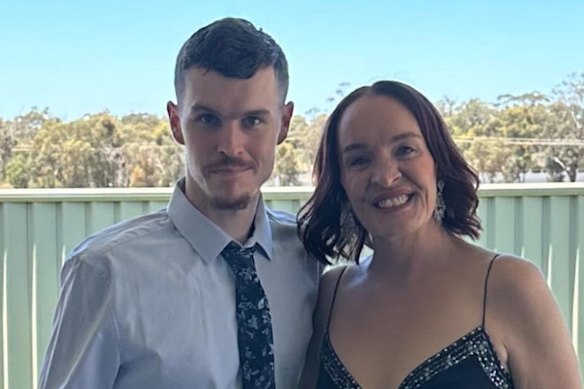
Katherine McDowell with her son, Harley, in November 2024.Credit: .
Perhaps the most powerful part of this moment isn’t just the treatment itself, but the conversation it has opened up. In the past week, Huntington’s has been spoken about more than I’ve ever seen in my life. I shared a simple TikTok about the news, and it has already been viewed more than 2.3 million times. People from Australia, the United States, the UK and beyond are commenting, sharing and telling their own stories.
It’s overwhelming, in the best way. For once, we don’t feel left out. For once, our voices are being heard. People are comparing science to the military and saying “this is where progress should be happening”. They’re cheering on researchers. They’re listening. That might sound small. But for a community that has always carried this disease in silence because of stigma, because of fear, it is everything.
What these scientists have achieved is nothing short of a miracle. They’ve cracked open a space we never thought would belong to us. For the first time, Huntington’s is not being whispered about as something cruel and hopeless. It’s being spoken of as something treatable, something where progress is possible. That shift has changed how Harley feels about himself. It has changed how our family feels about the future. And it has changed how our community feels about being seen.
Harley once told me he just wanted people to know what Huntington’s was. Today, not only do people know, they’re talking about it. That’s everything and then some.
Loading
I don’t know what comes next. I don’t know if treatment will arrive in time for Harley. I don’t know how governments will roll it out, what it will cost, or how widely it will be available. But I do know this: for the first time in a long time, our community feels hope that is bigger than fear. Families who have carried this quietly for generations are now speaking out, connecting, and finding strength together.
And for me, as a mother watching my son live with a disease that has taken so much already, that hope means more than life itself. Hope is real. The conversations have begun. And for families like mine, that feels like the start of something we never thought we’d see.
Katherine McDowell is a mother and disability advocate.
Most Viewed in Lifestyle
Loading